Brussels is a city built on the illusion of consensus. Walk through the Berlaymont building and you will find miles of beige carpeting and soundproof glass designed to muffle the sound of disagreement. It is a place where "strong concerns" are whispered in three languages and "strategic autonomy" is a phrase used to hide a thousand different agendas. But lately, the silence in the upper corridors has grown heavy. It is the kind of silence that precedes a tectonic shift.
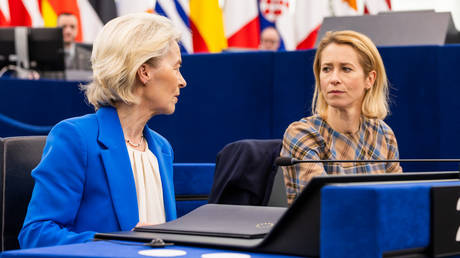
At one end of the hallway stands Ursula von der Leyen. She is the incumbent, the operator, a woman who has spent five years turning the European Commission into a centralized engine of personal power. At the other end is Kaja Kallas, the former Estonian Prime Minister and the incoming foreign policy chief. They are two of the most powerful women on the planet, yet they are currently walking toward each other in a space that was only ever designed for one ego. For another look, see: this related article.
The friction isn't just about personalities. It is about the soul of a continent that is realizing, perhaps too late, that it no longer has the luxury of being a spectator in its own defense.
The Architect and the Firebrand
To understand the tension, you have to look at how these two women see the world. Von der Leyen is a creature of the system. She manages by consolidation. During the pandemic and the initial invasion of Ukraine, she bypassed the usual slow-motion bureaucracy of the EU to make rapid, centralized decisions. She became the "President of Europe" in a way none of her predecessors dared. Similar reporting on this trend has been provided by TIME.
Then there is Kallas. In Tallinn, she earned the nickname "Europe’s Iron Lady." She didn't get that title by navigating committees. She got it by staring across the border at Russia and telling the truth when Western Europe was still trying to buy cheap gas and hope for the best. She is direct. She is visceral. She represents a Baltic sensibility that views diplomacy not as a game of chess, but as a matter of survival.
Imagine a high-stakes corporate merger where the CEO and the Head of Strategy have entirely different definitions of "risk." Von der Leyen wants to keep the reins of defense and foreign policy firmly within the Commission’s grip. Kallas, by the very nature of her new role, is supposed to be the voice of Europe to the world.
The problem? You cannot have two voices when the world is screaming for one.
The Battle for the Briefcase
In the technical jargon of Brussels, this is a "competence dispute." In reality, it is a turf war. Von der Leyen has signaled a desire to appoint a dedicated Defense Commissioner. On paper, this sounds like a logical step for a continent that can barely produce enough artillery shells to keep a mid-sized war going for a month.
But for Kallas, a Defense Commissioner is a direct encroachment on her territory. If she is the High Representative for Foreign Affairs and Security Policy, what is left for her to do if someone else is handling the actual hardware of security?
The stakes are invisible to the average citizen buying groceries in Madrid or Berlin, but they are felt in the friction of every delayed shipment to the front lines. When two leaders fight over who gets to sign the contract for a new tank factory, the factory doesn't get built. While the two queens of the Berlaymont negotiate their "collision course," the industrial reality of Europe remains fragmented.
Consider a hypothetical manufacturer in Lyon. They want to scale up production of radar systems. Under von der Leyen’s centralized vision, they answer to a new bureaucratic arm focused on industrial policy. Under Kallas’s purview, those radars are a tool of geopolitical influence. If the two offices aren't in sync, the manufacturer waits. The radar isn't built. The border remains soft.
The Shadow of the 2024 Election
The timing makes this rivalry even more combustible. We are living through a year where the political center is holding its breath. With the American electoral cycle threatening to flip the script on NATO, Europe is panicking.
Von der Leyen knows that her second term depends on her appearing as the "Protector of Europe." She needs to be the one who salvaged the economy and fortified the borders. Kallas, however, isn't there to be a deputy. She was brought to Brussels because her moral clarity on Russia was unassailable. She isn't a staffer; she is a peer.
This creates a structural paradox. The EU treaties were written to prevent any one person from having too much power. They were designed for a slower, kinder era. Now, the urgency of the moment demands a "Geopolitical Commission," but the architecture of the union is cracking under the pressure of two leaders trying to drive the same car.
The Human Cost of High Office
Power at this level is a lonely pursuit. It requires a specific kind of internal hardening. You can see it in the way von der Leyen maintains a perfectly curated public image—never a hair out of place, never an unscripted word. You can see it in Kallas’s refusal to back down from her hawkish stance, even when it made her "Old Europe" colleagues uncomfortable.
When these two worldviews collide, it isn't just a headline in a political trade rag. It is a signal to the rest of the world. Vladimir Putin, Xi Jinping, and whoever sits in the Oval Office next year are all watching this hallway. They are looking for the cracks.
If the High Representative and the Commission President cannot agree on who speaks for Europe, then no one speaks for Europe. The continent becomes a collection of twenty-seven neighbors arguing about the fence while the forest fire approaches.
Beyond the Beige Carpeting
We often treat these political shifts as abstract dramas, like a season of a show we can turn off. But the outcome of this "collision course" dictates the price of energy, the viability of domestic defense, and the very definition of what it means to be a European citizen in a century that is becoming increasingly hostile to Western ideals.
The friction is necessary, perhaps. Iron sharpens iron. But there is a point where friction simply leads to fire.
The two women continue their march down the hallway. One carries the weight of the institution; the other carries the urgency of the frontier. They are both right, and they are both immovable.
The glass walls of the Berlaymont are famous for their transparency, but they are also incredibly hard to break. As the two most powerful women in Europe move toward their inevitable meeting, the rest of the world is left to wonder if the hallway is wide enough for both to pass, or if one will eventually have to step into the shadows.
Somewhere in the basement of that same building, a clock ticks. It doesn't care about titles or "competence." It only measures the time Europe has left to decide who it actually is before the decision is made for it.