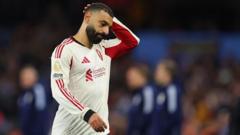
The air inside a football stadium during a farewell is heavy, thick with the scent of stale beer, damp coats, and a collective, suffocating nostalgia. You can feel it in your chest. For weeks, the Kop had been preparing its throat to sing a long, aching goodbye to Jürgen Klopp. It was supposed to be a pristine, cinematic ending. The heavy metal football era drawing to a close with flags waving, tears flowing, and the clean, righteous satisfaction of a modern empire built together.
Then came the touchline at West Ham. For an alternative perspective, read: this related article.
It lasted only a few seconds, but the friction between Jürgen Klopp and Mohamed Salah felt like watching a hairline fracture snap across a priceless marble statue. It was ugly. It was public. As Salah waited to sub on, words were exchanged—sharp, bitter, and defensive. Darwin Núñez had to step in as a peacemaker, playing the role of an awkward teenager separating his arguing parents. In that singular moment, the romantic myth of Liverpool’s modern golden age cracked.
Wayne Rooney saw that crack. He didn't just see it; he recognized the exact shade of its rot. When the Manchester United legend remarked that Mohamed Salah should be dropped for Klopp’s final Anfield farewell, the knee-jerk reaction from the red half of Merseyside was predictable outrage. But Rooney wasn't speaking as a bitter rival. He was speaking as someone who knows the terrifying, intoxicating gravity of being the biggest star in the room when the walls start closing in. Similar analysis on this trend has been shared by The Athletic.
Rooney’s verdict wasn't born out of malice. It was born out of an uncomfortable truth that football, in its desperate desire for fairy tales, tries to ignore. When a transcendent manager is taking his final bow, there is no room for a disgruntled king.
The Weight of the Crown
To understand why a genius like Salah finds himself on the cusp of being exiled from a historical send-off, you have to understand the psychological architecture of the elite goalscorer. They are not like us. They are not even like their teammates.
An elite forward operates on a diet of pure, unadulterated egotism. It is a mandatory requirement of the job description. Imagine standing in front of 60,000 screaming human beings, with millions more watching through screens, knowing that if you miss a kick by a fraction of an inch, you will become a national pariah. To survive that pressure, you must believe, with a chilling degree of certainty, that you are the center of the footballing universe.
For seven years, Salah was exactly that for Liverpool.
He wasn't just a winger; he was the Egyptian King. He smashed records like cheap glass. Three Premier League Golden Boots. A PFA Players' Player of the Year award. The fastest player in Liverpool history to score 100 league goals. He didn't just score goals; he manufactured miracles. When the ball found his feet on the right flank, the entire stadium shifted its weight forward, anticipating the inevitable cut-inside and the curling, unstoppable strike into the far corner.
But ego is a volatile fuel. When the team is winning and the trophies are piling up, that selfishness is rebranded as "elite mentality." We praise it. We write analytical essays about their hyper-focus.
When the gears begin to grind, however, that same obsessive drive curdles.
Salah’s form after returning from the Africa Cup of Nations and a nagging hamstring injury wasn't just poor by his cosmic standards; it was human. The touch grew heavy. The bursts of electric speed looked slightly labored. The shots that used to fly into the top corner found the palms of grateful goalkeepers. For a man who has spent nearly a decade validating his existence through the net bulging, this wasn't just a dip in form. It was an identity crisis.
When Klopp made the decision to bench him for a crucial match against West Ham, it wasn't an insult. It was a manager trying to manage a exhausted asset. But to a superstar accustomed to being the savior, a place on the bench feels like a public execution.
When the Script Belongs to the Manager
Every great football club is a delicate ecosystem of egos, balanced precariously on the whim of a single authority figure. Klopp’s genius at Liverpool was his ability to make multimillionaire superstars believe they were part of a socialist collective. He hugged them, he ran onto the pitch for them, and he absorbed the pressure so they could fly.
But the moment Klopp announced his departure, the gravity of Anfield shifted.
The remaining weeks of the season ceased to be about the future. They became a retrospective. The final home game against Wolves wasn't a sporting fixture; it was a secular liturgy. Fifty-four thousand people didn't buy tickets to watch a tactical breakdown of a mid-table clash. They bought tickets to say thank you to the man who gave them back their identity.
This is the core of Rooney’s argument.
If Salah starts that final game with the dark cloud of the West Ham spat still lingering over his head, the narrative becomes polluted. Every time Salah gestures in frustration at a teammate, every time he chooses to shoot instead of pass, the cameras will pan to Klopp's face on the bench. The media will read the tea leaves of their body language. The post-match press conference, which should be a tear-soaked celebration of a legendary managerial tenure, will instead be hijacked by questions about a fractured relationship.
Football matches are won by tactics, but clubs are sustained by mythologies. The mythology of Klopp’s Liverpool is one of unity—the famous "Mentality Monsters."
Allowing a visibly frustrated, out-of-form superstar to dominate the emotional airspace of Klopp’s final ninety minutes at Anfield threatens that myth. It turns a collective celebration into a uncomfortable domestic dispute played out on a global stage.
The Ghosts of Old Trafford
Rooney knows this because he lived it. He has been the player throwing his hands up. He has been the talisman demanding answers from a legendary manager who was moving in a direction he didn't agree with.
Think back to 2010. Rooney was the undisputed king of Old Trafford, a raging, brilliant bull of a forward who carried Manchester United on his back. Yet, he questioned Sir Alex Ferguson’s ambition. He handed in a transfer request. He broke the sacred code of the dressing room by suggesting his teammates weren't good enough to match his ambition.
Ferguson, a master psychologist, handled Rooney with a mix of public paternal warmth and private, ruthless calculation. Rooney stayed, but the power dynamic had been permanently altered. Ferguson always maintained a simple, terrifying maxim: the moment a player thinks they are bigger than the manager, they have to go.
When Rooney looked at Salah shouting at Klopp on the touchline, he didn't see an isolated incident. He saw history repeating itself. He saw a player who had forgotten, if only for a mad, passionate moment, that managers like Klopp don't get replaced. They get memorialized.
Consider what happens if a club allows the player to win that psychological war of attrition. The dressing room notices. The young players—the Harvey Elliotts, the Jarells Quansahs—watch how the king behaves when he doesn't get his way. If the king can publicly disrespect the architect of the modern club and still be handed the starting shirt for the most emotionally significant game of the decade, the culture begins to bleed out.
The Fine Line Between Greatness and Obstruction
There is a quiet tragedy in how sports chew up and spit out partnerships. For years, Klopp and Salah were a devastating symbiotic organism. Klopp created the chaotic, high-pressing system that allowed Salah to isolate defenders; Salah provided the lethal efficiency that turned Klopp’s heavy metal philosophy into tangible silverware. They needed each other. They made each other immortal.
But the end of an era is rarely clean. It is messy, full of pride and unsaid words.
Salah’s frustration doesn't make him a villain. It makes him a competitor who is terrified of his own footballing mortality. He looks at a changing Liverpool, a changing forward line with Cody Gakpo and Luis Díaz, and he feels the cold breath of transition on his neck. He wanted to drag Liverpool to one last Premier League title through sheer force of will, and when that dream evaporated in the spring rain, the frustration had to go somewhere. It went at the man who put him on the bench.
But the Anfield finale cannot be an exercise in managing a superstar's feelings.
The stadium needs to be a monoculture of gratitude. To achieve that, the pitch needs to be filled with players whose presence doesn't require an asterisk or an explanation. Starting Salah risks turning the afternoon into a referendum on his future, his attitude, and his relationship with a departing icon.
Imagine the alternative. The team sheet is announced. Salah’s name is absent from the starting eleven. There is a brief murmur through the crowd, but then the focus returns to where it belongs. The game kicks off. Liverpool play with the free-flowing, unburdened joy that characterized the best of the Klopp years.
Then, with twenty minutes to go, the game secure, number eleven walks to the touchline.
This time, there are no angry words. The stadium erupts, not just for the manager, but for the Egyptian King who helped him build the kingdom. He enters the pitch as a weapon of celebration, not a point of contention. He gets his moment, Klopp gets his stage, and the hierarchy of the football club remains intact.
The real problem lies in the temptation to prioritize the individual over the collective memory. Rooney’s advice wasn't a punishment for Salah; it was a protection order for Klopp’s legacy. In the grand theater of Anfield, the final act must belong to the director who changed the play, not the lead actor who forgot his lines in the final scene.