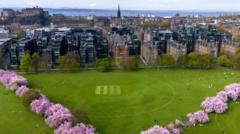
Walk down Great King Street on a Tuesday evening in November. The wind whips off the Firth of Forth, biting at your ears, but the Georgian sandstone glows with a warmth that has defined Edinburgh for two centuries. You look up at the windows. Many are dark. Not the "we’re out for dinner" kind of dark, but the hollow, unlived-in blackness of a space that hasn’t seen a human breath in months.
Edinburgh is not just a city; it is a monument to permanence. Yet, beneath the volcanic crags and the gothic spires, the very soil is shifting. The cobblestones aren't moving, but the names on the deeds are. A silent, steady migration of ownership is moving away from the people who walk these streets and toward bank accounts in places like Jersey, the British Virgin Islands, and Panama. For a closer look into this area, we suggest: this related article.
The capital of Scotland is being sold in increments.
To understand why this matters, you have to look past the spreadsheets. Consider a hypothetical resident named Elspeth. She has lived in a basement flat in the New Town for forty years. She knows which floorboards groan and exactly when the light hits the Scott Monument in the morning. Ten years ago, she knew every neighbor in her stairwell. Today, three of the five flats above her are owned by limited companies based in the Caribbean. She has never met the owners. She never will. The "community" is now a collection of digital transactions. For broader information on this development, extensive coverage can be read on Associated Press.
The Paper Trails of Paradise
The data is startling, though it arrives with a whisper rather than a bang. Recent analysis of the Land Register of Scotland reveals a sharp spike in overseas entities snapping up property in the EH1, EH2, and EH3 postcodes. While the local teacher or nurse struggles to find a starter home, international investment firms and high-net-worth individuals are viewing these historic streets as "gold with a roof on it."
This isn't just about a few luxury penthouses. We are talking about hundreds of millions of pounds flowing into a small, concentrated geography. The logic is simple for the buyer. In an unstable global economy, Edinburgh is a fortress. It has prestige, a world-class festival, and a finite supply of historic architecture. You can't build more Georgian New Town. That scarcity makes it a perfect hedge against inflation.
But a hedge doesn't go to the local butcher. A hedge doesn't volunteer for the school board.
When a property is bought through an offshore shell company, it enters a state of legal cryostasis. These structures are often used to shield the identity of the true owner and, crucially, to minimize tax liabilities. While the Scottish Government has introduced the Register of Persons Holding a Controlled Interest in Land to increase transparency, the reality remains opaque. Layer upon layer of corporate shells makes it nearly impossible for the average citizen to know who actually owns the building next door.
The Invisible Stakes of a Ghost Economy
The problem isn't just that the owners are absent. The problem is the distortion of the local ecosystem. When global capital competes with local wages, the outcome is a foregone conclusion.
Imagine a young couple. Both are professionals. They’ve saved for five years. They enter a bidding war for a two-bedroom flat on Dundas Street. They are offering the absolute limit of their mortgage capacity. Then, a cash offer comes in from an entity registered in the Isle of Man. No mortgage needed. No survey delays. 15% over the asking price.
The couple moves to the outskirts. The flat becomes a "holding."
This creates a phenomenon known as "lights-out Edinburgh." If you walk through certain parts of the city center after 8:00 PM, the silence is eerie. These neighborhoods were designed for density and social friction. Now, they are becoming high-end storage units for international wealth. When people don't live in the homes they own, the local economy suffers a "leakage" effect. The neighborhood coffee shop loses its regulars. The local pub sees fewer patrons on a Wednesday night. The vibrant, messy pulse of urban life is replaced by the sterile hum of a managed portfolio.
Why Edinburgh and Why Now?
It is tempting to blame the buyers, but the systemic pull factors are just as significant. For decades, the UK has been marketed as a safe haven for foreign capital. Compared to many European neighbors, the barriers to entry for overseas investors have been historically low.
Scotland’s property laws are distinct, yet they have not been immune to the global trend of "financialization." This is the process where housing stops being a human right or a place to live and becomes a financial asset, no different from a stock or a bond. In this world, the aesthetic beauty of a Grecian-style facade in the New Town is just "added value" to the underlying asset.
The irony is thick. The very charm that attracts the investment—the culture, the history, the lived-in grit of a capital city—is eroded by the investment itself. If you buy enough of a city and leave it empty, you eventually destroy the reason you wanted to buy it in the first place.
The Human Cost of Transparency
There is a psychological weight to living in a city that feels like it belongs to someone else. It changes the way you interact with your surroundings. When the "owner" is a name on a piece of paper in a filing cabinet in Tortola, the sense of stewardship vanishes.
Maintenance becomes a chore handled by distant agencies. The small repairs—the peeling paint on a front door, the overgrown weeds in a shared basement area—are ignored because no one with the power to fix them actually sees them. The city begins to feel like a stage set. It looks right from a distance, but up close, the paint is thin.
Recent legislative pushes have tried to pull back the curtain. The requirement for overseas entities to register their "beneficial owners" is a start. But the financial world moves faster than the bureaucratic one. By the time one loophole is closed, three more have been engineered.
Wealthy investors argue that they bring capital into the city, fueling the construction and renovation industries. There is some truth there. The high-end renovations of these properties provide jobs for skilled tradespeople. But those tradespeople are then priced out of living within a five-mile radius of the work they perform.
The city is hollowed out from the center.
The View from the Mound
Stand on the Mound and look across at the skyline. It is one of the most beautiful views in the world. You see the layers of history, from the medieval huddle of the Old Town to the rational, Enlightenment grids of the New Town.
That view belongs to everyone. But the spaces behind those windows are increasingly becoming private vaults.
We are at a crossroads of identity. Is Edinburgh a living, breathing community that welcomes the world, or is it a curated museum where the "residents" are merely temporary custodians for global equity? Every time a deed is signed over to a mailbox in a tax haven, the answer tilts further toward the latter.
There is a specific kind of mourning that happens when a neighbor moves out and the lights never come back on. It is a quiet grief for the loss of a city’s soul. The gold keys are turning in the locks, but they aren't letting anyone in. They are just making sure the door stays shut, the asset stays safe, and the silence stays unbroken.
The wind continues to howl through the Wynds, but it no longer carries the sound of footsteps.