A man sits in a quiet office in Westminster, staring at a screen that won't stop blinking. It is late. The tea in his mug has developed a thin, oily film on the surface. He is a mid-level staffer for the Labour Party, someone whose job usually involves drafting press releases about local bus routes or social care budgets. Today, however, he is reading a dossier that suggests the very digital architecture he uses to communicate with his colleagues has been compromised by a shadow.
Across the Atlantic, a different kind of light is flickering. It is the glow of a television screen in a Mar-a-Lago dining room, where a former president—and a potential future one—is outlining a worldview that feels less like a policy platform and more like a declaration of total economic defiance.
These two scenes seem miles apart. They are disconnected by geography and intent. Yet, they are the two jaws of a single vise tightening around the concept of global stability. We are no longer living in an era of "diplomatic friction." We are witnessing the moment the floor falls out from under the global order, replaced by a frantic, high-stakes scramble for survival in a world that has stopped trusting its own shadow.
The Spy in the Server
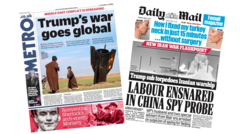
When we talk about a "China spy probe" hitting the heart of the British government, the mind tends to wander toward cinematic clichés. We think of dead drops in Hyde Park or poisoned umbrellas. The reality is far more clinical, and because of that, far more terrifying. It is a war of bits and bytes, where the casualty is not a person, but the sanctity of information.
The Labour Party, currently navigating the treacherous waters of governance, has found itself ensnared in an investigation that probes just how deep foreign influence can burrow into the democratic process. It isn’t always about stealing blueprints for a new fighter jet. Sometimes, it is about understanding the psychological profile of a junior minister. It is about knowing what a specific committee will say before they say it.
Information is the only currency that never devalues. When a foreign power gains access to the private communications of a ruling party, they aren't just eavesdropping. They are colonizing the decision-making process. They are sitting at the table, invisible, nudging the conversation toward outcomes that favor Beijing while London thinks it is acting of its own volition.
The staffer in that Westminster office feels a cold sweat. He wonders if the email he sent last Tuesday about a sensitive trade meeting was read by someone in an office building six thousand miles away. He realizes that his privacy wasn't just his own; it was a brick in the wall of national security. And that wall is looking increasingly porous.
The Architect of Friction
While London grapples with the invisible infiltration of its systems, Donald Trump is preparing to swing a sledgehammer at the visible structures of global trade. His "war," as the headlines call it, has gone global. This isn't a war fought with infantry, but with percentages. Ten percent. Sixty percent. One hundred percent.
Tariffs are often discussed as dry economic levers, the kind of things that make eyes glaze over during a Sunday morning news segment. But consider the reality of a tariff. A tariff is a wall built out of money. It is a deliberate choice to make the world smaller, more expensive, and more isolated.
For the American consumer, this feels like a distant argument about macroeconomics until they try to buy a washing machine or a laptop. For the global market, it is a tectonic shift. Trump’s strategy is built on the belief that the post-WWII era of "free trade" was not a mutual benefit, but a sophisticated heist where the United States was the victim. He isn't looking to fix the system. He is looking to resign from it.
This "global war" is an attempt to force the world to pivot back toward a singular axis. It is a high-risk gamble that assumes the rest of the world has no choice but to follow. But the world of 2024 is not the world of 1945. There are other players now. There are other systems. When the United States signals that it is no longer interested in being the guarantor of global commerce, the vacuum doesn't stay empty for long.
The Collision of Two Fears
What connects the Labour spy probe and the Trumpian trade war is a fundamental, bone-deep fear of the "Other."
In the UK, the fear is of a subtle, creeping loss of sovereignty through technological subversion. In the US, the fear is of a blatant, overt loss of dominance through economic competition. Both are responses to the same realization: the era of "One World" is over. We are fracturing into ideological and economic blocs that don't speak the same language, even when they are using the same translation software.
Imagine a manufacturer in the English Midlands. They rely on components from a factory in Shenzhen. They use software developed in California. They sell their finished product to a distributor in Berlin.
Under the new reality, that manufacturer is a man standing on a shrinking ice floe. The California software might be banned or restricted because of security concerns linked to the spy probe. The Shenzhen components might become 60% more expensive overnight because of a trade decree from Washington. The Berlin distributor might find their own regulations tightening in response to the chaos.
This isn't just "business." This is the dismantling of the connective tissue that has kept the world from major conflict for eighty years. We are trading efficiency for security, and in the process, we are finding that we might end up with neither.
The Human Cost of High Stakes
We often forget that "global politics" is just a collection of human decisions made by people who are often tired, biased, and afraid.
The spy probe in London isn't just about "Labour" or "China." It’s about the erosion of trust between colleagues. If you can’t trust the person in the next cubicle, or the device in your pocket, how do you govern? Politics becomes a game of shadows where everyone is a suspect and no one is an ally. It leads to a paralysis of policy, a government that spends more time looking inward at its own vulnerabilities than outward at the needs of its people.
Similarly, the "Trump war" isn't just a campaign slogan. It is a looming anxiety for the farmer in Iowa who needs to export soy, and the factory worker in Ohio who is told that prices will rise but their "patriotism" should foot the bill. It is a story of people being told that their prosperity depends on someone else's poverty.
The stakes are invisible until they aren't. They are invisible when you’re scrolling through a news app. They become visible when the mortgage rates spike, when the job market dries up because a multi-national corporation decides the "geopolitical risk" of your country is too high, or when a government's response to a crisis is delayed because their internal systems are being scrubbed for foreign malware.
The New Architecture of Power
We are moving toward a world of "fortress economies" and "digital iron curtains."
The Labour investigation is a symptom of a West that has finally woken up to the fact that the internet is not a neutral playground. It is a battlefield. The "war" described in the American headlines is the realization that the global supply chain is a leash that can be pulled by either end.
There is a certain irony in the timing. Just as the UK tries to secure its borders from digital infiltration, its most important ally is threatening to build economic borders that could be just as damaging. It is a pincer movement. On one side, an adversary that wants your data. On the other, an ally that wants your compliance—at a very high price.
Consider the complexity of the modern smartphone. It is a marvel of global cooperation. The design might come from the US, the chips from Taiwan, the assembly from China, the software updates from a team in India, and the raw minerals from the Congo. It is a miracle of the old world.
In the new world, that phone is a liability. The chips are a bottleneck. The assembly is a security risk. The minerals are a geopolitical hostage.
The End of the Long Peace
History books often talk about the Pax Americana, the period of relative stability following World War II. We are currently watching the final pages of that chapter being turned. What comes next isn't a new book, but a series of fragmented pamphlets, each shouting a different truth.
The Labour staffer finally closes his laptop. He decides to leave his phone in a locker before he goes into the next meeting. He doesn't know if it helps, but the gesture makes him feel a little more in control. He walks out into the cool London air, passing a shop window where the prices have already been adjusted for "inflationary pressures."
He doesn't realize that he is a character in a much larger story, one where the lines on the map are being redrawn not by soldiers, but by people who control the flow of data and the cost of bread.
The global war isn't coming. It's already here. It’s in your pocket. It’s in your bank account. It’s in the way your government looks at its own shadow. The only question left is whether we can find a way to talk to each other through the static, or if we are doomed to wait for the silence that follows the crash.
The screen in the Westminster office goes black, but the reflection in the glass is of a man who no longer recognizes the world he is trying to save.
Would you like me to analyze how these shifting trade policies might specifically affect the tech industry's supply chain over the next eighteen months?