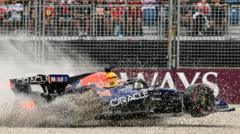
The current era of Formula 1 has hit a developmental wall that is beginning to crack the composure of the world’s elite drivers. While George Russell managed to find a rare "perfect storm" of setup and track conditions to snatch a recent result, the broader narrative in the paddock is one of profound frustration. Lando Norris and Lewis Hamilton have become the vocal leaders of a growing movement of drivers who despise the current generation of ground-effect cars. This isn't just the usual athlete complaining about a bad day at the office. It is a technical rebellion against a set of regulations that has turned the most sophisticated racing machines on earth into stiff, unpredictable, and physically punishing platforms that reward survival over pure driving instinct.
The core of the problem lies in the aerodynamic philosophy introduced in 2022. By shifting the bulk of downforce generation to the underbody, the FIA intended to allow for closer racing. They succeeded in that narrow goal, but the cost was the "feel" that defines a world-class driver. These cars operate within an incredibly narrow performance window. If the ride height is a fraction of a millimeter too high, the downforce evaporates. If it is too low, the car begins to "porpoise" or "bounce," effectively turning the floor into a pogo stick. Expanding on this idea, you can also read: The Statistical Implosion of Professional Football Excellence.
The Death of the Intuitive Front End
For a driver like Lando Norris, the frustration stems from a lack of communication between the front tires and the steering wheel. In previous generations, a driver could lean on the car, feeling the limit of adhesion through the scrub of the tires. The 2024 and 2025 iterations of these cars are different. They are "lazy" in slow corners and "knife-edge" in fast ones.
Norris has been candid about the McLaren’s shortcomings, noting that even when the car is fast on the stopwatch, it feels "horrible" to drive. This disconnect happens because the mechanical grip of the suspension has been sacrificed to keep the floor stable. To make the aerodynamics work, the cars must be run with suspension settings so stiff they resemble a go-kart more than a multi-million dollar prototype. When you hit a bump at 200 mph in a car with no suspension travel, the car doesn't absorb the impact; it launches. Experts at FOX Sports have shared their thoughts on this trend.
This technical rigidity has neutralized the advantage of drivers who rely on high-speed precision. When the car is constantly fighting its own floor, the driver becomes a passenger to the physics of airflow rather than a master of the racing line. George Russell’s occasional surges into the top three often coincide with tracks that have remarkably smooth surfaces, where the Mercedes can be lowered to its optimal "operating basement" without the car vibrating itself to pieces.
The Mercedes Paradox and the Russell Factor
George Russell’s "perfect storm" is a phrase that should haunt the engineers at Brackley. It implies that success is now a matter of external variables aligning rather than a consistent engineering triumph. For two seasons, Mercedes has chased a "diva" of a car that refuses to behave. Russell has shown a peculiar ability to "wrestle" a bad car into a decent starting position, a skill likely honed during his years at the back of the grid with Williams.
However, wrestling a car is not the same as refining one. The current technical regulations penalize refinement. Because of the cost cap and restricted wind tunnel time, teams cannot simply build their way out of a bad design. They are stuck with the fundamental "bones" of the chassis for the entire season. Russell’s ability to find a result when the stars align doesn't mask the fact that the Mercedes W15, and its predecessors, have failed to provide a stable platform for either him or Lewis Hamilton.
Hamilton’s struggle is perhaps even more telling. The seven-time champion thrives on a car that he can "rotate" on entry. The current ground-effect cars hate being rotated; they want to be driven in straight lines and sharp, geometric angles. The "worst cars" comment from the paddock isn't just about speed—it's about the loss of the "art" of driving.
The Physical Toll of the Venturi Effect
We must look at the physical reality of these machines. The Venturi tunnels under the car create a massive vacuum, sucking the chassis toward the asphalt. To prevent the floor from hitting the ground and stalling that vacuum, the springs are tightened to a point that would have been unthinkable a decade ago.
Drivers are reporting long-term back pain and micro-concussions from the high-frequency vibrations. When Norris or Hamilton talk about the cars being the "worst," they are also talking about the physical misery of driving them for two hours. The cars are heavy, weighing nearly 800kg without fuel. They are essentially heavy trucks with massive wings. The agility that once defined Formula 1—the ability to flick a car through a chicane like a scalpel—has been replaced by a heavy, thudding momentum.
Why the 2026 Reset Might Not Save Them
The industry is already looking toward the 2026 regulation change, which promises lighter cars and active aerodynamics. But there is a cynical view within the engineering offices that the "stiffness" issue won't go away. As long as the sport relies on underbody downforce, the cars will have to be low and stiff.
The "perfect storm" Russell found was a confluence of cool track temperatures (which helped tire life) and a lack of high-speed bumps. These are outliers. The reality for the rest of the calendar is a grueling slog where the driver who manages their frustration best, rather than the one who drives the fastest, often comes out on top.
We are seeing a shift in the hierarchy of skills. The "specialist" who can extract 101% from a balanced car is being replaced by the "adapter" who can survive a 90% effort in a chaotic car. Max Verstappen’s dominance is partly due to his ability to tolerate a car that is "pointy" to the point of being nervous, but even he has expressed boredom with the current technical limitations.
The "worst cars" era is a result of prioritizing "the show" (overtaking maneuvers) over the "sport" (the pursuit of the ultimate driving machine). Formula 1 has always been a balance between man and machine, but the scales have tipped. The machine is now so temperamental that the man is becoming an afterthought.
Engineers are currently trapped by the mathematics of the floor. Until the regulations allow for more downforce to be generated by the upper bodywork—allowing the suspension to be softened—the drivers will continue to complain. They aren't being "divas." They are athletes being asked to perform surgery with a sledgehammer.
The next time a driver climbs out of the cockpit looking like they’ve just finished a round in a boxing ring rather than a Grand Prix, remember that the "perfect storm" is the only thing keeping this generation of cars from being a total developmental failure. The stopwatch might say they are fast, but the men behind the wheel know the truth. They are driving the most advanced, most expensive, and most frustrating mistakes in the history of the sport.
The focus must move away from simply "closing the gap" to Red Bull and toward restoring the mechanical soul of the cars. If the drivers cannot feel the car, they cannot push the limit. And if they cannot push the limit, we aren't watching the best drivers in the world; we are watching the best managers of a flawed philosophy.
The telemetry doesn't lie, but it also doesn't feel. It doesn't feel the vibration that blurs the vision at the end of a long straight, and it doesn't feel the sudden loss of rear grip when a gust of wind stalls the underbody airflow. Norris and Hamilton are right to be unhappy. The sport is currently a contest of who can tolerate the most flaws.
The solution isn't more wings or more hybrid power. It is a fundamental return to a car that can handle a bump without becoming a projectile.