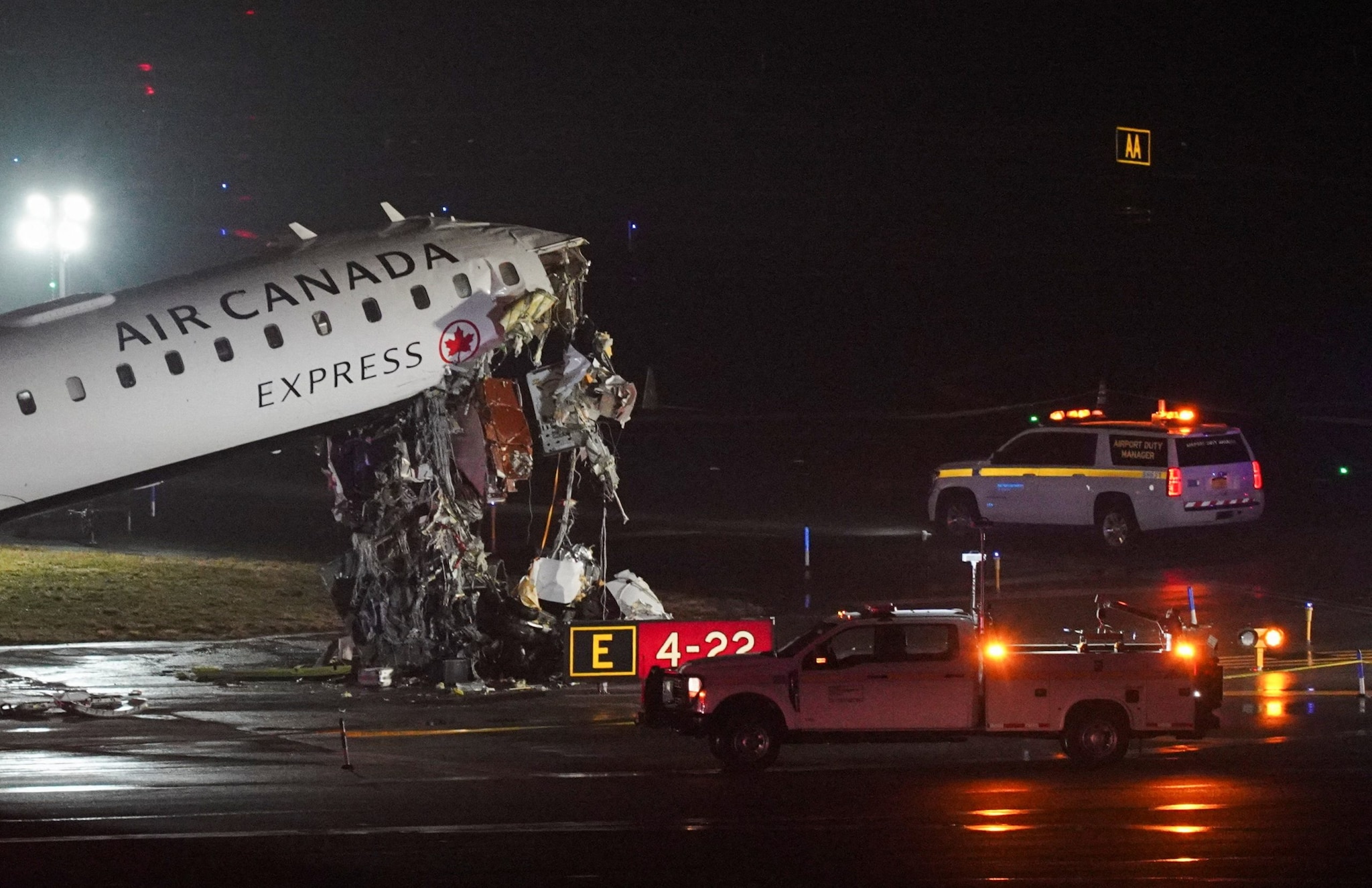
The collision involving an Air Canada Express flight at New York’s LaGuardia Airport has sparked a wave of frantic digital speculation regarding the fate of the flight crew. To be clear: both the pilot and the co-pilot survived the incident. In fact, there were no fatalities among the passengers or crew during the ground-level impact. The event, which involved a Bombardier CRJ-900 operated by Jazz Aviation for Air Canada Express and a stationary Republic Airways Embraer E175, was a high-stakes metal-on-metal encounter that occurred during taxiing, not a high-speed crash during takeoff or landing. While the visual damage to the aircraft was significant, the safety systems and cockpit structures performed exactly as engineered, preserving the lives of everyone on board.
The Anatomy of a Tarmac Crisis
Modern aviation safety is often viewed through the lens of catastrophic mid-air failures, yet the most consistent threats to operational integrity often happen at walking speeds. LaGuardia Airport is notorious among pilots for its cramped geography and "postage stamp" layout. When the Air Canada Express jet clipped the tail of the Republic Airways aircraft, it wasn't a matter of engine failure or a loss of altitude. It was a failure of spatial management in one of the most congested pieces of airspace and ground-space in the Western Hemisphere.
The winglet of the CRJ-900 sliced through the vertical stabilizer of the parked Embraer. For those inside the cabin, the sensation was described as a violent jolt followed by the screech of shearing aluminum. For the pilots in the cockpit, it was a moment of immediate professional reckoning. The survival of the crew was never in doubt from a structural standpoint because the impact occurred well behind the flight deck, but the career-ending potential of such a blunder is what truly haunts the industry.
Why LaGuardia Remains a Pilot Nightmare
Aviation analysts have long pointed to LaGuardia as a relic of a previous era. It was designed for smaller planes and lower frequencies. Today, it handles massive volumes of regional and mainline jets that are stretched to the absolute limit of the taxiway clearances.
When you sit in the cockpit of a CRJ-900, your visibility is excellent forward, but your wingspan is a distant afterthought. Pilots rely heavily on ground controllers and precise taxiway markings. On the day of the Air Canada Express collision, a combination of factors—possibly including communication lag, "tunnel vision" during a complex taxi sequence, or a simple misjudgment of the turning radius—led to the overlap.
The investigation by the National Transportation Safety Board (NTSB) focuses on "wingtip clearance." It is a deceptively simple concept. In a car, if you scrape a bumper, you trade insurance information and move on. In a multi-million dollar jet, a wingtip strike can cause structural ripples throughout the entire airframe. The energy of the impact is absorbed by the wing spars, meaning that even if the pilots survived unscathed, the aircraft itself may never fly again.
The Human Factor and the Cockpit Dynamics
We often demand perfection from the men and women at the controls. However, the "Sterile Cockpit Rule" is designed to prevent exactly these types of distractions. During taxiing, pilots are forbidden from engaging in non-essential conversation. They are supposed to be eyes-out, scanning for obstacles.
The survival of the crew allows investigators to do something they cannot do in fatal crashes: interview the participants. The captain and first officer were subjected to immediate drug and alcohol testing, a standard protocol that often leads to rumors of "trouble" even when the tests come back clean. In this instance, the focus isn't on whether they were capable of flying, but whether the workload of navigating LaGuardia’s "Coney Island" of taxiways simply overwhelmed their situational awareness.
The Financial and Operational Fallout
Air Canada Express operates as a brand, but the metal and the pilots belong to Jazz Aviation. This creates a complex web of liability. When a wing is sheared or a tail is struck, the costs go far beyond a simple repair bill.
- Aircraft Depreciation: A plane with a "major incident" on its record loses significant resale value.
- Schedule Disruption: Hundreds of passengers had to be rebooked, causing a cascading delay across the Air Canada network.
- Insurance Premiums: Liability for ground collisions at major hubs like LGA is astronomical.
The Republic Airways E175 that was struck was also sidelined. For a regional carrier, losing a hull for several months of repairs can be the difference between a profitable quarter and a massive loss.
The Reality of Regional Aviation Safety
There is a lingering perception that regional carriers like Air Canada Express or Republic are "lesser" than their mainline counterparts. This is a myth. The pilots undergo the same rigorous simulator training and must meet the same FAA or Transport Canada hour requirements. Yet, they are the ones tasked with flying the most legs into the most difficult airports.
A pilot flying a wide-body from London to New York might only perform one takeoff and one landing in an eight-hour shift. A regional pilot might do six legs in the same timeframe, navigating the chaotic ground traffic of LGA, DCA, and BOS repeatedly. Fatigue is the silent passenger in these cockpits. While the NTSB has not officially blamed fatigue for this specific Air Canada incident, it is the elephant in the room for every investigation involving regional taxiway incursions.
Misinformation and the Digital Echo Chamber
Immediately after the collision, social media was flooded with images of the mangled tail section of the Republic jet. Because the damage looked "violent," the leap to assuming fatalities was instantaneous. This is the danger of the modern news cycle. A "collision" is interpreted by the public as a "crash."
In aviation terminology, a crash involves the loss of control of the aircraft. A collision is a localized impact. The pilots were never in physical danger of losing their lives because the velocities involved were low. The "threat" was to the integrity of the aircraft and the safety of the ground crews who often work in the shadows of these moving giants. If a ground handler had been standing near the tail of that Republic jet, this would be a much different story.
Hard Lessons from the Tarmac
The aviation industry operates on a "no-fault" reporting culture to some extent, but ground collisions are rarely viewed with leniency. The pilots survived the impact, but their reputations are now under the microscope. This incident will likely lead to renewed calls for Ground Collision Avoidance Systems (G-CAS), technology that is standard in many high-end cars but is surprisingly absent from many commercial jetliners.
Until sensors can accurately tell a pilot exactly where their wingtip is in relation to a terminal or another plane, we are relying on human depth perception and mirrors. At an airport like LaGuardia, where the margin for error is measured in inches, that is a precarious way to run an airline.
The next time you are taxiing to the gate and feel the plane lurch or hear a sudden stop, remember that the most dangerous part of your journey might not be at 30,000 feet, but right there on the concrete, where the world’s most sophisticated machines are forced to navigate like trucks in a crowded alleyway.
Keep a close watch on the NTSB's final report on the Air Canada Express incursion, as it will likely dictate new taxiway procedures for every regional pilot flying into the New York basin.