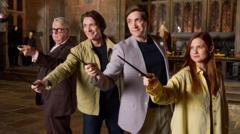
Nostalgia is a drug, and Warner Bros. is the dealer.
The 25th anniversary of Harry Potter and the Sorcerer’s Stone shouldn't be a celebration. It should be an autopsy. While the mainstream press treats the reunion of Daniel Radcliffe, Emma Watson, and Rupert Grint as a "magical homecoming," the reality is much bleaker. We are witnessing the desperate mummification of a franchise that has run out of ideas.
Stop pretending this is about the fans. This is about asset management.
The Myth of the Timeless Classic
The "lazy consensus" suggests that Harry Potter is an untouchable pillar of cinema that demands constant commemoration. That’s a lie. In reality, the Wizarding World is currently a brand in crisis, suffocating under the weight of its own lore and the diminishing returns of its spin-offs.
The Fantastic Beasts series didn't just stumble; it face-planted into a puddle of narrative incoherence. When your prequel series loses its grip on the audience so thoroughly that you have to pivot back to 19-year-old footage of kids in robes to keep shareholders happy, you aren't celebrating a legacy. You’re performing CPR on a ghost.
I’ve spent years watching studios burn through "legacy IP" like cheap fuel. The pattern is always the same:
- Original brilliance.
- Market saturation.
- Creative exhaustion.
- The "Reunion Special" (The Final Stage of Grief).
Nostalgia as a Financial Defensive Maneuver
Why now? Why a 25th-anniversary push for a film that has already been analyzed to death?
Because the streaming wars demand "stickiness." Max (formerly HBO Max) needs you to keep that subscription active. They know that a new, daring, original fantasy series is a risk. It might fail. But a grainy shot of the Great Hall? That’s a guaranteed hit of dopamine for a generation that refuses to grow up.
This isn't "Mischief Managed." It's "Revenue Managed."
The industry refers to this as "IP Harvesting." You aren't planting new seeds; you’re just stripping the soil of every last nutrient until the land is barren. By focusing on the past, the studio avoids the hard work of building the next cultural phenomenon. They’d rather sell you the memory of your childhood than give you a reason to be excited about the future of film.
The Radcliffe Paradox
Look at the actors themselves. Daniel Radcliffe has spent the last decade trying to outrun the shadow of the lightning bolt. He’s played a farting corpse, a guy with guns bolted to his hands, and a "Weird Al" Yankovic impersonator. He is a talented, versatile actor who clearly wants to move on.
Yet, every few years, the gravitational pull of the brand drags him back.
The reunion isn't for the actors’ benefit. It’s a velvet cage. It reinforces the idea that these performers—and by extension, the audience—can never truly leave Hogwarts. It’s a refusal to let the art breathe. True art should have a beginning, a middle, and an end. Hollywood has deleted the "end" because endings don't have quarterly earnings reports.
The Cost of the "Safe Bet"
People often ask: "What's the harm? If fans like it, why complain?"
The harm is the opportunity cost.
Imagine a scenario where the $50 million+ spent on producing, marketing, and licensing these retrospective specials was instead funneled into five $10 million indie fantasy films. We might find the next Pan’s Labyrinth or Children of Men. Instead, we get a 90-minute documentary of actors sitting in expensive chairs saying, "It was like a family."
It’s hollow. It’s scripted emotion designed to trigger a hashtag.
The Problem with "Comfort Viewing"
The "People Also Ask" sections of the internet are filled with queries about "Will there be a Harry Potter 9?" or "Is there a Cursed Child movie coming?"
The honest answer? I hope not.
But the studio answer is a resounding "Yes, if we can find a way to make it look like a safe investment." This obsession with the "Safe Bet" is why mid-budget cinema is dead. It’s why every movie theater looks like a museum of the 1990s and early 2000s. We are trapped in a loop of cultural recycling.
Breaking the Spell
If you actually care about the actors, the stories, and the medium of film, you should stop demanding reunions.
The 25th anniversary of Harry Potter should have been a quiet moment of reflection, a "thanks for the memories" before moving into the unknown. Instead, it was turned into a high-gloss product launch for a brand that is increasingly out of touch with the modern world.
The Wizarding World isn't a world anymore; it's a theme park with no exits.
The "contrarian" take isn't that the movies are bad. They were great for their time. The take is that their time is over. By clinging to them, we are preventing the next great storyteller from even getting in the room. We are trading innovation for comfort, and in the process, we’re making our culture incredibly boring.
The most magical thing a franchise can do is stay dead.
Stop visiting the grave. Stop buying the anniversary editions. Stop feeding the machine that treats your childhood memories like a line item on a balance sheet.
Let the boy who lived finally retire.