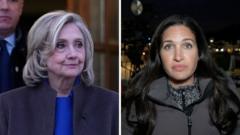
Hillary Clinton spent six hours behind closed doors this week answering questions she insists have no basis in reality. The former Secretary of State sat for a high-stakes deposition in Chappaqua, New York, on February 26, 2026, marking a significant escalation in the House Oversight Committee’s investigation into the late Jeffrey Epstein’s sprawling network of influence. While the session was private, the political fallout is very much public. Clinton told investigators she had no knowledge of Epstein’s crimes and, more pointedly, that she does not recall ever meeting the man.
This testimony comes after months of legal maneuvering and a looming threat of a contempt of Congress vote. The committee, led by Representative James Comer, pushed for the in-person session despite Clinton’s offer of a written statement. For many, the deposition represents a long-awaited reckoning; for Clinton, it is a "political theater" designed to distract from contemporary scandals involving Donald Trump.
The Chappaqua Showdown
The setting was the Chappaqua Performing Arts Center, a quiet venue near the Clinton family home. Inside, the atmosphere was reportedly tense. Republican lawmakers aimed to bridge the gap between documented facts and the former First Lady’s firm denials. While Bill Clinton’s ties to Epstein are well-documented—including multiple flights on the "Lolita Express" for foundation work—Hillary Clinton has maintained a much larger distance.
During the six-hour marathon, Clinton was grilled on her interactions with Ghislaine Maxwell. Unlike her stance on Epstein, she did not deny knowing Maxwell, describing her instead as a "casual acquaintance." She addressed the awkward fact of Maxwell’s attendance at Chelsea Clinton’s 2010 wedding, explaining that the socialite was a guest of another invited individual. This distinction is critical. By acknowledging a peripheral connection to Maxwell while denying any contact with Epstein, Clinton is drawing a legal and social perimeter intended to insulate her from the more toxic elements of the scandal.
Beyond the Denial
The investigation is not just about social calendars. The House Oversight Committee is probing how Epstein utilized his connections to political elites to shield himself from prosecution for decades. Investigators are particularly interested in the 2008 non-prosecution agreement in Florida, which allowed Epstein to avoid federal charges for sex trafficking.
Clinton’s defense centered on her global work against human trafficking during her tenure as Secretary of State. She argued that her record speaks for itself, yet Republicans pointed to the $25,000 donation the Clinton Foundation received from an Epstein-affiliated entity in 2006. While a drop in the bucket for a multi-billion-dollar foundation, the committee views it as part of a pattern of "reputation laundering" that Epstein practiced with various high-profile institutions.
The Trump Counter-Argument
In a move typical of her combative political style, Clinton used her opening statement to go on the offensive. She accused the committee of a "fishing expedition" and challenged them to look at the current president.
"If this Committee is serious about learning the truth about Epstein’s trafficking crimes, it would not rely on press gaggles to get answers from our current president on his involvement; it would ask him directly under oath," Clinton stated.
This refers to the fact that Donald Trump’s name appears extensively in the newly released Epstein files, totaling thousands of mentions. By framing the deposition as a partisan hit job, Clinton seeks to neutralize any potential revelations by labeling them as fruits of a poisoned tree.
The Strategy of Silence
The legal strategy employed by the Clintons has been one of controlled compliance. They resisted the subpoena until the very last moment, only agreeing to testify when the threat of criminal contempt became unavoidable. This delay allowed their legal team to negotiate the terms of the deposition, ensuring it remained behind closed doors and away from the immediate glare of live television.
However, the "I don't recall" defense has its limits. While it protects a witness from perjury charges in the absence of contradictory evidence, it does little to satisfy a public hungry for transparency. The committee has promised to release the full transcript and video after a review by Clinton’s lawyers, a move that will likely spark a new cycle of scrutiny as every pause and inflection is analyzed by the public.
What the Documents Reveal
The backdrop to this deposition is the release of millions of pages of documents from the Department of Justice and various civil lawsuits, most notably Giuffre v. Maxwell. These files have revealed the granular details of Epstein’s operation, including his "birthday book" and logs of visitors to his private island and New York townhouse.
While Bill Clinton appears in several photographs within these tranches—including a notorious image in a swimming pool with Maxwell—Hillary Clinton’s presence is notably absent from the physical evidence of Epstein’s inner circle. This lack of a "smoking gun" is her strongest asset, yet the investigation persists because of the sheer gravity of the crimes and the perceived culture of impunity that surrounded Epstein for decades.
The deposition of a former First Lady and Secretary of State is a rare event in American politics. It signals that the Epstein saga is far from over, despite his death in 2019. The focus has shifted from the crimes themselves to the system that enabled them, and the Clintons, rightly or wrongly, remain at the center of that inquiry.
As Bill Clinton prepares for his own deposition tomorrow, the pressure on the family has never been higher. They are fighting not just a legal battle, but a struggle for their historical legacy. Whether these depositions provide a definitive end to the questions or merely fuel more speculation depends entirely on what is revealed when the transcripts finally see the light of day.
Would you like me to analyze the specific mentions of the Clinton Foundation within the recently unsealed Epstein financial records?