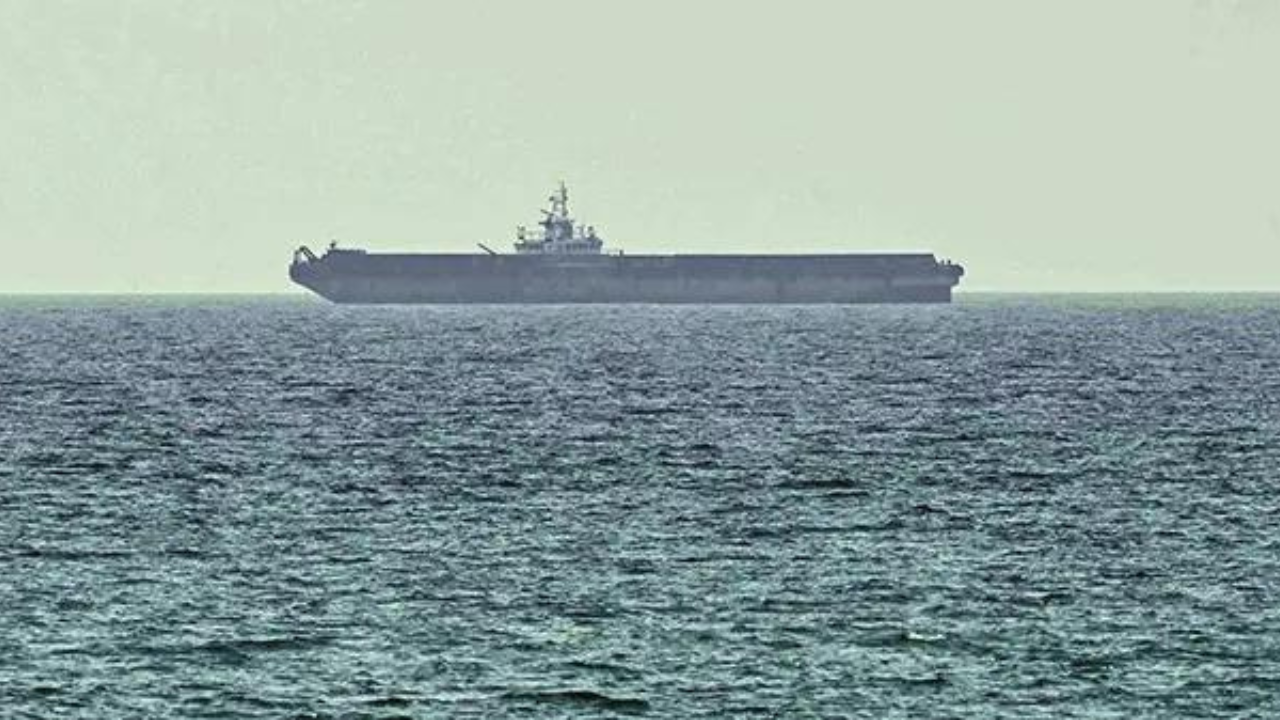
The headlines are screaming about a "blockade" in the Strait of Hormuz. They want you to believe that the United States sending ten Iranian tankers packing is a display of absolute naval dominance. It looks clean on a map. It sounds tough in a briefing room.
It is a tactical win that masks a massive strategic bankruptcy.
Standard geopolitical analysis treats the Strait of Hormuz like a garden hose. If you kink the hose, the water stops, and the problem is solved. But global energy markets and shadow fleets do not operate on plumbing logic. By focusing on the "victory" of turning back ten ships, the mainstream narrative ignores the reality that a blockade is not a solution—it is an admission that every other lever of power has already failed.
The Fallacy of Physical Containment
The "lazy consensus" suggests that physical interdiction is the gold standard of maritime pressure. It isn't. When the U.S. Navy blocks a ship, it creates a temporary vacuum that the market immediately rushes to fill with more expensive, more dangerous, and more illicit alternatives.
I have watched desks at major trading houses navigate these "blockades" for decades. A blocked ship in the Strait does not disappear; it becomes a floating storage unit or rebrands its hull under a flag of convenience before popping up in a different port forty-eight hours later.
The math is simple. If the cost of the blockade to the enforcer exceeds the cost of the workaround for the target, the enforcer is losing. Keeping a carrier strike group on station costs millions per day. Sending a tanker back to port costs the IRGC a rounding error in fuel.
We are using a $13 billion aircraft carrier to play a game of "keep away" with rust-bucket tankers. That isn't a blockade. It's an expensive hobby.
The Ghost Fleet Reality
Mainstream news outlets rarely mention the "Ghost Fleet"—the hundreds of aging vessels operating with disabled transponders and falsified paperwork. While the media fixates on the ten ships "sent back," they miss the thirty ships that slipped through under the cover of darkness or via ship-to-ship transfers in the Gulf of Oman.
A blockade only works if it is total. A partial blockade is just a price hike.
By forcing Iran to rely more heavily on these shadowy networks, the West is actually making the problem harder to track. We are incentivizing the professionalization of smuggling. We are training the very adversaries we claim to be "containing" to build a logistics network that exists entirely outside the reach of the SWIFT banking system and traditional maritime law.
Why the "Blockade" is a Business Gift to China
Every time a Western navy creates friction in the Strait, the primary beneficiary is not "regional stability." It is the Chinese energy buyer.
China remains the primary destination for sanctioned Iranian crude. When the U.S. blocks ships or increases the risk profile of the Strait, the "risk discount" on Iranian oil increases. This means China gets to buy its energy even cheaper.
We are effectively subsidizing the Chinese economy by depressing the price of Iranian crude through artificial risk. The "tough" stance in the Middle East is a direct transfer of wealth to Beijing.
- The Myth: Blockades starve the target of revenue.
- The Reality: Blockades create a black market where the most ruthless buyers (China) get the best deals.
The Logistics of a Failed Premise
Let's look at the physics. The Strait of Hormuz is roughly 21 miles wide at its narrowest point. The shipping lanes themselves are only two miles wide in each direction.
Proponents of the blockade argue that control of these lanes is total. But control of the surface does not mean control of the supply chain. If you block a tanker, the oil doesn't vanish from the global balance sheet. It just waits.
Imagine a scenario where the U.S. maintains this "ten ships a week" pace for a year. The result isn't a collapsed Iranian economy; it is a permanent increase in global insurance premiums (Lloyd's of London isn't stupid) and a structural shift toward land-based pipelines and alternative routes that bypass Western influence entirely.
What "People Also Ask" Gets Wrong
Most people ask: "Can the U.S. Navy close the Strait of Hormuz?"
The answer is yes, they can. But that is the wrong question. The real question is: "Can the global economy survive the U.S. Navy closing the Strait of Hormuz?"
The answer is a resounding no.
A total blockade would send oil to $250 a barrel overnight. It would trigger a global recession that would make 2008 look like a minor market correction. Therefore, the "blockade" we see today is theater. It is a calibrated, performative act designed to satisfy domestic political hawks without actually disrupting the flow of energy enough to hurt the American consumer at the pump.
The Cost of Professional Ignorance
I’ve sat in rooms where "maritime security" is discussed as if it were a game of Battleship. It isn't. It's a game of Incentives.
If you want to stop Iranian influence, you don't stop their ships. You stop the demand for their product or you break their ability to process the payments. Turning a ship around is the geopolitical equivalent of a bouncer standing outside a club while the back door is wide open and the manager is handing out VIP passes.
The downside to my perspective? It isn't "tough." It doesn't look good on a campaign poster. It requires the slow, boring work of financial forensics and diplomatic maneuvering rather than the high-octane visual of a destroyer intercepting a tanker.
But if we keep pretending that sending ten ships back is a victory, we are going to wake up in a world where the Strait of Hormuz is irrelevant because the rest of the world has built a bypass around our influence.
Stop Watching the Ships, Start Watching the Ledger
The true battle isn't happening in the water. It’s happening in the digital ledgers of small banks in Southeast Asia and the murky ownership structures of shell companies in Panama.
Every time we celebrate a "blockade," we signal our own obsession with 20th-century warfare in a 21st-century economic conflict. We are bring a knife to a spreadsheet fight.
The IRGC isn't worried about ten ships. They are worried about their access to the global financial system. The U.S. Navy is currently acting as a very expensive, very loud distraction from the real front lines.
If you want to win, stop trying to play "gatekeeper" at the Strait. Start playing "liquidator" in the banks.
Until then, these headlines about blockades are just noise for people who don't understand how the world actually moves.
Get off the deck of the carrier and look at the trade data. The ships we "send back" today are the same ones that will deliver their cargo under a different name tomorrow.
The blockade isn't working because the blockade is an illusion.