Stop buying garbage.
The internet is currently drowning in "curated" lists of spring-to-summer transitions, all promising that for the low price of $89.99, you can achieve a "timeless" look. It is a lie. These lists are not service journalism; they are landfill recruitment strategies. When a publication suggests ten items under $100 to bridge the seasonal gap, they aren't helping your style. They are helping fast-fashion conglomerates offload seasonal overstock before it becomes a liability. Meanwhile, you can explore related developments here: Why Wi Spa is still the king of Koreatown saunas.
The "under $100" price point is the most dangerous trap in the industry. It’s high enough to feel like a "step up" from ultra-fast fashion, but low enough to bypass your critical thinking. It is the sweet spot of mediocrity.
I have spent fifteen years watching the mechanics of textile production and retail margins. I have seen brands take a $4 polyester blend shirt, slap a "conscious" label on it, price it at $78, and watch as "experts" call it a must-have. If you want to actually look better this summer, you need to burn the checklist and understand why the current advice is designed to keep you broke and poorly dressed. To see the bigger picture, check out the detailed article by Apartment Therapy.
The Myth of the Transitional Piece
Mainstream fashion advice hinges on the idea of the "transitional" item. You’ve seen the pitch: "This lightweight knit works for breezy May mornings and August nights!"
No, it doesn't.
A garment that tries to do everything ends up doing nothing well. In physics, heat transfer doesn't care about your aesthetic goals. A synthetic "spring knit" is a greenhouse for your torso. It traps moisture during the humid climb into June and provides zero actual thermoregulation when the AC is blasting in July.
True seasonal transition isn't about buying new middle-ground clothes. It’s about understanding fabric weight and fiber physics.
- The Cotton Deception: Most $60 "summer" sweaters are made of short-staple cotton blended with acrylic. Short-staple cotton pills after three washes. Acrylic doesn't breathe. You aren't buying a "staple"; you're buying a disposable sponge.
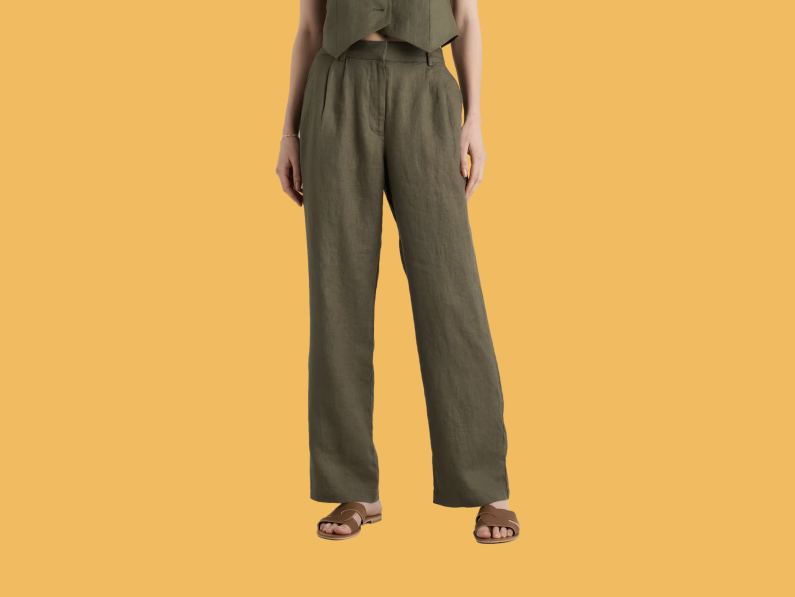
- The Linen Lie: Cheap linen is often treated with heavy starches to feel crisp on the rack. After one wash, it turns into a limp, translucent rag. High-quality linen (long-fiber, high-density) costs more than $100 because the weaving process is agonizingly slow.
If you are spending $80 on a "versatile" blazer, you aren't getting a deal. You are paying for a garment constructed with glued interlinings that will bubble and warp the first time you sweat in it.
The Cost Per Wear Fallacy
"But it's only $40! If I wear it four times, it’s $10 a wear!"
This is the math of the defeated. The Cost Per Wear (CPW) metric is frequently used to justify impulsive, low-quality purchases. The problem is that it ignores the Residual Value and the Cost of Replacement.
When you buy a $400 pair of genuine Goodyear-welted loafers, the CPW might look high initially. However, those shoes can be resold for $200 three years later, or resoled for $50 to last another decade. When you buy the $85 "essential" summer loafer from a mall brand, the residual value is $0. The moment you step outside, you have lost 100% of your capital.
You aren't "saving" $315. You are flushing $85 into a gutter.
Why You Should Never Buy Under 100
There is a literal floor for quality in the garment industry. To produce a shirt that retails for $90, the brand likely spent $15 to $20 on manufacturing and materials. Take out the shipping, the marketing, and the retail overhead, and you are left with a piece of clothing made of the cheapest possible inputs.
At this price point, you are paying for:
- Polyester "Silks": Petroleum-based fabrics that smell like chemicals the moment they touch body heat.
- Weak Seams: Stitches per inch (SPI) are kept low to save time on the machine. This is why your "under $100" finds lose their shape after two cycles in the laundry.
- Exploitative Labor: Let’s be blunt. You cannot ethically produce a high-quality, complex garment, ship it across the ocean, and sell it for $70 while everyone in the chain makes a living wage. The "savings" are being extracted from someone else’s quality of life.
The Counter-Intuitive Summer Strategy
If you want to disrupt your own closet and actually look like a person of substance, stop following the "10 Must-Haves" lists. Instead, adopt these three rules that the "Curators" hate.
1. Buy Winter Clothes in July
The biggest secret in the industry is the massive margin on "off-season" high-end goods. While everyone else is fighting over $90 polyester sundresses, the secondary markets (The RealReal, Grailed, eBay) are flooded with $1,200 cashmere and heavy wool coats that people are panic-selling because they need space.
I once watched a colleague buy a $2,000 Loro Piana overcoat for $300 in the middle of a heatwave. That is how you build a wardrobe. You don't buy what the magazines tell you to buy now. You buy what the market is undervalued now.
2. Invest in "High-Stress" Items Only
If you must buy for summer, spend your entire budget on the items that touch your skin and handle the most movement.
- Footwear: Your feet sweat more in summer. Cheap glues in cheap shoes fail under heat and moisture. Buy one pair of $300 leather sandals or loafers rather than four pairs of $75 junk.
- Trousers: Stop buying "stretch" chinos. The elastic (elastane) in them is a plastic that snaps over time, leading to "baggy knees." Buy 100% high-twist wool or heavy linen. It stays cool and holds a shape.
3. The "Two-Season" Rule
If an item is advertised as "transitional," don't buy it. If it doesn't have a clear purpose for either 90-degree heat or 30-degree cold, it is a compromise piece. Compromise pieces are the "filler" of the fashion world. They are the beige walls of your closet. They make you look unremarkable.
Dismantling the "People Also Ask" Nonsense
"What are the best summer staples for 2026?"
The question itself is flawed. "Staples" shouldn't be tied to a year. If your wardrobe needs an update every twelve months, you aren't buying staples; you're buying trends. A white linen button-down hasn't changed its "essential" status in eighty years. The only thing that changes is the quality of the fabric, which is currently at an all-time low.
"How can I look expensive on a budget?"
You can't. You can look "neat," but "expensive" is a tactile and visual reality created by the way light hits high-quality natural fibers. You can mimic the look in a photo with filters, but in a boardroom or at a dinner party, the drape of cheap fabric gives you away instantly. Instead of trying to "look expensive," try to look "intentional." One well-tailored, expensive shirt looks better than a different $50 outfit every day of the week.
"Are cheap clothes ever worth it?"
Only if they are utilitarian. Buying a cheap t-shirt for a mud run makes sense. Buying a cheap blazer for a wedding makes you look like you’re wearing a costume.
The Reality of the "Curated" List
When you see a list of "10 items under $100," understand the incentive structure. The publisher gets a commission via affiliate links. They need you to click. They need the price to be low enough that you'll make an impulse purchase without closing the tab to "think about it."
They are not curate-ing style. They are curate-ing clicks.
They will tell you that "utility jackets" are back. They will tell you that "tote bags with rope handles" are a must. These are distractions. They are low-cost, high-margin items designed to make you feel like you've refreshed your life without actually improving your standing.
The Burden of Quality
The downside of my approach is that it requires patience. It requires you to have a smaller closet. It requires you to ignore the dopamine hit of a "New Arrivals" email. It means you might only buy three things this entire year.
But those three things will still be in your closet in 2030. They will fit better. They will breathe better. And you won't look like a walking advertisement for a mall brand’s quarterly earnings report.
Fashion is a game of attrition. The industry wants to wear down your bank account $80 at a time. The only way to win is to refuse to play at their price point.
Go to a high-end department store. Touch a $400 shirt. Then go to the mall and touch a $70 shirt. If you can't tell the difference, you haven't been paying attention. If you can, you’ll realize that the "under $100" list isn't a guide—it's an insult.
Stop collecting rags. Start building a wardrobe.