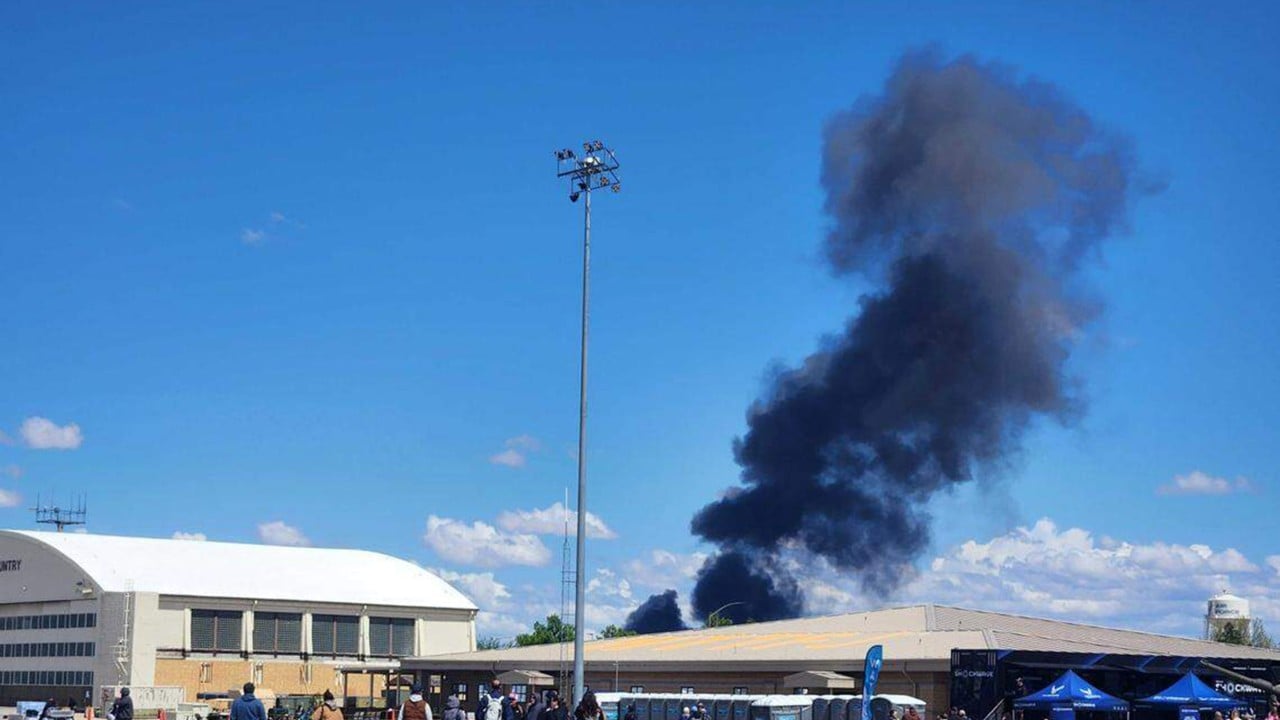
Two military jets collide mid-air during a public demonstration. The crew members eject. The media rushes to print the official press release: "Crew members safely ejected." Everyone breathes a sigh of relief. The public claps, reassured by the flawless execution of multi-million-dollar escape systems.
This reaction is fundamentally flawed.
Fixating on a "successful" ejection misses the entire point of the systemic failure that preceded it. Treating a mid-air collision at a civilian air show as a mechanical success story is a dangerous distraction. When two advanced fighter jets touch wings over a populated or semi-populated area, the narrative should not be about the triumph of engineering. It needs to be about why we are still risking elite pilots and irreplaceable hardware for weekend entertainment.
The Physical Fiction of a Safe Ejection
The aviation community handles the word "safely" with far too much leniency. Surviving is not the same as walking away unscathed.
An ejection seat is a violent, last-second violent intervention against death. It is an explosion happening directly beneath a human spine. When a pilot pulls that handle, they are subjected to forces ranging from 12g to over 20g depending on the aircraft and airspeed.
Consider the mechanics. The canopy shatters or blows clear. Rockets ignite. The pilot is violently propelled out of the cockpit into a wall of high-velocity air.
- Spinal Compression: The instantaneous acceleration routinely compresses vertebrae, sometimes permanently reducing a pilot's height or ending their flying career on the spot.
- Flail Injuries: At high speeds, the wind blast can dislocate shoulders, break limbs, or tear ligaments before the parachute even deploys.
- Concussions: The sudden deceleration as the seat hits the ambient air stream frequently causes traumatic brain injuries.
I have spoken with aviators who spent months in rehabilitation after a "textbook" ejection. To frame these incidents as neat, consequence-free rescues is a disservice to the physical toll these crews endure. Surviving an ejection is a medical crisis, not a victory lap.
The True Risk Profile of Precision Flight Demonstrations
Air shows exist in a strange regulatory gray area regarding public risk. We are told these maneuvers are tightly controlled, calculated risks executed by the finest pilots in the world. That is true. But human error scales with proximity.
In operational combat or standard training, military jets maintain strict separation minimums. In a tight demonstration formation, those buffers shrink to mere feet. At 400 knots, a microsecond delay in reaction time or a sudden pocket of turbulent air transforms a tight formation into a pile of falling debris.
The Problem With Crowd Proximity
The official line always emphasizes that maneuvers are performed over a designated aerobatic box away from the crowd line. But physics does not respect a painted line on an airfield map.
If a collision occurs at 1,500 feet while traveling at high speed, the momentum carries the wreckage forward in a ballistic arc. The engine blocks, heavy structural ribs, and unburned fuel do not stop where the pilot ejected. They continue along their kinetic trajectory.
"Relying on the ejection seat to save the crew acknowledges that the primary barrier keeping a 30-ton machine from falling into a civilian area has already failed."
We are gambling with high-performance hardware over civilian spaces for the sake of recruitment and public relations. The return on investment is no longer adding up.
The Financial Madness of Scraping Airframes
Let us talk about the cold math of these incidents. A modern frontline fighter jet is not just a vehicle; it is an aggregation of constrained supply chains, specialized metallurgy, and thousands of hours of technician labor.
When an aircraft is lost in an air show mishap, the taxpayers lose an asset worth anywhere from $30 million to over $100 million. That airframe cannot be easily replaced by writing another check. Production lines are backed up for years. Depriving operational squadrons of a hull so that a crowd can eat hot dogs and watch low passes is an operational failure.
Training Hours vs. Public Relations
Every hour an elite pilot spends practicing a specialized air show routine is an hour they are not training for actual tactical employment.
- Maneuver Divergence: Air show routines emphasize visual drama—tight turns, smoke generation, and close-quarters formation flying. Combat requires radical energy management, beyond-visual-range missile employment, and electronic warfare integration.
- Skill Decay: Spending a season on a demonstration team refines a very specific, non-combat skill set while letting tactical proficiency degrade.
We are actively reducing the readiness of our military personnel to maintain a public relations apparatus designed for a pre-internet era.
Redefining the Public Engagement Model
The immediate defense of these spectacles is always the recruitment argument. We are told that without the roar of the engines over local airports, the next generation of aviators will never sign up.
This argument is stuck in 1985. The modern teenager is not inspired to join a highly technical, digitally driven military branch because they saw a jet fly fast in a straight line. They are looking at the technology, the drone integration, the cyber capabilities, and the actual mission profiles.
If the goal is genuine engagement, the military needs to shift resources toward immersive technical exhibits, high-fidelity simulator access, and transparent looks into the actual engineering and strategic challenges our forces face.
Stop risking human lives and priceless equipment to perform stunts that can be rendered flawlessly in a modern VR headset for a fraction of the cost and zero percent of the physical risk.
The next time an official report praises a successful ejection at a local demonstration, look past the survival statistics. Look at the smoldering wreckage on the ground, calculate the lost operational readiness, and ask yourself why we are still running this dangerous circus.