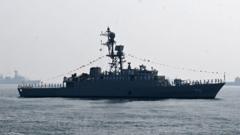
The headlines are screaming victory because a billion-dollar US attack submarine turned an Iranian surface vessel into an artificial reef. Pete Hegseth is taking a victory lap. The Pentagon is briefing on "deterrence restored." The media is treating this like a masterclass in projection of power.
They are all looking at the wrong map.
Sinking a surface ship in the Indian Ocean with a sophisticated submarine is not a feat of arms. It is a predictable outcome of an aging doctrine. If you put a $3 billion Virginia-class submarine against a surface combatant that lacks integrated, multi-layered anti-submarine warfare (ASW) suites, the result is academic. It is like bragging that a professional sniper hit a target standing in an open field.
The real story isn't that the US won the engagement. The story is that we are still measuring success by the number of hulls we put on the seafloor, while the very nature of maritime denial has shifted under our feet.
The Myth of the Big Stick
The "lazy consensus" among defense analysts is that this strike sends a message to Tehran. It doesn't. It sends a message to the US taxpayer that we are still using 20th-century solutions for 21st-century asymmetrical headaches.
Iran does not care about losing a warship. Their entire naval strategy is built on attrition through insignificance. They operate a "mosquito fleet" of fast attack craft, semi-submersibles, and land-based missile batteries. Losing a flagship is a PR hit, but it doesn't degrade their ability to close the Strait of Hormuz with $20,000 suicide drones and $500,000 anti-ship missiles.
We just used a multi-billion dollar asset and a $2 million MK-48 ADCAP torpedo to delete a vessel that was likely worth less than the fuel in our carrier strike group's tanks. That isn't winning. That is bad math.
Precision is the New Vulnerability
Every time the US Navy flexes its muscle like this, it exposes the "exquisite" nature of our fleet. We have a handful of incredibly expensive, incredibly capable platforms. The opposition has thousands of cheap, "good enough" systems.
In a true high-intensity conflict, the math of the Indian Ocean fails.
Imagine a scenario where a swarm of 50 low-cost, autonomous underwater vehicles (AUVs) detects the acoustic signature of that same Virginia-class sub. These AUVs don't need to sink the sub. They just need to stay near it, pinging it, making its location known to every shore-based ballistic missile battery in the region.
- The Cost Gap: A single torpedo costs more than an entire swarm of scout drones.
- The Repair Gap: We cannot replace a submarine in under five years. The adversary can weld a new missile boat in five weeks.
- The Intelligence Gap: Satellite imagery and signal intelligence have made the ocean "transparent." The idea that a 7,000-ton steel tube can remain hidden forever is a romantic vestige of the Cold War.
I have sat in rooms where admirals sweat over "the reload problem." We are great at the first strike. We are terrible at the sustained exchange. By cheering for a single sinking, we ignore the fact that our magazine depth is shallow and our shipyards are at a standstill.
Why the Indian Ocean is a Distraction
Focusing on Iranian warships in the Indian Ocean is a strategic error. The Indian Ocean is deep water. Deep water favors the US Navy.
The fight is moving to the "littorals"—the shallow, cluttered waters near the coast. This is where sonar fails due to thermal layers and bottom bounce. This is where Iran, China, and even non-state actors hold the advantage.
The competitor's article suggests this sinking proves we "own the waves." It proves nothing of the sort. It proves we own the deep blue, which is increasingly irrelevant. If you want to control the global economy, you have to control the chokepoints. You can't navigate a Virginia-class sub into the shallowest parts of the Persian Gulf or the Red Sea without becoming a massive, slow-moving target for a teenager with a drone controller.
The Professional's Delusion
There is a specific kind of arrogance in naval circles regarding "overmatch." We assume that because our sensors are better, our crews are better trained, and our steel is thicker, we are invincible.
I’ve seen this play out in wargames where the "Blue Team" (USA) gets its teeth kicked in because they refuse to acknowledge that quantity has a quality of its own. We count our VLS (Vertical Launch System) cells and think we’re safe. We aren't.
- Acoustics: The MK-48 is a masterpiece of engineering. But it is a loud masterpiece. Once it fires, the sub’s position is compromised.
- Logistics: Where does that sub reload? If the local piers are leveled by IRBMs (Intermediate-Range Ballistic Missiles), that sub is a one-and-done asset.
- Political Will: Sinking a ship is easy. Explaining why we lost a $3 billion sub to a $50,000 sea mine is impossible.
Stop Asking if We Can Sink Them
The question shouldn't be "Can the US Navy sink an Iranian warship?" Of course we can. We've been able to do that since the 1980s.
The real question—the one Hegseth and the Pentagon are dodging—is: "Can we sustain a presence in contested waters without losing the entire fleet to a thousand small cuts?"
The answer, currently, is no.
Our current shipbuilding plan is a mess. Our maintenance backlogs are legendary. We are retiring ships faster than we are building them. Taking out one Iranian vessel is a tactical sugar high that masks a strategic rot.
We are obsessed with the "Big Kill." We want the dramatic explosion, the sonar hit, the cinematic confirmation. Meanwhile, the real threat is the slow, methodical denial of access through cheap, mass-produced technology.
The Actionable Reality
If we actually wanted to secure the Indian Ocean, we wouldn't be bragging about submarine strikes. We would be flooding the zone with our own low-cost, attritable systems.
- Divest from the "Exquisite": Stop building $13 billion aircraft carriers that require an entire city of escort ships to survive.
- Invest in Mass: We need 1,000 small, unmanned vessels, not 10 massive ones.
- Accept Loss: We have to build a Navy that expects to lose ships and can keep fighting anyway. Right now, losing a single carrier would be a national trauma that ends a war. That is a liability, not a strength.
The sinking of that warship wasn't a show of force. It was the last gasp of an era where a few large machines could dictate the fate of the seas. That era is over. The ocean is no longer a hiding place; it is a sensor-saturated kill zone where the cheapest player usually wins the long game.
Stop celebrating the hit. Start worrying about the cost of the swing.