The drum of a concrete mixer is a brutal, unforgiving place. It is a hollow cylinder of heavy-gauge steel designed for a single, violent purpose: to churn aggregate, sand, water, and cement into a homogenous slurry that eventually hardens into the bedrock of human infrastructure. When the machine is running, the noise is deafening, a mechanical roar that vibrates through the soles of your boots. When it stops, the interior remains a dark, suffocating cavern coated in a thick, abrasive paste. It is the absolute antithesis of nature.
Yet, it was inside this spinning metal tomb that a small, terrified pair of yellow eyes blinked against the dark.
We treat the boundary between our industrial landscapes and the wild world as a hard line. We build fences. We pour foundations. We assume that the noise of our progress keeps the wild at bay. But nature does not recognize our property lines. It creeps into the gaps we leave behind, sometimes with devastating consequences. This is not just a story about a lucky rescue. It is a stark reminder of what happens when the machinery of human ambition collides head-on with the fragile, silent lives operating right under our noses.
The Weight of the Slurry
To understand the stakes of that morning, you have to understand the physical reality of wet cement. It is not just mud. It is a highly alkaline substance, chemically capable of causing severe burns to exposed skin and tissue. As it dries, it shrinks, hardens, and heavy locks anything caught within its grasp. It adds dead weight. For a creature that relies entirely on the aerodynamics of its plumage to survive, wet cement is a death sentence.
The workers at the construction site did not expect to find life inside the machinery. The mixer had been active, a routine part of a grueling shift. It was only during a standard inspection or a brief lull in operations that someone noticed a anomaly. A shape. It was entirely caked in gray sludge, unrecognizable as a living creature at first glance. It looked like a chunk of debris, a hardened buildup of aggregate that had somehow detached from the inner wall.
Then, the debris moved.
An owl. Specifically, a screech owl, though its defining features were completely erased by the mortar.
Imagine the sheer terror of that moment from the bird's perspective. Owls are creatures of silence. They are stealth predators designed to drift through the night sky on feathers that muffle the sound of the wind. They rely on impeccable hearing and flawless vision. Inside the mixer, this bird had been subjected to an assault on every single one of its senses. The noise would have been catastrophic to its sensitive ears. The dust would have choked its lungs. The heavy slurry had pinned its wings to its body, transforming a master of the air into a heavy, immobile stone.
The human element changed instantly. The construction site, a place governed by tight deadlines, budgets, and physical labor, ground to a halt. The rough-handed crew, men and women used to dealing with stone and steel, suddenly found themselves holding something incredibly delicate. The stakes were invisible but massive. If they mishandled the bird, the dried cement would tear its feathers from the skin, ensuring it would never fly again. If they left it, the chemical burns would do the rest.
The Chemistry of Mercy
The crew did the only thing they could do: they reached out for help. The bird was rushed to a local wildlife rehabilitation center, a place where volunteers spend their days undoing the accidental damage caused by human expansion.
When the rehabilitation team received the owl, the prognosis was grim. The cement was already beginning to set. The bird was hypothermic, exhausted, and likely suffering from internal trauma from the vibration of the machine. The first challenge was not medical; it was chemical. How do you remove hardened industrial concrete from the feathers of a bird that weighs less than a pound without killing it in the process?
You cannot use harsh solvents. Chemical cleaners would penetrate the owl's skin, poisoning its bloodstream or destroying its respiratory system. The solution had to be painstaking, slow, and incredibly gentle.
The rehabilitators used warm water, mild detergents, and an immense amount of patience. They worked millimeter by millimeter, soaking the hardened crust, teasing the fibers of each individual feather away from the matrix of sand and lime. Every movement had to be calculated. An owl's feathers are a marvel of evolutionary engineering, featuring microscopic hooks called barbules that lock together to create a smooth, airtight surface for flight. The concrete was threatening to ruin this structure permanently.
- The first wash removed the heavy outer crust, revealing the bird's true size.
- The second wash targeted the eyes and beak, clearing the airways and allowing the owl to breathe without inhaling toxic dust.
- The subsequent rinses focused on the flight feathers, the primary and secondary wings that dictate lift and control.
During the process, the owl remained remarkably still. Wildlife experts often note that animals in severe shock enter a state of tonic immobility. To a casual observer, it looks like cooperation. In reality, it is a survival mechanism born of absolute terror. The bird believed it was being handled by predators, its heart rate spiking even as its body remained limp. The rehabilitators knew this. They worked in near-silence, minimizing human speech, keeping the lights low to reduce the sensory overload on an animal that had already endured the unimaginable.
The Ghost in the Suburbs
This incident highlights a growing tension in our modern world. We are expanding our footprint at a pace that outstrips the ability of local wildlife to adapt. Owls are nocturnal hunters. They are drawn to human structures not out of a desire to coexist, but because our developments inadvertently create perfect hunting grounds. Construction sites, trash dumps, and suburban yards attract rodents. Mice and rats thrive in the debris and food waste left behind by human activity.
To an owl, a construction site at night is a buffet.
The bird likely entered the mixer looking for a meal. A mouse, seeking shelter or scraps, may have scurried into the open drum. The owl followed, focused entirely on the hunt, oblivious to the fact that the hollow log it had entered was a piece of heavy machinery scheduled to roar to life at dawn.
This is the hidden cost of our development. For every animal that is found and rescued, dozens more vanish into the gears of our infrastructure without anyone ever noticing. They are the ghosts of the suburbs, adapting to our world until the moment the world catches up to them.
The Test of the Sky
After the concrete was successfully removed, the real trial began. A clean owl is not necessarily a healthy owl. The rehabilitation team had to monitor the bird for delayed signs of toxicity. The alkaline nature of the concrete could have caused corneal ulcers in its eyes, which would ruin its ability to hunt. There was also the risk of respiratory infection from inhaling the dry dust before the wash.
Days turned into weeks. The owl was moved to an outdoor flight enclosure, a long, netted structure designed to let recovering birds rebuild their muscle atrophy.
The staff watched from a distance. They needed to see if the bird could fly silently. They needed to know if it could still track live prey. If it couldn't hunt, it couldn't be released. The line between a successful rescue and a lifetime of captivity is razor-thin.
Watching a bird recover its dignity is a profound experience. The owl, which had arrived as a gray, cemented lump of misery, began to preen. It restored the alignment of its feathers. The natural camouflage—a beautiful, mottled pattern of grays and browns designed to mimic tree bark—returned. The fierce, untamable glare in its yellow eyes sharpened. It was no longer a victim of industrial negligence; it was a predator again.
Then came the night of the release.
The team brought the transport box to the edge of a wooded area, far away from the active construction sites and the roar of rotating drums. The door was opened.
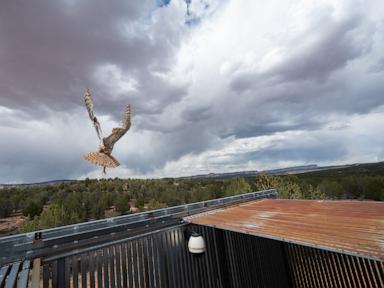
There was no hesitation. The owl moved to the edge of the crate, paused for a fraction of a second to assess the open air, and launched itself into the dark. There was no sound. No flapping of wings, no rustle of leaves. It simply dissolved into the tree line, a shadow returning to the shadows, entirely free of the concrete that had threatened to bury it alive.