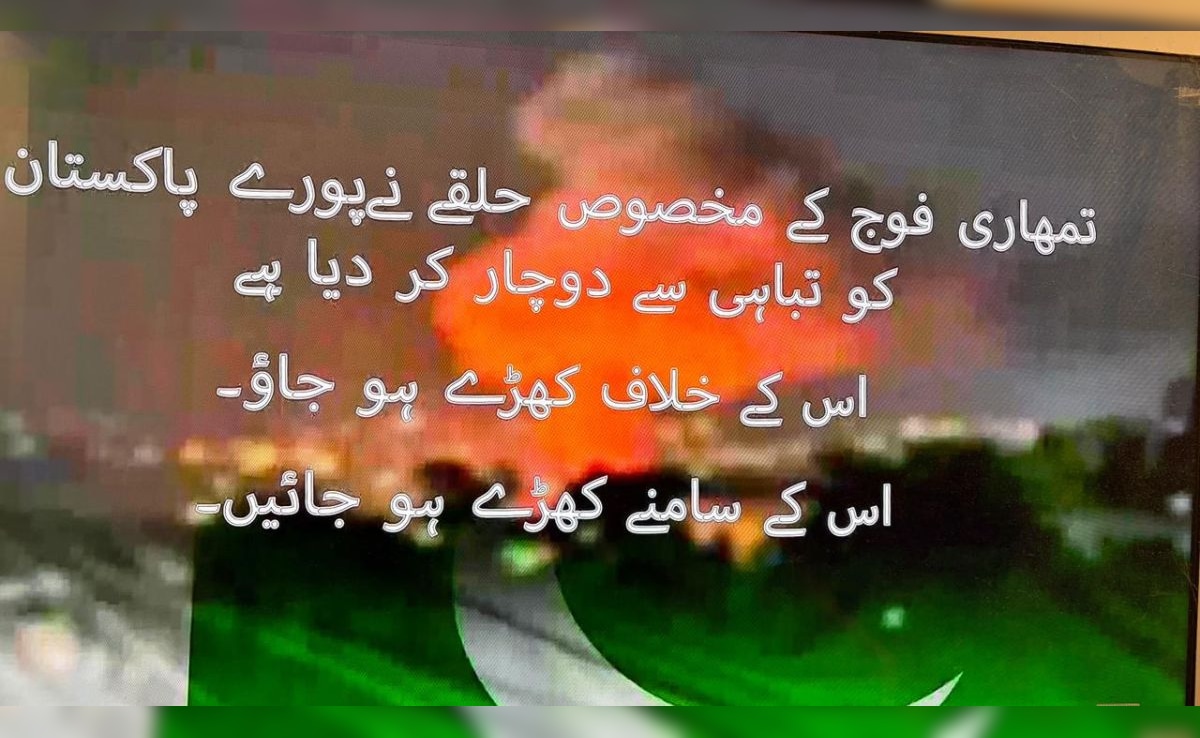
The hijacking of Pakistani broadcast infrastructure during periods of Iranian domestic upheaval represents more than a digital prank; it is a clinical demonstration of how regional instability weaponizes the neighbor’s information ecosystem. When Pakistani news channels were compromised to broadcast messages urging the military to "stand up" against its own command—framed against the backdrop of protests following reports regarding Supreme Court Leader Ayatollah Ali Khamenei—it signaled a shift from traditional state-sponsored propaganda to decentralized, high-impact cyber-kinetic interference.
Understanding this event requires moving beyond the surface-level narrative of "hacking." It demands a structural analysis of three intersecting vectors: the vulnerability of aging broadcast hardware, the psychological exploitation of shared religious-political borders, and the breakdown of regional signal security.
The Architecture of Broadcast Vulnerability
The compromise of a national news ticker or a live video feed is rarely the result of "brute forcing" a television. Instead, it targets the Ingest and Distribution Layer. Broadcast networks rely on a specific chain of command for data:
- The Playout System: The software that sequences content, ads, and tickers.
- The Encoder: The hardware translating digital signals into broadcast-ready formats.
- The Satellite Uplink/CDN: The final transmission point to the viewer.
The intrusion in Pakistan highlights a critical failure in the Remote Management Interface. Many regional stations utilize legacy IP-based controllers for their news tickers. These controllers often sit on public-facing networks with default credentials or unpatched vulnerabilities. By gaining access to the playout server, an actor can inject a secondary stream or override the "lower-third" graphics without triggering immediate failsafes.
This creates a Response Lag. Because the intrusion happens at the source of the "truth"—the newsroom's own servers—automated monitoring systems often register the broadcast as legitimate. The delay between the initial breach and the manual override provides the "viral window" necessary for the message to be captured, recorded, and redistributed on social media, magnifying the reach of a 30-second hack into a 48-hour news cycle.
Strategic Transference: Why Pakistan is the Proxy for Iranian Unrest
The geopolitical logic of targeting Pakistani airwaves during Iranian protests is rooted in the concept of Strategic Transference. Information operations (IO) rarely aim to convince the primary target (the Iranian state) of a new reality. Instead, they aim to destabilize the primary target’s perimeter.
The Border-Information Nexus
Pakistan and Iran share a porous 900-kilometer border and a complex history of sectarian and security cooperation. When rumors of Khamenei’s health or death circulate, the Iranian state implements "Internet Shutdowns" or "Grey-Zoning" of digital traffic. This creates an Information Vacuum.
In the absence of internal data, regional actors look toward the "near-abroad"—Pakistan—for signals. By hacking Pakistani channels, the actors achieve two objectives:
- Validation through Proxy: An Iranian citizen seeing a report on a foreign (Pakistani) channel views it as more credible than a domestic report, assuming the foreign channel is outside the reach of local censors.
- Sectarian Friction: Messages calling for the Pakistani Army to "revolt" leverage existing internal tensions in Pakistan to create a secondary crisis. This forces the Pakistani security apparatus to pivot its attention inward, reducing its capacity to coordinate border security with Tehran during a period of Iranian vulnerability.
The Cost Function of Digital Insurgency
To quantify the impact of such hacks, we must analyze the Credibility Depreciation Curve. Every time a "high-trust" medium like a national news channel is compromised, the cost of future communication increases for the state.
- Verification Overhead: Following a breach, newsrooms must implement "Human-in-the-loop" (HITL) verification for every automated ticker update. This slows down the delivery of breaking news, ceding the speed advantage to unverified social media accounts.
- Infrastructure Hardening Costs: Securing a broadcast network that was designed for connectivity, not combat, requires a complete overhaul of the Air-Gap Protocol. For many Pakistani outlets operating on thin margins, the cost of robust cybersecurity is prohibitive, leading to a "Security Debt" that makes future hacks inevitable.
- The Panic Multiplier: The specific messaging used—calling for a military uprising—is designed to trigger the "Coup Logic" inherent in Pakistani political history. Even if the hack is recognized as fake within minutes, the psychological shock ripples through the markets and the military bureaucracy, requiring a disproportionate expenditure of political capital to reassure the public.
Mechanisms of Attribution and the False Flag Dilemma
Attributing such an attack is fraught with technical "Noise." Actors in this space frequently use Obfuscated Infrastructure, routing their traffic through residential VPNs or compromised IoT devices within Pakistan itself to make the attack appear domestic.
The Actor Profiles
- The State-Sourced Kinetic Actor: Sophisticated entities (often linked to regional rivals) using the Khamenei rumors as a "force multiplier" to stretch the Iranian and Pakistani security states thin.
- The Ideological Hacktivist: Non-state groups (such as those aligned with Balochi insurgencies or Iranian dissidents) who lack the means for a physical coup but possess the technical skill to execute an "Information Coup."
- The Opportunistic Disruptor: Entities interested in testing the "Elasticity" of Pakistani cyber defenses for future, more damaging strikes against power grids or financial systems.
The danger of this hack is not the message itself, but the Proof of Concept. It demonstrates that the transition from digital signal to mass-psychological reaction is nearly instantaneous. The lack of a centralized, rapid-response cyber command within the Pakistani media regulatory framework means that the "Kill Chain" of the hack—from entry to broadcast—remains uninterrupted for far too long.
Structural Fragility of the Media-Security Complex
The incident exposes a disconnect between Physical Security and Spectrum Security. While the Pakistani Army is a dominant force in physical space, its ability to protect the "Cognitive Space" of its citizenry is limited by the private sector's technological laggardness.
Most Pakistani media houses operate as Silos. There is no unified threat-sharing intelligence platform. If Channel A is hacked, Channel B has no automated way of knowing or protecting its own playout system from the same exploit. This creates a "Domino Risk" where a single exploit can be replicated across the entire media landscape before a manual "All-Stop" can be issued.
Furthermore, the integration of Deepfake Audio and Video into these hacks is the next logical step. In this specific instance, the hijackers used text tickers and static imagery. Had they utilized AI-generated video of a senior military official or a high-ranking cleric, the time to debunk would have increased from minutes to hours, potentially long enough to trigger actual civil unrest.
The Strategic Pivot for Regional Stability
Countering this level of information warfare requires a move away from "Firewall Logic" toward Resilience Logic.
The immediate tactical requirement is the deployment of Blockchain-Verified Ingest. By cryptographically signing every piece of content that enters the playout server, stations can ensure that only "Authorized Keys" can alter the broadcast. If a hacker gains access to the server but lacks the hardware-stored cryptographic key, the playout system will reject the injected data.
On a broader scale, the Pakistani state must recognize that Media Infrastructure is Critical Infrastructure. In the same way that a power plant is protected by specialized cyber-units, the "National Narrative" platforms must be shielded by the state's central cybersecurity frameworks.
The intersection of Iranian leadership rumors and Pakistani broadcast vulnerabilities is not a coincidence; it is a calculated exploitation of a regional "fault line." The hack was a low-cost, high-yield operation that achieved total saturation of the target audience without a single kinetic shot being fired. This is the new baseline for regional conflict: the subversion of the neighbor’s reality to manage one's own internal crisis.
Media organizations must now operate under the assumption of Persistent Compromise. The goal is no longer to prevent the breach—which is statistically unlikely given the number of entry points—but to minimize the "Blast Radius" of the misinformation. This involves creating "Circuit Breakers" in the broadcast chain that can instantly revert a feed to a localized, unhackable emergency signal the moment an unauthorized change is detected in the playout metadata.
Failure to adopt these structural defenses ensures that the Pakistani information environment remains a playground for regional actors seeking to outsource their domestic turmoil. The next iteration of this tactic will not merely ask the military to "stand up"; it will provide the falsified visual evidence that they already have, leaving the state to chase a ghost in its own machines.