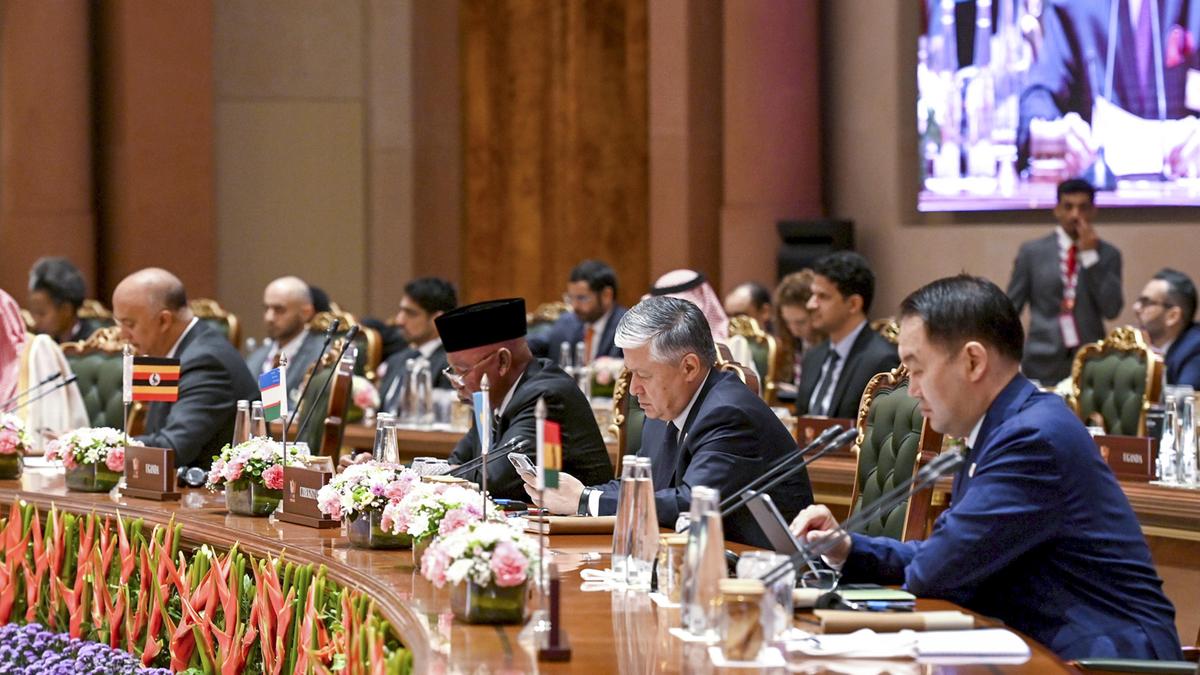
The ambition of creating a unified counterweight to Western global hegemony has run directly into the realities of Middle Eastern geopolitics. In New Delhi, a high-stakes meeting of BRICS foreign ministers collapsed without a joint communiqué, exposing deep structural vulnerabilities within the newly expanded bloc.
The primary cause of the breakdown was a bitter, localized dispute over the war involving Iran, Israel, and the United States. This marks the second time in less than a month that the grouping has failed to reach a consensus on the issue, forcing host country India to settle for a diluted "Chair's Statement" accompanied by a telling footnote regarding member reservations.
This diplomatic failure reveals that rapid expansion has severely compromised the bloc's decision-making apparatus. By inducting historical rivals into its ranks, the organization has imported the very geopolitical fractures it previously claimed to transcend. What was designed as a powerful vehicle for the Global South has transformed into an unmanageable forum hamstrung by internal vetos.
The Anarchy of Over-Expansion
When BRICS inducted Iran, the United Arab Emirates, Egypt, and Ethiopia, the move was celebrated by its architects as a masterstroke. The narrative was simple. More members meant a larger share of global GDP, greater control over oil supply chains, and undeniable leverage against the G7.
That narrative is dead. The two-day ministerial summit at New Delhi’s Bharat Mandapam proved that economic statistics cannot mask fundamental security contradictions.
The core of the dispute centered on an open rhetorical clash between Iranian Foreign Minister Abbas Araghchi and the UAE’s Minister of State Khalifa Shaheen Al Marar. Araghchi demanded that the bloc explicitly condemn Western and Israeli military strikes against Iranian territory. He went further, directly accusing the UAE of complicity by providing airspace, land, and military bases to United States forces involved in operations against Tehran.
The UAE pushed back, seeking a condemnation of Iranian regional destabilization.
When a grouping operates on the principle of absolute consensus, an active military conflict between two members makes a unified statement impossible. The final outcome document could only note that "differing views among some members" remained, a euphemism that exposes the limits of the bloc's diplomatic utility.
The Flaw in the Consensus Model
The institutional architecture of BRICS was built for a smaller, ideologically aligned club. When the core comprised Brazil, Russia, India, China, and South Africa, the shared objective was clear: reforming international financial systems and diversifying away from dollar dominance. These nations had bilateral friction—most notably India and China—but they maintained a mutual interest in separating economic cooperation from border disputes.
The new configuration changes the equation entirely.
BRICS Decision-Making Bottleneck:
[Geopolitical Conflict] ➔ [Member A Demands Condemnation] ➔ [Member B Exercises Veto] ➔ [Total Consensus Collapse]
The introduction of Middle Eastern power dynamics introduces zero-sum security dilemmas into the tent. For Iran, its survival and regional proxy strategy are non-negotiable national security priorities. For the UAE, its security architecture is deeply intertwined with Western defense pacts. These are not trade tariffs or currency swap agreements that can be negotiated down to a middle ground. They are existential foreign policy positions.
Indian External Affairs Minister S. Jaishankar attempted to manage the friction by noting in his opening remarks that newer members must fully subscribe to existing consensus mechanisms. It was an understated warning that went unheeded. The structural reality is that you cannot invite rivals into a room and expect them to drop their regional animosities at the door.
Host Country Casualties
The lack of a joint statement is a distinct diplomatic setback for India. As the current chair of the bloc, New Delhi intended to use the platform to solidify its position as the premier voice of the Global South.
Instead, Indian diplomats spent forty-eight hours engaged in damage control. India’s foreign policy relies on strategic autonomy—maintaining strong defense ties with Washington, energy partnerships with Moscow, and infrastructure projects like the Chabahar Port with Tehran. When the bloc splits along these exact fault lines, India's balancing act becomes significantly harder to maintain.
China, too, faces a quiet challenge to its grand strategy. Beijing brokered the historic diplomatic normalization between Saudi Arabia and Iran, viewing itself as the new security guarantor of the region. The open animosity between Iran and the UAE at a China-supported forum suggests that Beijing’s regional diplomacy is far more fragile than its state media suggests.
The Illusion of Alternative Global Governance
The broader implication of the New Delhi collapse hits at the core promise of the multipolar movement. For years, the global community has heard that institutions like BRICS would offer a more stable, equitable alternative to Western-led bodies like the United Nations Security Council or the G7.
The New Delhi meeting demonstrated that the bloc is susceptible to the exact same paralysis that plagues the UN. When a crisis occurs, national self-interest overrides collective statements. The inclusion of a formal footnote in the outcome document, highlighting that an unnamed member held reservations regarding sections on Gaza and maritime security in the Red Sea, shows that the bloc is now institutionalizing its divisions rather than resolving them.
This creates a serious credibility problem. If a bloc cannot agree on a basic statement regarding an ongoing war that directly involves its members and impacts global energy markets, it cannot credibly present itself as an alternative security anchor. It remains an economic talking shop, unable to project collective political power when the stakes are highest.
The lesson of New Delhi is that scale is no substitute for cohesion. Without a mechanism to resolve or bypass internal security conflicts among its members, further expansion will only guarantee deeper paralysis.