The air inside a Boeing 737 cockpit during the final approach is a choreographed silence. It is a place of checklists, calculated descents, and the rhythmic clicking of switches. Outside the glass, the world of Modesto, California, rises to meet the landing gear. On January 22, 2026, the pilots of United Airlines Flight 1898 were immersed in this routine. They were doing what they had done thousands of times before: transitioning from the vast, empty sky to the precision of a runway.
Everything was normal. Until the sky stopped being empty.
We often think of the sky as an infinite ocean, but near an airport, it is a series of tightly packed corridors. It is a grid of invisible glass walls. When those walls shatter, even for a few seconds, the consequence is a visceral, bone-deep terror that no flight simulator can truly replicate.
The Geometry of a Near Miss
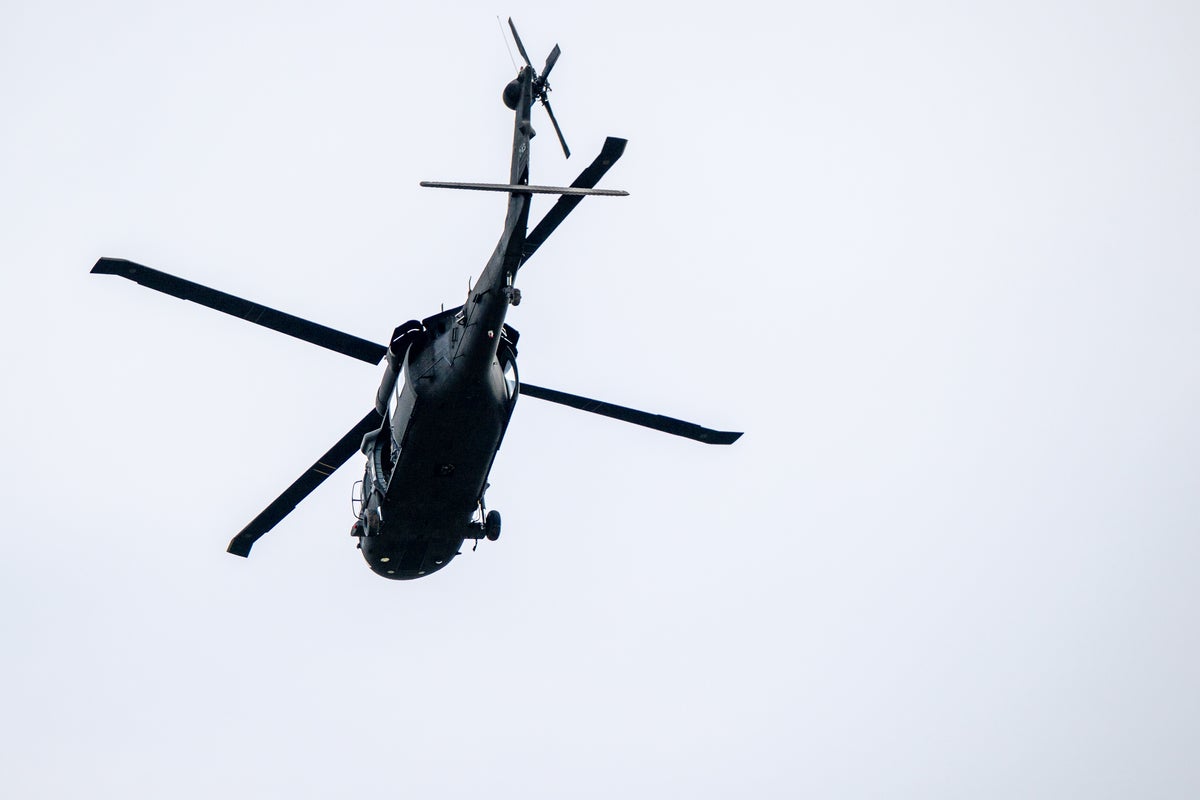
At approximately 12:30 p.m., the United jet was descending toward Modesto City-County Airport. Simultaneously, a U.S. Army UH-60 Black Hawk helicopter was operating in the same airspace. In the world of aviation, "near" is a relative term, but in this instance, the two aircraft occupied the same patch of reality with a proximity that defies comfort.
The Federal Aviation Administration (FAA) later confirmed the gravity of the encounter. The Black Hawk and the 737 came within a distance that forced the United pilots to take immediate, evasive action.
Imagine you are driving down a quiet suburban street. You check your mirror, you glance at the radio, and suddenly, a massive truck is grill-to-grill with your sedan because it turned off a side street without a stop sign. Your heart doesn't just beat; it slams against your ribs. Now, multiply that speed by four. Remove the pavement. Add 100 tons of metal and 150 souls sitting behind you, blissfully unaware, finishing their ginger ales and stowing their laptops.
The Human Element in the Cockpit
We talk about "automated systems" and "Air Traffic Control" (ATC) as if they are infallible deities. They are not. They are tools wielded by tired, focused, brilliant, and occasionally overwhelmed human beings. When a Black Hawk—a machine designed for the unpredictability of combat—crosses paths with a commercial liner designed for the predictability of logistics, the "system" has already failed.
The United crew had to rely on a technology called TCAS—the Traffic Collision Avoidance System. It is a high-pitched, synthetic voice that barks orders when the distance between two transponders shrinks to a critical margin.
"Climb! Climb!" or "Descend! Descend!"
It is a jarring sound. It overrides everything. In those seconds, the pilot is no longer a navigator; they are a reflex. They are a human being pulling back on a yoke or pushing it forward, fighting gravity to save lives they will never meet. The sheer physical force of an evasive maneuver in a commercial jet is violent. The plane tilts, the engines roar as they compensate for the sudden change in pitch, and for the passengers in the back, the world simply falls away for a moment.
Why the Rules of the Sky Broke
How does an Army helicopter end up in the path of a United flight? The investigation is currently peeling back the layers of communication. Modesto is a "towered" airport, meaning there are eyes on the ground and radar on the screens. However, military and civilian coordination is a complex dance.
Military pilots often operate under different mission parameters. They might be practicing low-level maneuvers or transitioning between bases. The commercial pilot is on a literal rail in the sky. When those two philosophies of flight collide, the friction is dangerous.
Consider the "see and avoid" principle. It is the oldest rule in aviation. Even with billion-dollar satellites and radar, the final line of defense is a pair of human eyes looking out of a window. But at 150 knots, a Black Hawk painted in matte olive drab can be nearly invisible against the brown and green patchwork of the California valley until it is too late.
The Weight of a Second
The United flight eventually landed safely. There were no injuries reported. On paper, it will be logged as an "incident"—a statistic for a quarterly safety briefing. But for the people in that cockpit, and the controller whose voice likely jumped an octave as they realized the icons on their screen were merging, it wasn't a statistic. It was a brush with the void.
Safety in the air is a fragile illusion maintained by constant vigilance. We trust that the person in the tower saw the helicopter. We trust that the helicopter pilot heard the frequency. We trust that the software in the United jet won't glitch. Most of the time, that trust is rewarded. But as the skies become more crowded—with drones, private jets, military exercises, and increasing commercial frequency—the margins are thinning.
The modesto incident is a warning. It is a reminder that the "invisible stakes" of travel are always present. Every time we buckle that belt, we are participating in a miracle of coordination that is only one misunderstood radio call away from catastrophe.
The engines eventually cooled on the tarmac at Modesto. The passengers walked up the jetway, complaining about the weather or the price of Ubers, unaware that their lives had just been saved by a series of frantic, professional movements in a small room at the front of the plane.
The sky is wide, but it has never felt smaller than it did that afternoon in California. We live our lives in the gaps between these narrow escapes, relying on the quiet competence of strangers to keep the world from crashing down.
The sun set over the airfield, the runway lights flickered on, and the next flight began its descent, trusting the silence to hold.
Would you like me to look up the official NTSB preliminary report numbers or the specific flight history of that United aircraft?