The sound is a sickening, metallic crack. It isn't the soft thud of a tire meeting rubber; it’s the bone-deep shudder of an axle being forced into a jagged crater of frozen asphalt. For a moment, time stops. The coffee in your center console leaps into the air. Your steering wheel jerks with a violent, independent will. Then comes the hiss of escaping air and the realization that your Tuesday morning just became a five-hundred-dollar hostage situation.
Across the northern hemisphere, this scene is playing out millions of times. We call them potholes. It’s a domestic, almost cute name for what is essentially a structural failure of our civilization's most basic connective tissue.
After a winter defined by brutal "freeze-thaw" cycles, the ground is literally screaming. In cities like Chicago, Detroit, and New York, the roads haven’t just aged; they have disintegrated. Public works departments are calling it a "blitz," a word borrowed from the vocabulary of total war. They aren't exaggerating.
The Chemistry of a Crumbling Empire
To understand why your commute feels like a lunar expedition, you have to understand the secret life of water.
Imagine a microscopic hairline fracture in the road. It’s a tiny flaw, barely visible to the eye. When it rains in late November, that crack fills with liquid. Then the temperature drops. As water freezes into ice, it expands by roughly 9%. That expansion exerts an incredible, silent pressure—up to 30,000 pounds per square inch—pushing against the surrounding pavement.
The ice acts like a hydraulic wedge. It forces the crack wider. When the sun comes out and the ice melts, it leaves behind a larger void. More water rushes in. The cycle repeats. This isn't a slow erosion; it’s a rhythmic, seasonal demolition.
Consider the data from the American Society of Civil Engineers. They’ve been sounding the alarm for years, noting that nearly 40% of our road system is now in "poor" or "mediocre" condition. When a winter is particularly "brutal"—meaning it bounces back and forth across the freezing mark rather than staying cold—the damage doesn't add up linearly. It multiplies.
In a standard year, a city might fill 50,000 holes. After a winter like the one we just endured, that number can easily double. In Kansas City, crews recently reported filling over 100,000 potholes in a single season. That isn't maintenance. That’s a desperate holding action.
The Human Cost of the Crater
Meet Sarah. She’s a hypothetical but painfully accurate representation of the thousands of commuters currently navigating this obstacle course. Sarah works as a pediatric nurse. She drives a ten-year-old sedan that represents her only way to get to her shift on time.
Last week, Sarah hit a "Mariana Trench" on an unlit off-ramp.
The damage wasn't just a flat tire. The impact bent her rim and destroyed her suspension’s control arm. The repair bill was $1,200. For a high-earning executive, that’s an annoyance. For Sarah, that’s two months of groceries. It’s the difference between a child getting new shoes for spring or wearing the ones that hurt their toes.
This is the "pothole tax." It is a regressive, invisible tax that falls hardest on those who can least afford it. According to AAA, American drivers spend an average of $3 billion a year on repair costs specifically attributed to poor road conditions. The average individual repair bill sits between $250 and $1,000.
We talk about infrastructure in terms of steel and concrete, but its true measure is in the stress levels of a parent trying to get home before daycare closes, or the small business owner whose delivery van is sidelined for three days waiting for a part. When the roads break, the economy bleeds.
The Blitz and the Band-Aid
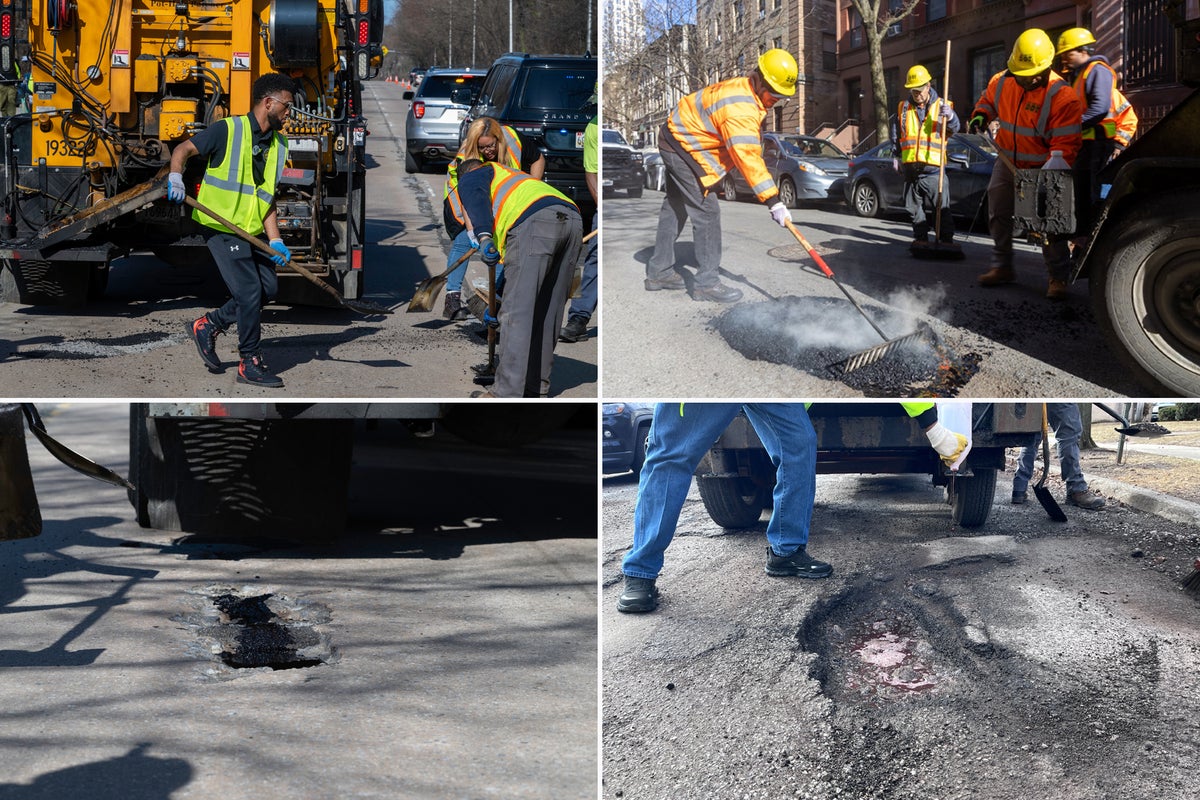
Walking onto a municipal maintenance yard at 4:00 AM feels like entering a staging area for an invasion. The smell of hot bitumen—thick, oily, and primal—hangs in the freezing air.
"Cold patch" is the primary weapon in the early spring. It’s a temporary fix, a mixture of asphalt and specialized polymers that can be shoved into a wet hole even when the ground is still freezing. It’s not a cure. It’s a bandage.
Crews work twelve-hour shifts, zig-zagging through neighborhoods based on "pothole trackers" and citizen complaints. But the math is demoralizing. For every hole they fill, the spring rains and heavy trucks create three more.
The real enemy isn't just the ice; it’s the weight. A single fully loaded semi-truck does as much damage to a road as 9,600 cars. When the sub-base of a road is saturated with meltwater, it becomes soft. When that truck rolls over the weakened surface, the pavement flexes. It bends. And then, finally, it snaps.
The Search for a Permanent Peace
Why can't we just build better roads? It’s a question every frustrated driver screams at their dashboard.
The answer is a messy mix of chemistry and coins. We have the technology to build "self-healing" asphalt that uses bacteria or capsules of oil to seal cracks as they form. We have "rubberized" asphalt made from recycled tires that handles temperature swings with much more grace.
But these solutions cost significantly more upfront. In a world of two-year election cycles and overstretched municipal budgets, spending 30% more today to save 200% over the next decade is a hard sell. We are trapped in a cycle of "reactive maintenance"—fixing the hole after it breaks the car, rather than rebuilding the road so the hole never forms.
There is a quiet revolution happening in some corners, though. Some cities are deploying AI-equipped cameras on garbage trucks. As the trucks move through their routes, the AI scans the pavement, identifying cracks before they become craters. By sealing a crack for $20 today, a city can avoid a $500 pothole repair next year. It’s a shift from being a doctor who performs surgery to being a nutritionist who prevents the heart attack.
The Ground Beneath Our Feet
The "pothole blitz" will continue until the sun finally stays out long enough to dry the deep earth. Until then, we are all participants in a high-stakes game of memory, memorizing the exact location of the dip on 5th Avenue and the jagged edge near the school zone.
We treat the road as a given. It is the background noise of our lives, a gray ribbon that exists only to be ignored. But this spring, the road is demanding our attention. It is reminding us that civilization is a continuous act of will. It is a fragile agreement between us and the elements, maintained by exhausted crews in orange vests throwing hot rocks into the dark.
Tonight, thousands of those crews will be out under the streetlights. They will be fighting a war against physics, trying to bridge the gaps we’ve allowed to open.
When you drive over that smooth patch of fresh black asphalt tomorrow morning, you aren't just driving over a repair. You are driving over a brief, hard-won victory against the entropy of the world.
The silence of a smooth road is a luxury we only notice once it’s gone.