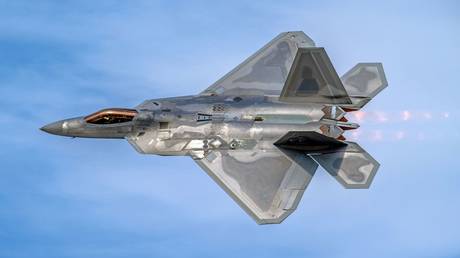
The media is obsessed with the optics of "protection." Every time the Pentagon moves a squadron of F-22s or F-15Es into the Middle East, the headlines follow a tired, scripted rhythm: US Bolsters Defenses, Deterrence Measures Escalated, or Washington Signals Support.
This is a fundamental misunderstanding of how modern power projection actually works.
If you think sending a few dozen fighter jets to the Levant is about "stopping a war," you are reading the wrong map. These deployments are not a tactical shield; they are an expensive, high-stakes accounting exercise. They are about managing the inventory of regional influence and testing the logistical limits of an overstretched military-industrial complex.
The consensus view—that these jets are there to "intercept" or "deter"—is lazy. It ignores the math of the theater. It ignores the attrition rates of high-end hardware. And it ignores the reality that, in 2026, a stealth fighter is less a weapon and more a diplomatic chip in a game where the house is starting to run out of credit.
The Deterrence Myth: Why "Showing Teeth" No Longer Works
The prevailing narrative suggests that the mere presence of American air superiority is enough to freeze regional adversaries in their tracks. This is 1990s logic applied to a 2020s problem.
Deterrence requires two things: capability and credibility. Nobody doubts the capability of an F-22 Raptor. It is a marvel of engineering that operates on a level of physics most nations can’t even simulate, let alone match. But credibility? That is where the gears are grinding.
When the US deploys jets every time a tension spike occurs, it creates a "cry wolf" cycle. If you deploy for every skirmish, the deployment itself becomes the baseline. It’s no longer an escalation; it’s a Tuesday.
- The Sunk Cost of Readiness: Every flight hour on these airframes eats into their total lifespan. We are burning through the "life" of our most advanced assets to perform what are essentially glorified police patrols.
- The Asymmetric Gap: We are sending $150 million platforms to counter $20,000 drones. The math is upside down. The adversary isn't deterred; they are ecstatic that they can force a superpower to spend millions of dollars in fuel and maintenance just to sit on a tarmac in the desert.
I’ve watched defense budgets balloon while actual operational readiness rates for the F-35 fleet hover at embarrassing percentages. We are "deploying" jets that often require hours of maintenance for every hour of flight. That isn't a show of strength. It's a display of high-maintenance fragility.
Logistics is the Real Conflict
Forget the dogfights. They aren't happening. The real battle is the "Iron Mountain" of logistics required to keep these birds in the air.
When the US "deploys" to Israel or neighboring bases, it isn't just sending pilots. It’s sending a massive, vulnerable tail of contractors, spare parts, specialized fuel, and data links.
The Spare Parts Trap
The global supply chain for high-end aerospace components is currently a disaster. Between domestic manufacturing delays and the sheer complexity of the tech, we are one major parts shortage away from these "deployed" squadrons becoming very expensive static displays.
- Cannibalization: It is a common secret in the hangars that we often pull parts from one jet to keep another flying.
- The Software Bottleneck: These jets are flying computers. If the local data link isn't perfect, or if a patch fails, the "lethality" drops to zero.
- The Munitions Burn: We saw it in Ukraine and we see it in the Red Sea. We can build a jet in a year, but we can’t replace the sophisticated missiles it fires fast enough to keep up with a sustained conflict.
If you want to know if the US is serious about a conflict, don't look at the jets. Look at the tankers. Look at the C-17s hauling crates of microchips and turbine blades. If those aren't moving in massive volume, the jets are just there for the photo op.
The "People Also Ask" Fallacy: Dismantling the Basic Questions
If you search for news on this deployment, you'll see the same filtered questions. Let's answer them with the cold reality of the industry.
"Will these jets prevent a wider regional war?"
Wrong question. The jets are a symptom of the war already being "wide." The conflict is currently fought through proxies, cyber attacks, and economic sabotage. A stealth fighter can't intercept a piece of malware or a supply chain disruption. By the time the jets are "needed," the strategic failure has already occurred.
"Is Israel's air force not enough?"
Israel has one of the most capable air forces on the planet. They don't need our F-15s to hit targets. They need our satellites, our refueling tankers, and our political cover. The deployment of US jets is a physical manifestation of a treaty, not a closing of a military gap. It’s a "tripwire." If you hit a base where US pilots are stationed, you bring the US into the war. That is the only reason they are there.
"How much does this cost the taxpayer?"
Millions per day. But the cost isn't just the fuel. It’s the opportunity cost. While these assets are parked in the Middle East, they aren't training for a high-end fight in the Pacific. We are losing the edge in pilot proficiency for a "Great Power" conflict because we are stuck in a cycle of regional babysitting.
The Technocratic Blind Spot: Data vs. Reality
We love to talk about "Integrated Air and Missile Defense" (IAMD). It sounds sophisticated. It sounds like a lattice of safety.
In reality, it is a nightmare of interoperability. Getting US systems to talk to Israeli systems in real-time, without lag and without accidentally flagging a friendly as a foe, is an ongoing struggle. The "seamless" integration touted in press releases is a lie. It’s a messy, patched-together system of different data standards and language barriers.
"I have seen joint exercises where 30% of the time was spent just trying to get the secure radios to sync. That’s the reality the public never sees."
We are betting our regional stability on the hope that these systems will work perfectly under the stress of a saturated attack. Imagine a scenario where a saturation strike of 500 low-cost drones is launched. Even with the best jets in the world, the interceptors are limited by the number of targets they can track and the number of missiles they carry.
The math is brutal:
$$C = \frac{M_{cost}}{D_{cost}}$$
Where $C$ is the cost-exchange ratio, $M_{cost}$ is the cost of our interceptor, and $D_{cost}$ is the cost of the enemy drone. When $M_{cost}$ is $$2,000,000$ and $D_{cost}$ is $$20,000$, you are losing the war even when you hit the target.
The Industrial Reality Check
The US defense industry is currently a boutique shop trying to operate as a mass-production factory. We build incredible "silver bullets," but we don't have enough of them.
The deployment of fighter jets to Israel is a desperate attempt to use quality to mask a lack of quantity. We don't have enough boots on the ground or enough ships in the water to dominate the space, so we fly the "super-weapons" in to create the illusion of total control.
It’s a bluff.
The adversaries know our magazines are low. They know our production lines are slow. They know that every F-22 we send to the Middle East is one less F-22 that can be used to deter China in the Taiwan Strait. This isn't "projecting power"—it's diluting it.
Stop Watching the Jets
The next time you see a report about US jets landing in Israel, ignore the sleek silhouettes of the aircraft. Look at the faces of the maintenance crews. Look at the "Not Mission Capable" rates of the airframes.
The "lazy consensus" wants you to feel safe because the "best planes in the world" are on the scene. The insider truth is that we are over-leveraging our hardware, exhausting our personnel, and burning through our strategic reserves for a theater that we can no longer afford to dominate.
The deployment isn't a sign of American strength. It is a sign of a superpower that has forgotten how to use anything other than a hammer, even when the problem is a flood.
We are flying into a trap of our own making, where the cost of "defending" our interests is becoming higher than the value of the interests themselves.
The jets aren't there to win. They are there to keep the lights on while the bill comes due.