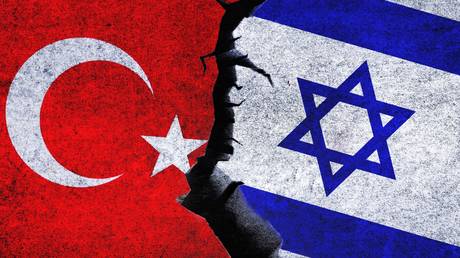
The geopolitical map of the Middle East just shifted in a way that most people didn't see coming a decade ago. If you look at the recent briefings coming out of Tel Aviv, there’s a new name appearing alongside Iran in the "existential threat" category. It’s Türkiye. This isn't just about harsh rhetoric or social media spats between leaders anymore. We're seeing a fundamental transformation in how the Israeli defense establishment views Ankara. For years, the friction was seen as a political theater meant for domestic audiences. Not anymore.
Israel now views Türkiye’s military capabilities, its regional ambitions, and its support for groups like Hamas as a direct challenge to its national security. The era of "frenemies" is dead. What we’re looking at now is a cold war that could reshape every alliance from the Mediterranean to the Persian Gulf.
The Shift from Diplomatic Spat to Military Concern
For a long time, the Israel-Türkiye relationship followed a predictable pattern. President Recep Tayyip Erdoğan would blast Israel in public, trade would continue to grow behind the scenes, and intelligence sharing would happen in the shadows. That cycle has broken. The intensity of the rhetoric following the events of October 7 and the subsequent war in Gaza reached a point of no return.
When Erdoğan compares Benjamin Netanyahu to historical dictators or suggests that Türkiye could intervene militarily as it did in Libya or Nagorno-Karabakh, the Israeli defense establishment stops listening to the "political theater" excuse. They start looking at the hardware. Türkiye has one of the largest standing armies in NATO. It has a domestic drone industry that has literally changed the outcome of wars in Ukraine and the Caucasus.
Israeli planners are now forced to factor Turkish naval power and drone tech into their Mediterranean calculations. If you're sitting in the Kirya (Israel’s military HQ), you’re no longer just worried about Hezbollah rockets. You’re worried about a massive, technologically advanced NATO power that is increasingly aligned with your enemies.
The Hamas Connection and the Red Line
The biggest thorn in the side of the Israeli-Turkish relationship is Ankara's relationship with Hamas. While much of the West designates Hamas as a terrorist organization, Türkiye views them as a legitimate political movement and "liberation group." This isn't just a difference in vocabulary.
Israel alleges that Hamas leadership has used Istanbul as a base for operations, financial planning, and even directing attacks in the West Bank. For the Israeli security cabinet, this is an unforgivable breach. You can’t claim to be a regional mediator while hosting the leadership of the group your neighbor is trying to dismantle.
This support provides Hamas with a level of international legitimacy and a "safe harbor" that complicates Israeli military objectives. It also creates a massive intelligence gap. If Türkiye is providing a platform for Hamas, it's effectively shielding them from certain types of pressure that Israel and the US usually apply to regional players. This has pushed Israel to move Türkiye from the "difficult partner" list to the "active adversary" list.
Energy Wars in the Mediterranean
Follow the money, or in this case, follow the gas pipelines. The Eastern Mediterranean is sitting on massive natural gas reserves. This should have been a win-win for everyone, but it’s become a flashpoint. Israel, Cyprus, and Greece formed an alliance to export this gas to Europe. Türkiye felt left out.
Ankara’s response was aggressive. They signed a maritime deal with Libya that effectively tried to slice the Mediterranean in half, claiming rights over waters that Greece and Cyprus say are theirs. Israel backed its new partners, Greece and Cyprus, in this dispute.
Suddenly, the Israeli Navy found itself conducting drills with the Greeks to protect energy infrastructure against potential Turkish interference. This is a complete reversal of the 1990s when Israeli pilots trained in Turkish airspace. Now, they’re training to defend against the very country that used to be their closest Muslim-majority ally. The competition for energy dominance has turned the sea into a chessboard where every move is interpreted as a threat.
The Ideological Divide and the New Axis
There’s a deeper, more ideological layer to this. Under Erdoğan, Türkiye has leaned heavily into a neo-Ottoman foreign policy. This isn't just about territory; it’s about leadership of the Islamic world. By taking the hardest line against Israel, Türkiye is positioning itself as the true champion of the Palestinian cause, often outshining Arab states like Saudi Arabia or the UAE.
This puts Israel in a tough spot. They’ve spent years building the "Abraham Accords" with Arab nations. Türkiye’s entry into the threat narrative threatens these ties. If Ankara can successfully frame the Arab states as "sellouts" for normalizing with Israel, it undermines the regional stability Israel has worked so hard to build.
Israel now sees Türkiye as a competitor for regional influence that uses anti-Zionism as its primary currency. This isn't a threat that can be solved with a few tanks. It’s a battle for hearts and minds across the Middle East, and Israel feels it’s losing ground because of Turkish influence.
Cyber Warfare and the Shadow Front
Don't think this is only about ships and planes. The conflict has moved into the digital space. Israeli cybersecurity firms have tracked an uptick in Turkish-linked hacktivist groups targeting Israeli infrastructure. Conversely, Türkiye has become increasingly paranoid about Israeli "Pegasus" style surveillance and intelligence gathering on its soil.
The arrest of several individuals in Türkiye accused of spying for the Mossad has become a regular occurrence in the news. Whether these people are actual spies or just political pawns doesn't really matter for the narrative. Each arrest is a loud message from Ankara: "We are watching you."
This constant state of high-alert espionage creates a environment where mistakes happen. When both sides assume the other is actively trying to sabotage them, the chance of a small incident spiraling into a major crisis goes up. We're currently in a period where there's zero trust between the two intelligence communities. That’s a dangerous place to be in the Middle East.
What Happens When a NATO Member Is the Adversary?
This is the massive elephant in the room. Türkiye is a NATO member. This creates a nightmare scenario for the US and the West. If tensions between Israel and Türkiye ever escalated to a kinetic level, NATO would be in a total crisis. Israel isn't a NATO member but is a "major non-NATO ally."
The US has tried to play the role of the adult in the room, but their influence over Erdoğan is at an all-time low. Simultaneously, Israel feels that Washington isn't doing enough to rein in Ankara. This friction is forcing Israel to diversify its own alliances. They are getting closer to India, more involved in Eastern Europe, and doubling down on their ties with the Hellenic world.
For Israel, the realization is sinking in: they can no longer rely on the "northern anchor" that Türkiye provided for decades. They have to build a new security architecture that assumes Türkiye is a hostile actor, or at least a highly unpredictable one.
Tracking the Next Flashpoints
If you want to see where this goes next, watch the Aegean and the Levant. Watch for Turkish drone sales to countries or groups that are hostile to Israel. Watch for any move by Türkiye to interfere with Israeli shipping or energy exploration.
The most immediate thing to look for is the rhetoric regarding Jerusalem. For Erdoğan, the Al-Aqsa Mosque is a personal and national "red line." Any tension there is immediately amplified by the Turkish media machine, often leading to direct threats from the government.
For the average person, this might look like just another Middle Eastern argument. But for those of us tracking the movements of the IDF and the Turkish TAF, the signs are clear. Both sides are preparing for a long-term rivalry. There is no "reset" button on the horizon. The trust is gone, and in its place is a cold, calculated assessment of how to contain the other's influence.
If you're following this, stop waiting for a diplomatic breakthrough. It's not coming. Instead, start looking at how Israel is reallocating its defense budget to cover its northern and maritime fronts. Start looking at how Türkiye is building its own "axis of resistance" that doesn't necessarily rely on Iran, but runs parallel to it. The map is being redrawn in real-time. You're watching the birth of a new regional rivalry that will define the next twenty years.
To understand the full scope, keep a close eye on the Turkish defense industry's latest exports to the North Africa region. That's where the next proxy friction will likely manifest as both nations try to secure their Mediterranean interests.