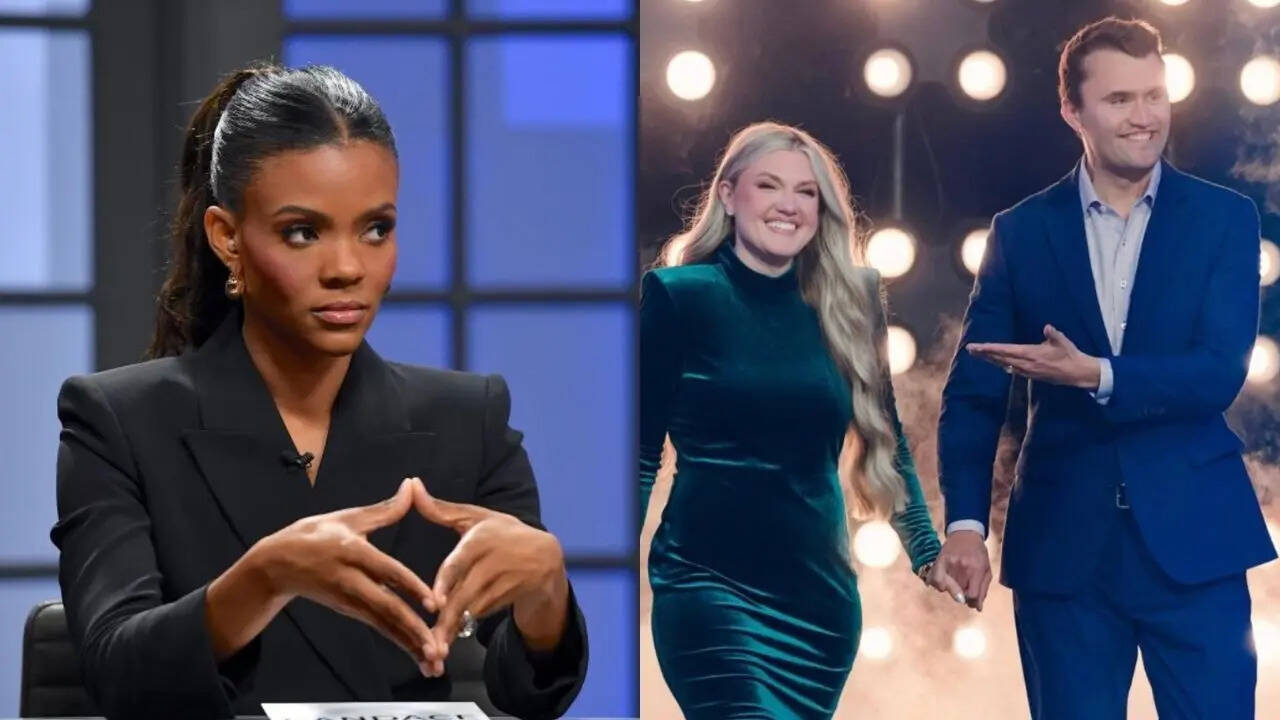
The internet is currently vibrating with the frantic energy of a thousand keyboard detectives. The catalyst? Erika Kirk—widow of the late, legendary tech pioneer and libertarian icon—quietly backed out of a high-profile appearance with JD Vance. Right on cue, the professional provocateurs like Candace Owens have swooped in to manufacture a "mystery." They are leaning hard into the "what is the establishment hiding?" trope, feeding the beast of clickbait cynicism.
They are all wrong. They are missing the forest because they are too busy staring at the shadows of the trees.
This isn’t about a cover-up. It’s not about secret pressures from the RNC or deep-state intimidation. If you actually understand the brutal mechanics of high-stakes political branding, the reality is far more mundane and, frankly, far more calculating. This was a clinical extraction. It was a cold, hard assessment of risk versus reward where the risk finally outweighed the optics.
The Myth of the "Forced" Withdrawal
The lazy consensus suggests that Kirk was "silenced" because she might say something off-script or because the JD Vance campaign feared her proximity to certain explosive topics. This narrative assumes the campaign is incompetent. It’s the opposite.
When a high-profile figure like Erika Kirk pulls out of an event, it’s rarely because someone "got to her." It’s because the legal and PR advisors in the room finally looked at the "earned media" trajectory and realized they were about to lose control of the narrative.
In politics, visibility is currency until it becomes a liability. For months, the association between the Vance camp and the legacy of a man whose death remains a flashpoint for anti-establishment sentiment was a net positive. It signaled "outsider" status. But as the spotlight intensified, the liability shifted.
The moment the conversation moved from "honoring a legacy" to "answering for the theories surrounding that legacy," the utility of the appearance evaporated. The campaign didn’t cancel Erika Kirk; they likely looked at the data and realized that five minutes of stage time would result in five weeks of defending themselves against questions they have no interest in answering.
Why Candace Owens Is Getting It Wrong
Candace Owens is a master of the "Just Asking Questions" (JAQing) off technique. It’s a brilliant business model, but it’s a terrible way to analyze political strategy. By framing Kirk’s withdrawal as a sign of something "nefarious," she’s doing exactly what the campaign wanted to avoid: keeping the focus on the conspiracy rather than the policy.
The "contrarian" take here isn’t that there is a secret; it’s that the strategy of silence is the most effective weapon in a politician's arsenal. Owens posits that the public deserves "answers." The harsh truth? The public doesn’t want answers; they want validation for their existing biases.
I have watched political operations spend millions to keep a single "inconvenient" person off a stage. It’s not because that person has a smoking gun. It’s because that person represents an unpredictable variable. In a race as tight as the current one, unpredictable variables are the enemy of progress.
The Logistics of Political Distancing
Imagine a scenario where Kirk takes the stage. Every reporter in the room isn't looking for a quote about JD Vance’s tax plan. They are looking for a reaction shot. They are looking for a slip of the tongue. They are looking for a way to link the Vice Presidential candidate to the more fringe elements of the tech-libertarian world.
By removing the physical presence of the person at the center of the storm, the campaign kills the visual. No photo-op, no problem.
- Risk Mitigation: Kirk's presence was a lightning rod.
- Narrative Hijacking: The "assassination" discourse was drowning out the campaign’s core message.
- Focus Shifting: Moving her off the schedule forces the media to find a new target, or better yet, go back to talking about the economy.
This isn’t "the establishment" winning. This is the establishment being efficient.
The Fallacy of the "Truth Seeker"
We love the idea of the lone widow standing up to the machine. It’s a cinematic trope. But Erika Kirk is a sophisticated individual with her own brand and her own interests to protect. The assumption that she is a pawn being moved across a board ignores her agency.
What if she just didn't want to be the centerpiece of a circus? What if she realized that being a prop for a political campaign—regardless of whether she supports the candidate—was cheapening the very legacy she is trying to preserve?
The "conspiracy" crowd hates this explanation because it’s boring. It doesn't involve secret meetings in smoke-filled rooms. It involves a woman deciding that her peace of mind and her husband’s memory are worth more than a twenty-minute speech in a gymnasium.
The Cost of the "Contrarian" Brand
We are living in an era where being "contrarian" has become its own kind of conformity. If the mainstream says "A," the professional contrarian must say "B." But true insight comes from looking at "C."
The "C" here is that the Vance campaign is attempting to professionalize a movement that has historically been chaotic. To do that, you have to cut the ties that bind you to the more volatile elements of your base. You have to trade the "shock value" of a controversial guest for the stability of a controlled message.
It is a classic bait-and-switch. You use the firebrands to get the attention, and then you quietly usher them out the back door when it’s time to actually govern (or win over the suburbs).
The Industry Reality
I have been in the rooms where these decisions are made. It’s never a grand debate about morality. It’s a spreadsheet.
- Metric A: Potential votes gained from the appearance.
- Metric B: Potential news cycles spent explaining the appearance.
- Result: If B > A, the guest "has a scheduling conflict."
It’s that simple. To frame it as anything else is to engage in a fantasy. The "new questions" being raised are distractions. They are noise designed to keep you clicking, keep you outraged, and keep you from seeing the machine for what it is: a giant, cold-blooded machine designed to minimize friction.
The machine didn't break because Erika Kirk didn't show up. The machine worked exactly as intended. It identified a point of friction and smoothed it over before the heat could start a fire.
Stop looking for the hidden hand. Look at the open one. It’s the one waving you away from the distraction while it moves the pieces that actually matter. The tragedy of modern political commentary is that everyone wants to be Sherlock Holmes, but nobody wants to be the guy reading the balance sheet.
The real story isn't why she left. The real story is that you were ever expected to believe she’d stay.