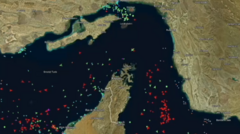
The Strait of Hormuz functions not merely as a waterway but as a high-pressure valve for the global energy economy, where 21% of the world’s petroleum liquids consumption must pass through a navigational channel only two miles wide in each direction. Visualizing changes in ship flow via timelapse imagery reveals the underlying tension between sovereign territorial claims and the United Nations Convention on the Law of the Sea (UNCLOS). To understand the shifting patterns of these vessels, one must deconstruct the interplay of the Traffic Separation Scheme (TSS), the escalation of "shadow fleet" activity, and the physical constraints of bathymetry that dictate every course correction.
The Triad of Operational Constraints
Maritime movement in the Strait is governed by three non-negotiable variables. When any of these variables are altered by geopolitical friction or technical failure, the ripple effects manifest as immediate spikes in Worldscale shipping rates and insurance premiums.
1. The Geometry of the Traffic Separation Scheme
Vessels do not move freely through the Strait. They follow a strictly defined Traffic Separation Scheme managed by the Sultanate of Oman. The inbound and outbound lanes are each two miles wide, separated by a two-mile wide buffer zone.
The efficiency of this corridor depends on the "Innocent Passage" doctrine. Under UNCLOS, ships have the right to pass through territorial waters as long as they are not prejudicial to the peace, good order, or security of the coastal state. However, Iran, which has signed but not ratified UNCLOS, asserts a more restrictive "Transit Passage" interpretation. This legal friction creates a perpetual "gray zone" in maritime law where any vessel can be legally challenged based on perceived environmental or safety violations.
2. Bathymetric Limitations and Draft Requirements
The deepest part of the Strait lies within Omani waters, north of the Musandam Peninsula. Deep-draft Ultra Large Crude Carriers (ULCCs) and Very Large Crude Carriers (VLCCs) are restricted to these specific channels. A VLCC fully laden with 2 million barrels of oil requires a draft of approximately 20 to 22 meters. This physical reality limits the ability of ships to "divert" or "scatter" if the primary lanes are obstructed. A timelapse of these vessels shows a rigid, almost rail-like movement pattern because the margin for error against the seabed is razor-thin.
3. The Risk-Adjusted Cost Function
Shipping companies operate on a cost function where:
$$Total Cost = Operating Expense + (Risk Premium \times Asset Value) + Opportunity Cost of Delay$$
As regional tensions increase, the "Risk Premium" variable—specifically War Risk Insurance—can increase by 1000% in a single week. This forces a behavioral change in ship flow: vessels may loiter in the Gulf of Oman, waiting for daylight or for a naval escort, creating a visible "pulse" or "stutter" in timelapse data compared to a steady-state flow.
Tactical Deviations and the Rise of the Shadow Fleet
Standard AIS (Automatic Identification System) data often fails to capture the full scope of movement in the Strait due to the proliferation of "dark" or "shadow" fleet tactics. These are vessels engaged in the transport of sanctioned oil that actively manipulate their reported positions.
AIS Spoofing and "Dark" Transits
A sophisticated analyst identifies three distinct signatures of non-standard flow:
- Gap Filling: A ship disappears from AIS near the island of Qeshm and reappears 48 hours later near the Fujairah anchorage.
- Location Spoofing: The AIS signal reports a vessel is stationary at an anchorage, while satellite imagery confirms it is mid-transit or engaged in a Ship-to-Ship (STS) transfer.
- ID Switching: The use of "ghost" MMSI (Maritime Mobile Service Identity) numbers to mask the true origin of a cargo.
These maneuvers create "noise" in the timelapse. Where a legitimate tanker follows the TSS with surgical precision, a sanctioned vessel may hug the Iranian coastline, utilizing the complex archipelago of the Hormozgan Province to obscure its silhouette from terrestrial observers. This deviation is not just a pathfinding choice; it is a calculated evasion of the global financial monitoring system.
The Logistics of Choke Point Saturation
The Strait's capacity is not infinite. It is limited by the "Entry-Exit Throughput" of the ports it serves, such as Ras Tanura, Jubail, and Das Island.
The Bottleneck Effect
When a security incident occurs—such as a mine threat or a vessel seizure—the flow doesn't just slow down; it clusters. This creates a "shock wave" in maritime logistics.
- The Upstream Cluster: Ships trapped inside the Persian Gulf cannot exit, leading to a saturation of anchorages in Kuwait and Qatar.
- The Downstream Cluster: Incoming ships wait outside the Strait in the Gulf of Oman, creating a target-rich environment for non-state actors or rapid-response forces.
This clustering is a lead indicator of supply chain volatility. A 24-hour closure of the Strait necessitates a minimum of 72 hours of "recovery flow" to clear the resulting backlog, assuming no further interruptions.
Intelligence Frameworks for Monitoring Flow
To outpace the "vague observations" of standard news reporting, analysts must employ a multi-layered verification framework. Relying on a single data source like AIS is a fundamental strategic error.
Synthetic Aperture Radar (SAR) vs. Optical Imagery
Optical satellite imagery is limited by cloud cover and darkness. SAR, however, can "see" through weather and detect the metallic hulls of ships regardless of whether their AIS is active. By overlaying SAR data onto AIS feeds, we can identify "Dark Targets"—vessels that are physically present but electronically invisible.
Radio Frequency (RF) Geolocation
Advanced monitoring involves detecting the RF emissions from a ship’s navigation radar or satellite communications. If a vessel turns off its AIS but keeps its radar on for safety, RF geolocation can pinpoint its coordinates. This reveals the "hidden flow" of the Strait, showing that the actual density of traffic is often 10-15% higher than what is reported on public tracking sites.
The Economic Implications of Flow Variance
The Strait of Hormuz is the primary artery for the Asian energy market. Specifically, China, India, Japan, and South Korea receive the vast majority of their crude imports through this 21-mile gap.
The Asian Premium and Transit Elasticity
Because these economies have limited "swing" suppliers that do not require Hormuz transit, their demand is relatively inelastic. If the flow in the Strait becomes erratic, these nations must dip into Strategic Petroleum Reserves (SPR). The "Change in Flow" observed in a timelapse is therefore a real-time visualization of the depletion of global energy buffers.
The second-order effect is the impact on the liquefied natural gas (LNG) market. Qatar, the world's leading LNG exporter, is entirely dependent on the Strait. Unlike crude oil, which can be stored relatively easily, LNG is a "just-in-time" commodity. A disruption in the rhythmic flow of LNG carriers is more catastrophic for European and Asian power grids than a temporary dip in crude supply, as it directly impacts immediate electricity generation capacity.
Strategic Realities of the Musandam Peninsula
The Omani enclave of Musandam sits as the "sentinel" of the Strait. The deep-water channels are closest to this rugged coastline. Any analysis of ship flow must account for the tactical positioning of Omani and coalition naval assets in these fjords. The presence of high-speed interceptors and coastal surveillance batteries acts as a "dampening field" that stabilizes flow by providing a credible deterrent against low-level harassment.
However, the proximity of the TSS to the Iranian islands of Abu Musa and the Greater and Lesser Tunbs creates a "Tactical Overlap." These islands serve as forward operating bases for the IRGC (Islamic Revolutionary Guard Corps) Navy. The "change in flow" often seen in timelapses—where ships suddenly veer further south within their designated lane—is a direct response to Iranian naval exercises or the presence of fast-attack craft near these islands.
Infrastructure as a Counter-Strategy
Regional powers are actively attempting to "bypass" the Strait's physics through pipeline infrastructure.
- The Abu Dhabi Crude Oil Pipeline (ADCOP): Capable of moving 1.5 million barrels per day to the port of Fujairah, bypassing the Strait entirely.
- The East-West Pipeline (Petroline) in Saudi Arabia: Can transport up to 5 million barrels per day to the Red Sea.
While these pipes exist, they cannot currently handle the total volume required by global markets. They serve as "redundancy systems" rather than replacements. The Strait remains the definitive bottleneck. The timelapse of ships is, in essence, a heartbeat monitor for a global system that has no viable bypass for 70% of its current throughput.
Tactical Response for Stakeholders
The primary strategic move for entities reliant on Hormuz flow is the transition from "Reactive Monitoring" to "Predictive Modeling."
- Integrate Non-Traditional Signal Intelligence: Do not rely on AIS. Use SAR and RF geolocation to track the "shadow fleet" as their movement patterns often precede wider market disruptions.
- Quantify the "Sovereign Risk Buffer": Adjust inventory levels based on the velocity of flow through the TSS. A decrease in average transit speed of 2 knots over a 48-hour period typically signals an increase in regional friction before it hits the news cycle.
- Hedge Against Port Saturation: In the event of a flow stutter, the first bottleneck is not the Strait itself, but the bunkering and anchorage capacity at Fujairah. Securing priority access or alternative bunkering in the Gulf of Aden provides a 48-to-72-hour operational advantage.
The flow of ships through the Strait of Hormuz is a data-rich environment that reveals the true state of global stability. Watching the lines move is not enough; one must understand the friction that makes them bend.