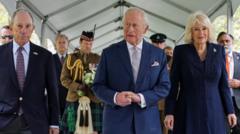
The sight of King Charles III and Queen Camilla standing in silence at Ground Zero isn't just another royal tour stop. It’s a heavy moment. They stood where the Twin Towers once pierced the New York skyline, now replaced by the infinite pull of the reflecting pools. Laying flowers at the 9/11 Memorial is a ritual of grief, but when the British monarch does it, the gesture carries the weight of a "special relationship" that has been tested by fire, steel, and twenty-five years of shared history.
You see plenty of dignitaries visit this site. They walk the perimeter, look at the bronze names, and move on to the next meeting. But this visit feels different because of the specific, intertwined history between the UK and New York City. The British suffered the greatest loss of any foreign nation on September 11, 2001. Sixty-seven British souls never went home that day. When the King lays a wreath, he isn't just representing a government; he’s acknowledging a shared scar that hasn't fully faded.
The Quiet Power of the White Rose
The choice of flowers usually flies under the radar for most people, but it’s intentional. It’s a language. The Queen often favors rosemary for remembrance, but at the 9/11 Memorial, the symbolism is often about purity and the stubbornness of memory. They didn't just toss a bouquet and leave. They spent time at the "Survivor Tree," a Callery pear tree that was pulled from the rubble, charred and broken, only to bloom again years later.
It’s a gritty metaphor for New York itself. The King’s interest in the tree isn't surprising given his lifelong obsession with botany and urban resilience. He sees the environment as something that mirrors human struggle. To him, that tree isn't just a plant. It’s a witness. It survived the collapse, the heat, and the toxic dust, much like the families who still gather here every September.
Why British Royalty Stays Connected to Ground Zero
Critics might say royal visits are just theater. They're wrong. These visits serve as a diplomatic anchor. Think back to 2010 when the late Queen Elizabeth II visited the site for the first time. She didn't just see a construction site; she saw the British Garden at Hanover Square. That garden remains a living tribute to the UK citizens lost in the attacks.
The current King and Queen are following a blueprint of steady, quiet support. They understand that for New Yorkers, 9/11 isn't a history book chapter. It's a "where were you" moment that defines their adulthood. When the King touches the cold bronze of the memorial, he’s validating that collective trauma. He's saying the world hasn't moved on as much as it thinks it has.
The Logistics of a Royal Memorial Visit
Planning a visit like this is a nightmare of security and protocol. You don't just "show up" at the 9/11 Memorial. Every inch of the plaza is swept. The Secret Service and the NYPD work with the Metropolitan Police to create a bubble. Yet, within that bubble, the King and Queen try to find moments of genuine human connection.
- They meet with first responders who still carry the physical toll of that day.
- They talk to family members who manage the foundations built in the names of the dead.
- They acknowledge the museum staff who curate the artifacts of a nightmare.
I’ve watched these events unfold before. The most striking thing is usually the silence. New York is the loudest city on the planet. Horns, shouting, subways, construction—it never stops. But when the royal party approaches the pools, the sound of the falling water takes over. It’s a natural white noise that drowns out the city. It forces you to be present.
What Most People Miss About the 9/11 Memorial Architecture
If you haven't been there, you might think it’s just two big holes in the ground. It’s actually a masterpiece of engineering designed by Michael Arad and Peter Walker. The footprints of the towers are the exact dimensions of the originals. The water drops thirty feet into a square basin and then drops again into a smaller, central void.
You can't see the bottom of that second void. It’s designed to represent "Reflecting Absence." It’s the idea that the loss is bottomless. When the King and Queen look over the edge, they're looking into a literal representation of what was stolen from thousands of families.
Names Arranged by Meaning
One detail the King was reportedly briefed on is the "meaningful adjacency" of the names. The names on the bronze parapets aren't in alphabetical order. That would be too cold. Instead, they’re grouped by who these people were to each other.
- Work colleagues are together.
- Friends who ate lunch every day are together.
- Flight crews are grouped by their specific planes.
This allows a family member to see their loved one surrounded by the people they actually knew, rather than a list of strangers. It’s these small, human touches that the King often focuses on during his tours. He’s a fan of architecture that serves the human spirit, not just the ego of the builder.
Moving Beyond the Grief
While the flower laying is the headline, the broader purpose of this New York visit is to talk about the future. The King is pushing his "Terra Carta" initiative, which focuses on nature and the private sector. It’s an interesting contrast. On one hand, he’s honoring a site of massive destruction. On the other, he’s at the UN or meeting with CEOs to talk about preventing the destruction of the planet.
It’s about legacy. The 9/11 Memorial is a legacy of what happens when the worst of humanity takes control. The King’s environmental work is a legacy of what happens if we don't take control of our own impact. He’s trying to bridge that gap.
The Impact on New York Tourism
Let’s be real for a second. A royal visit is a massive PR win for the city. After the years of struggle following the global pandemic, New York needs the world to see that it’s vibrant, safe, and still the center of the world. Seeing the British King at one of the most visited sites in the country sends a message to international travelers. It says New York is open. It says the history here matters.
If you’re planning to visit the memorial yourself, don't just rush through.
- Go early. The morning light hits the water in a way that makes the names easier to read.
- Look for the white roses. On their birthdays, the memorial staff places a single white rose in the engraved name of the victim. It’s a stunning, simple tribute.
- Visit the museum. It’s heavy, and it’s emotional, but you can't understand the memorial without seeing the "Slurry Wall" or the "Last Column."
The King and Queen didn't stay for hours. They couldn't. But their presence acts as a permanent record. It reminds us that while the towers are gone, the alliance they forged remains. Grief doesn't disappear; it just changes shape. By laying those flowers, the royals helped New Yorkers hold that shape for just a little bit longer.
Take a walk down to Liberty Street. Stand by the South Pool. Read a few names. You don't need a crown to appreciate the silence there.