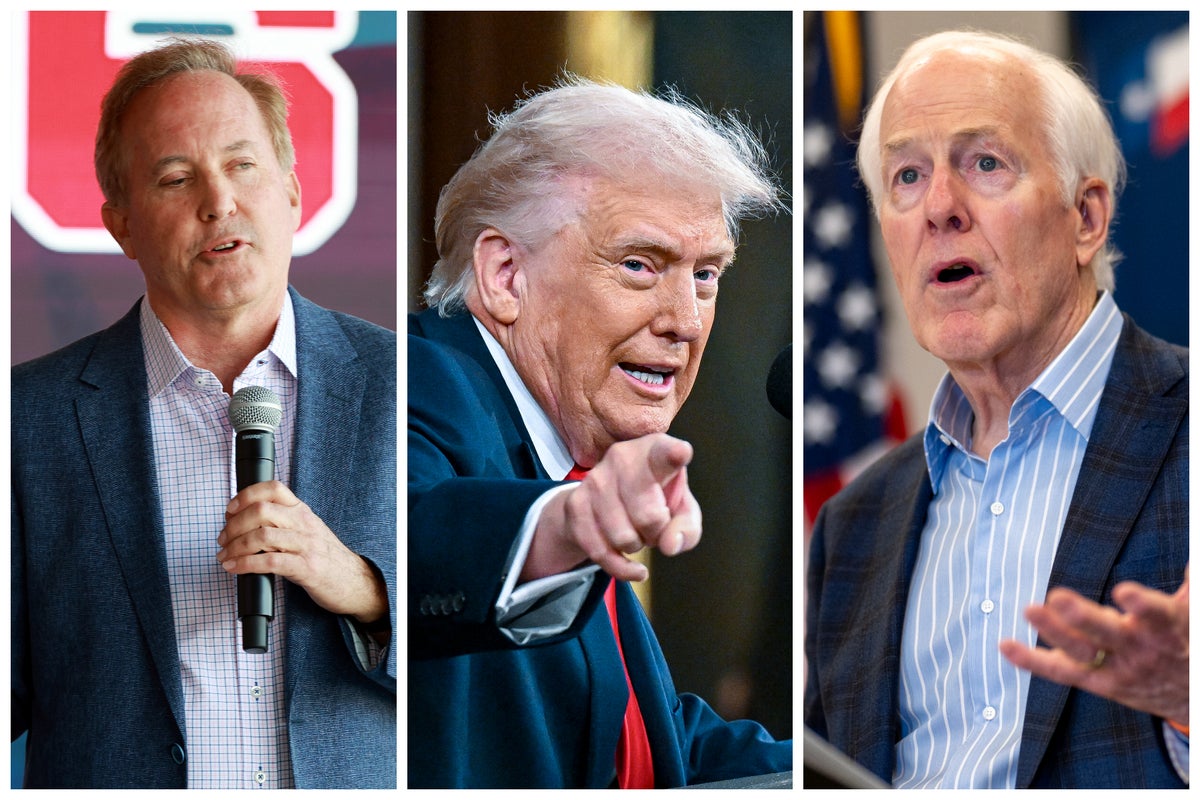
The air in a Texas campaign office during a runoff doesn't smell like victory. It smells like stale coffee, industrial carpet cleaner, and the sharp, metallic tang of desperation. When a primary race stretches past the first Tuesday in March and into the sweltering uncertainty of a runoff, the bravado of the stump speech begins to crack.
The money is drying up. The volunteers are exhausted. The polling numbers are flickering like a dying fluorescent bulb. In this high-stakes corner of the Texas Senate race, two candidates are currently locked in a room that is rapidly losing oxygen. They are staring at each other, waiting for a single phone call from a private club in Palm Beach that can either provide a life-support tank or suck the remaining air out of the room entirely.
Donald Trump is currently holding the oxygen mask.
He knows it. They know it. And the voters, sensing the impending drama, are leaning in to watch the spectacle. But this isn't just about a political endorsement. It is a study in the brutal efficiency of modern power and the psychological toll of waiting for a king to speak.
The Math of the Modern Coliseum
To understand why this specific runoff feels like a slow-motion car crash, you have to look at the mechanics of the Texas GOP. It is no longer enough to be conservative. You have to be the right kind of conservative, and that definition is currently being rewritten in real-time by a single man’s social media feed.
When Trump announced that he would be making an endorsement in this "nail-biting" runoff, he didn't just offer a helping hand. He issued a warning. He suggested that one of the participants should "drop out" before he makes his move. It was a classic gambit: the offer of a graceful exit before the public execution of a political career.
Consider the candidate sitting in second place. Let's call him the Challenger. He has spent a lifetime building a resume, raising millions, and shaking hands at every Rotary Club from El Paso to Texarkana. He believes he is the best man for the job. But now, he faces a terrifying geometric reality. If the endorsement goes to his opponent, his path to victory doesn't just narrow—it vanishes. The donors will stop calling. The "grassroots" will pivot on a dime. The very ground he stands on will turn to vapor.
The Challenger is currently weighing the cost of his pride against the reality of a scorched-earth defeat. If he drops out now, he keeps his dignity and perhaps stays in the good graces of the party elite. If he stays and loses the "Trump Lottery," he becomes a pariah.
The Weight of the Golden Ticket
Political endorsements used to be a collection of local favors. A sheriff here, a popular governor there, a handful of labor unions or industry groups. It was a mosaic. Today, in the Republican ecosystem, it is a Monolith.
When Trump weighs in, it isn't a nudge; it's a gravitational shift. For the candidate who receives the nod, it is the ultimate validation. It acts as a universal solvent for every past mistake, every awkward quote, and every policy flip-flop. Suddenly, they are the "chosen one."
But there is a hidden cost to the Golden Ticket.
The candidate who wins the endorsement often finds themselves indebted in ways that transcend policy. They aren't just representing their district anymore; they are a proxy for a movement. Their identity is subsumed. They become a data point in a larger narrative about Trump’s "win-loss record."
The pressure is immense. Imagine the phone calls behind closed doors. The frantic attempts by campaign managers to "get to" the inner circle at Mar-a-Lago. The vetting process isn't about legislative records or constitutional theory. It’s about loyalty. It’s about who defended the former President more loudly on television last Tuesday at 2:00 PM.
It is a grueling, undignified scramble for a blessing that can be revoked as quickly as it was granted.
The Spectator’s Hunger
While the candidates sweat, the electorate watches with a mixture of fascination and fatigue. Texas is a state that prides itself on independence, yet its political future is being dictated by the whims of a man in Florida. There is a deep irony there, one that isn't lost on the veteran political consultants who remember a time when Texas primaries were won on the back of a pickup truck, not on Truth Social.
The "nail-biting" nature of this runoff speaks to a fractured base. Half the voters want a fighter. The other half want a winner. They are waiting for the endorsement to tell them who is which.
This creates a vacuum. In the absence of a clear signal, the campaign turns into a war of attrition. Negative ads flood the airwaves, each candidate trying to out-MAGA the other before the final judgment is rendered. It is expensive, it is ugly, and it leaves the eventual winner bruised and battered just in time for the general election.
Trump’s suggestion that someone "drop out" is a move to bypass this messiness. He wants a clean win. He doesn't want to back a horse that might limp across the finish line. He wants a champion who can be held up as a symbol of his enduring influence.
The Loneliness of the Long-Distance Candidate
Politics is often described as a blood sport, but we rarely talk about the psychological isolation of the runoff period. You are trapped in a loop. You are saying the same lines to the same groups of people, hoping that this time, the "Endorsement Gods" are listening.
You see your opponent at the same forums. You look into their eyes and see the same exhaustion, the same fear of being the one who gets "the tweet" that ends it all. It’s a shared trauma.
The human element of this story isn't found in the polling data. It’s found in the quiet moments at 1:00 AM when a candidate looks at their bank account and wonders if it’s time to listen to the warning. It’s found in the campaign staffer who has to decide whether to book more TV time or start looking for a new job.
There is no "holistic" way to describe this. It is a meat grinder.
The stakes are invisible but absolute. A seat in the United States Senate is a platform for life. It is the power to shape laws, confirm judges, and direct the flow of billions of dollars. But to get there, you must first survive the runoff. You must endure the public humiliation of being told you should quit. You must wait for the Kingmaker to point his finger.
The Final Calculation
As the clock ticks toward the endorsement, the tension in Texas is palpable. The "drop out" warning wasn't just a suggestion; it was a stress test. Who has the stomach for the fight? Who is willing to risk a public drubbing for a slim chance at an upset?
The reality of the 2026 political landscape is that the "nail-biter" will eventually end, not with a roar, but with a notification on a smartphone. One candidate will be elevated to the status of a hero. The other will be relegated to a footnote, a cautionary tale about what happens when you ignore the warning from the top of the mountain.
The candidates continue to pace their respective stages. They continue to shake the hands. But their eyes are always shifting toward the wings, waiting for the shadow to move, waiting for the voice that will tell them if their journey continues or if the road has finally run out.
A campaign is a house of cards built on the hope that the wind won't blow from the wrong direction. In Texas, the wind is currently picking up speed, and everyone is holding their breath. Would you like me to look into the specific polling numbers for the individual candidates involved in this race to see who has the most to lose?