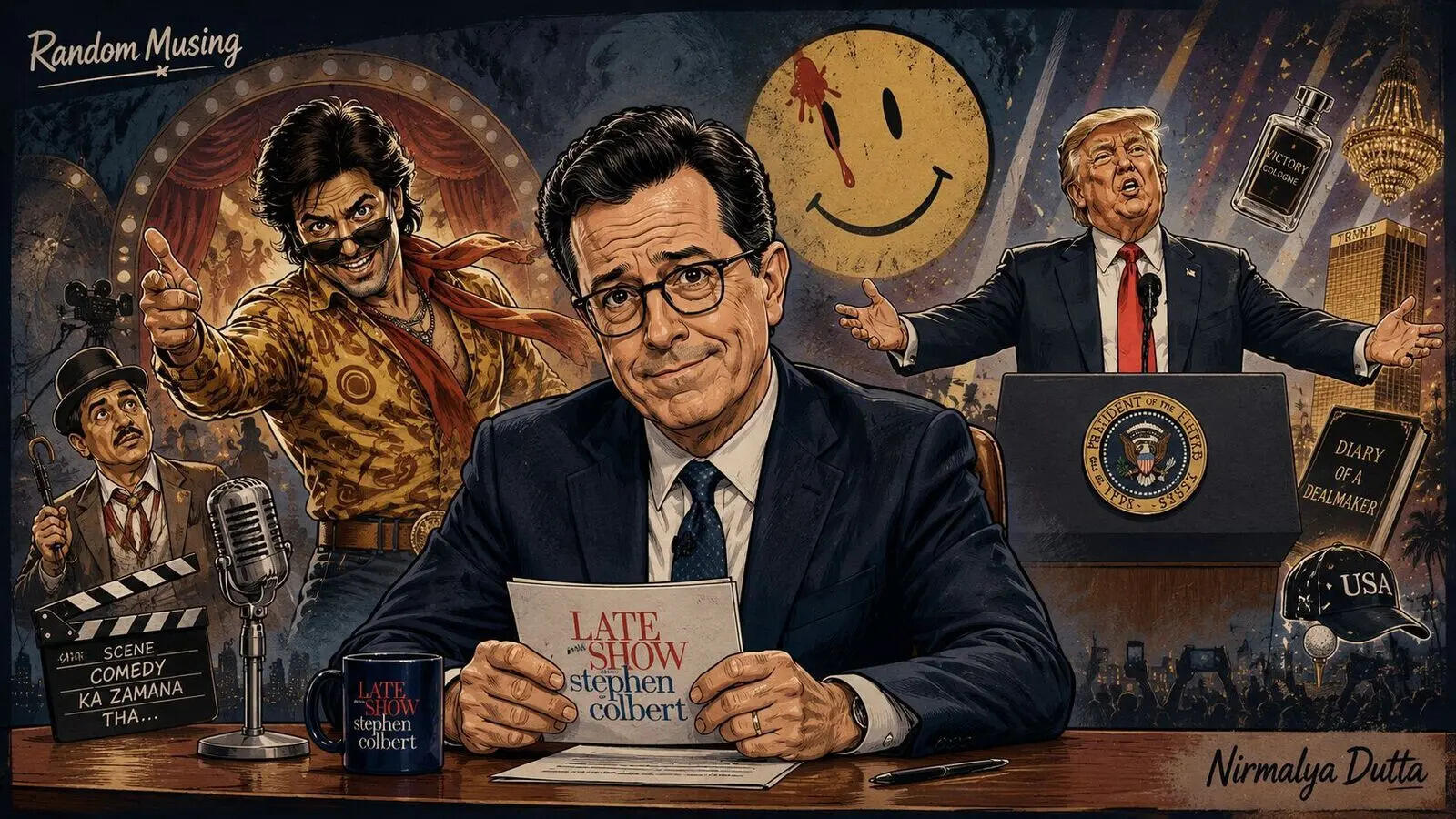
The lazy media consensus is weeping over the demise of late-night television, framing the impending cancellation of CBS's The Late Show with Stephen Colbert as a tragic casualty of political polarization. Pundits are rushing to copy-paste a comforting narrative: Colbert was a fearless truth-teller, his corporate masters panicked, and Donald Trump was simply too funny, too absurd, and too dominant for a traditional comedian to survive.
To make this intellectual bankruptcy sound profound, commentators are grasping at bizarre international analogies. They claim American late night is suffering from a "Bollywood twist." The thesis? Just as 1970s Bollywood megastars like Amitabh Bachchan swallowed up the livelihoods of specialized comedic sidekicks by doing their own jokes, political figures like Trump have usurped the comedian's role, leaving Colbert obsolete.
It is a beautiful, cinematic excuse. It is also completely wrong.
Donald Trump did not kill late-night comedy by being "too funny." Corporate media executives did not pull the plug out of political cowardice. Stephen Colbert and his contemporaries systematically destroyed their own industry through a decade of creative laziness, audience alienation, and an utter refusal to adapt to modern media economics. Blaming the politician at the podium for the death of late night is like Blockbuster blaming Netflix for making movies too convenient. It completely misdiagnoses the rot at the core of the business.
The Myth of the Omnipotent Politician
The core premise of the Bollywood analogy relies on a fundamental misunderstanding of both Indian cinema history and American television economics. When Amitabh Bachchan or Govinda absorbed comedy into their leading-man personas, they did so to maximize the entertainment value of a three-hour mass-market film. They expanded the scope of their performance to capture a broader audience.
What did American late-night hosts do when Trump entered the political arena? They did the exact opposite. They shrunk their world.
Instead of expanding their appeal to capture the mass network audiences that once fueled Johnny Carson, Jay Leno, and David Letterman, modern hosts turned their shows into hyper-partisan echo chambers. They stopped writing jokes and started delivering moral sermons. They chose to validate the anxieties of a highly specific, coastal demographic rather than entertain a nation.
Consider the data from the golden era of late night. When Jay Leno dominated the ratings in the 1990s and 2000s, his monologue jokes targeted everyone equally. Bill Clinton's scandals were eviscerated with the same frequency and bite as George W. Bush's verbal gaffes. Leno understood a basic rule of broadcast television: half of your audience votes one way, half votes the other, and your job is to keep 100% of them laughing.
By contrast, Colbert’s Late Show became a de facto media arm of a single political party. During the run-up to recent elections, the show abandoned any pretense of comedic distance. Colbert didn't write satire about Kamala Harris; he fawned over her, treating political figures like pop culture icons rather than public servants who deserve skepticism.
When a comedian spends years demanding total ideological conformity from their audience, they don't get to act surprised when half the country turns off the television. The missing audience isn't a mystery. They didn't leave because Trump was funnier; they left because Colbert stopped trying to be funny to them.
The Financial Collapse the Network Pundits Ignore
The narrative that Colbert is a victim of a "missing comedian" phenomenon conveniently masks the brutal, unsexy reality of television finance. Late-night television is dying because its economic foundation has entirely collapsed, not because a political figure hijacked the cultural spotlight.
For decades, the late-night business model relied on three highly lucrative pillars:
- Massive, locked-in linear television audiences who stayed tuned in after local news.
- High-premium advertising slots sold on the guarantee of those massive live audiences.
- Cheap production costs relative to prime-time dramas or comedies.
Every single one of those pillars is gone.
I have watched network executives pour tens of millions of dollars into expensive New York and Los Angeles studio productions, pretending that YouTube clips and social media virality could offset the loss of traditional broadcast ad revenue. It is a mathematical impossibility. A million views on a YouTube clip monetization revenue share yields a fraction of the cash a single 30-second broadcast commercial spot brought in during the early 2000s.
Colbert might have spent years sitting at the top of the late-night ratings mountain, but that mountain is now a molehill. A top-rated late-night show today pulls in a fraction of the viewers that a mid-tier cable broadcast generated twenty years ago. The overhead costs of producing five nights of television a week with top-tier writers, live bands, and massive production staffs are completely unsustainable in a fragmented media landscape.
The networks aren't canceling these shows because they are afraid of political blowback. They are canceling them because the ledger is bleeding red ink.
The Creative Laziness of Clapping over Laughing
The ultimate failure of modern late night is creative, not political. The industry traded the pursuit of laughter for the pursuit of "clapplause"—that distinct phenomenon where an audience claps not because a joke was clever, but because they agree with the political sentiment expressed.
Satire requires distance. It requires the willingness to look at power, regardless of the party affiliation attached to it, and expose its absurdities. When late-night hosts decided that their primary societal function was to defend democratic institutions rather than mock human folly, they ceased to be comedians. They became high-priced institutionalists.
This created a massive creative vacuum. While network hosts were busy delivering solemn, self-serious opening monologues that read like opinion columns, an entire generation of raw, unvarnished, and genuinely subversive comedic talent migrated online. Podcasters, independent streamers, and social media creators didn't need a multi-million dollar CBS studio or a permission slip from a network standards department. They just needed a microphone and a point of view.
The contrarian truth that the industry refuses to admit is that the internet didn't steal late night's audience; late night handed its audience over on a silver platter. By sanitizing the comedy, predictable punchlines became the norm, and viewers looking for actual edge looked elsewhere.
Stop blaming the political climate. Stop blaming foreign cinematic trends. Stop pretending that a change in the political winds will somehow resurrect the cultural relevance of the 11:30 PM talk show. Late-night television died of self-inflicted wounds, brought on by an industry that forgot its first and most important rule: make them laugh, or get off the stage.