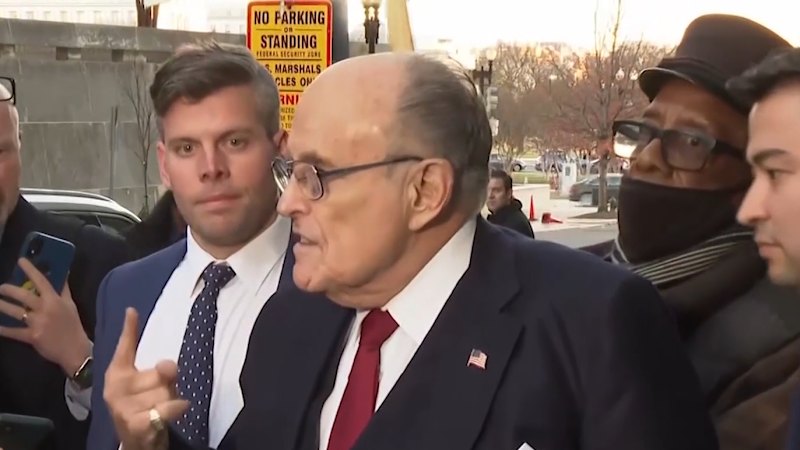
The hospital corridor has a specific, sterile hum. It is the sound of expensive machinery fighting a silent war against the inevitable. Somewhere behind those double doors, tucked away from the flashbulbs and the courtroom sketches, a man who once personified the jagged, unyielding soul of New York City is now struggling for his next breath.
Rudy Giuliani was never a quiet man. He was a creature of noise, of sirens, of the frantic, rhythmic tapping of news tickers. To see him now, or rather, to sit with the reality of his silence, is to witness the final, fraying thread of an era that redefined the American political identity. This isn't just about a politician in a hospital bed. This is about the collapse of a titan whose shadow once stretched from Ground Zero to the highest offices in the land, and the agonizing human toll of a legacy built on the edge of a knife.
He was the "Prosecutor." He was the "Hero." Lately, he has been the "Defendant." But today, he is simply a patient.
The Weight of the Concrete Jungle
Think back to the early nineties. New York was a different beast then. It was grittier, louder, and arguably more dangerous. Into this fray stepped a man who treated the city like a crime scene that needed to be scrubbed with steel wool. Giuliani didn't just govern; he enforced. He was the face of "Broken Windows" policing, a philosophy that suggested if you fix the small things—the graffiti, the turnstile jumping—the big things would fall into line.
It worked, or so the numbers said. But the cost was a hardening of the city’s heart.
I remember walking through Midtown during those peak years. There was a sense of order, yes, but it was an order maintained by a frown. Giuliani thrived in that tension. He was a man who needed an enemy to stay sharp. Whether it was the mob, the squeegee men, or the political elites who looked down on his pugnacious Brooklyn roots, he was always at war.
Then came the morning that changed everything.
The smoke. The ash. The smell of burning jet fuel and pulverized history. On September 11, 2001, the world watched a city break, but they saw one man walking through the dust. He wasn't hiding in a bunker. He was on the ground, his face caked in the gray soot of the towers, his voice a steadying rasp in a moment of pure, unadulterated terror. For a few months, he wasn't a Republican or a Democrat. He was America’s Mayor.
That version of Rudy Giuliani—the one who stood as a pillar while the world shook—is the one people are mourning today, even while he’s still technically here.
The Pivot into the Storm
Power is a strange drug. It doesn't just change how others see you; it warps how you see the horizon. After the height of 2001, the path for Giuliani seemed destined for the White House. But the very traits that made him a wartime leader—his stubbornness, his refusal to back down, his "with me or against me" mentality—became his greatest liabilities in a peaceful world.
When he hitched his wagon to Donald Trump, it wasn't just a political alliance. It was a fusion of two similar spirits: two New Yorkers who felt the world had moved on from them and were determined to drag it back by the throat.
The images from the last few years are a jarring contrast to the hero in the soot. There was the press conference at Four Seasons Total Landscaping, sandwiched between a crematorium and an adult book store. There was the dark streaks of hair dye running down his face during a heated briefing about election fraud. There was the mounting pile of lawsuits, the disbarment, and the staggering $148 million judgment for defaming election workers.
It is easy to mock these moments. The internet certainly did. But if you look past the memes, there is something deeply Shakespearean about it. This is the story of a man who spent his life building a reputation for law and order, only to spend his final years being dismantled by the very legal system he once chaired.
The stakes aren't just political anymore. They are existential. When a man loses his livelihood, his license to practice the craft he loves, and his standing in the city that bore him, what is left? The physical body often follows where the spirit has already gone.
The Invisible Stakes in the Room
Medical reports are often cold. They speak of "stable conditions" or "critical monitoring." They don't speak of the stress of a thousand headlines.
Consider the sheer physical toll of the last five years on an octogenarian. Constant travel, hours of testimony, the relentless pressure of being under the federal microscope. The human heart is a pump, but it is also a barometer. It can only take so much pressure before the valves begin to fail.
In that hospital room, the legal battles don't matter. The bankruptcy filings don't matter. The "Stop the Steal" rallies are a distant echo. There is only the rhythm of the ventilator and the quiet presence of those few who haven't left his side. It is a lonely place to be for a man who used to command the attention of millions.
We often talk about public figures as if they are characters in a play, forgetting that they bleed, they age, and they eventually break. Giuliani’s current fight for life is a reminder that no one is immune to the gravity of time. Not the prosecutors. Not the mayors. Not even the icons.
The Echo of the Gavel
The tragedy of the Giuliani story is that there is no consensus on how it ends. For some, he will always be the man who saved New York. For others, he is the man who tried to break American democracy. There is no middle ground, because Rudy Giuliani never allowed for one.
He lived his life in the superlatives.
But as he lies in that bed, the complexity of his life shouldn't be flattened into a soundbite. He represents a specific American archetype: the brawler who stayed in the ring three rounds too long. We see it in sports, we see it in business, and we see it most vividly in politics. The inability to exit the stage while the lights are still bright.
The nurses move with quiet efficiency. They check the monitors. They adjust the IV drip. They are indifferent to the history of the man in the bed; their duty is to the pulse, not the pedigree. This is the ultimate equalizer. In the sterile light of the ICU, the "Mayor of the World" is just another soul navigating the twilight.
The city outside continues to roar. The subways screech, the tourists crowd Times Square, and a new generation of New Yorkers walks streets that he helped pave, often without knowing his name. The world is indifferent to our individual endings.
There is a profound, heavy irony in the fact that a man who spent his career arguing, shouting, and demanding to be heard is now in a place where words have no power. The bullhorn is silent. The courtrooms are quiet. There is only the long, slow shadows of the afternoon sun moving across the floor, and the steady, fragile ticking of a clock that doesn't care about legacies.
He is fighting. Of course he is. It is the only thing he has ever known how to do. But for the first time in eighty years, the opponent isn't a mob boss or a political rival. It is the silence. And the silence always, eventually, wins.