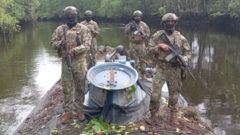
Ecuadorian soldiers just stumbled upon a massive secret hidden deep within a nature reserve. It wasn't a rare species or a lost ruin. It was a 35-meter-long "narco-sub" capable of carrying 15 tonnes of drugs. This discovery in the Cuyabeno Wildlife Reserve near the Colombian border proves that drug cartels aren't just getting bolder. They're becoming sophisticated naval engineers.
You might think of these vessels as cramped, leaky DIY projects. Some are. But this one? This is a different beast entirely. We're talking about a semi-submersible built with enough precision to evade modern radar while sitting right under the nose of environmental protectors. When the armed forces shared images of the find, the scale of the thing was hard to wrap your head around. It’s roughly the length of three school buses parked end-to-end.
Why the Cuyabeno Discovery Matters for Regional Security
The location is the first red flag. The Cuyabeno Wildlife Reserve is a protected area of immense biodiversity. It’s supposed to be a sanctuary. Instead, traffickers used the dense canopy and winding waterways as a natural hangar. It makes sense from a tactical standpoint. The thick vegetation provides perfect overhead cover against satellite surveillance and aerial patrols.
The Ecuadorian army didn't find this by accident during a casual hike. This was a targeted operation based on intelligence. It highlights a massive shift in the region's power dynamics. Ecuador used to be a "transit country." Now, it's a primary logistical hub for global cartels. Finding a vessel of this size suggests that the infrastructure for mass-scale smuggling is deeply embedded in the local geography.
The Engineering Behind a 15 Tonne Payload
Building a 35-meter vessel in the middle of a jungle is a logistical nightmare. Think about it. You need fiberglass, engines, fuel systems, and electronics. You need a workforce that stays quiet. You need a way to launch the thing without being seen.
Most narco-subs are actually "low-profile vessels" (LPVs). They don't fully submerge like a military submarine. Instead, they sit just below the waterline. This makes them incredibly hard to spot with the naked eye or standard radar because they don't leave a significant wake. This specific craft was designed for long-distance transport. With a 15-tonne capacity, it wasn't built for a short hop. It was built to move a fortune across the ocean.
The Growing Sophistication of Transnational Crime
This isn't just about drugs. It's about the erosion of sovereignty. When a criminal organization can build a naval-grade transport in a national park, it shows a blatant disregard for borders and law enforcement. The Ecuadorean military has been under immense pressure lately. The country has seen a spike in violence linked to these very groups.
These vessels are often "disposable." The crews sail them to a rendezvous point, offload the cargo, and then scuttle the sub to hide the evidence. However, a 35-meter craft represents a significant investment. You don't build something that large unless you’re confident in your route. It suggests that for every one the army finds, several others likely made it through.
Why Technology Struggles to Keep Up
You’d think with all our drones and sensors, we’d see these coming. We don't. The hulls are usually made of wood and fiberglass. These materials don't reflect radar waves well. Since the engines are often cooled by the surrounding water, the heat signature is minimal. They're essentially "stealth" boats for the underworld.
The sheer size of the Amazonian basin and its coastal fringes provides infinite hiding spots. The Ecuadorean troops had to move through difficult terrain just to reach the site. It’s a game of cat and mouse where the mouse has a multi-million dollar budget and no rules to follow.
What This Means for the Future of Interdiction
The find in the nature reserve should be a wake-up call. It's not enough to patrol the open seas. The fight has moved into the most remote parts of the rainforest. This requires a different kind of warfare. It’s about jungle rot, humping gear through swamps, and acting on whispers from informants.
If you’re tracking how global trade works, you have to look at these "dark" logistics. They mirror legitimate shipping in everything but the legality. The same principles apply. Scale, efficiency, and risk management. Only here, the "risk" is a life sentence or a firefight in the mud.
Moving forward, expect more cooperation between Ecuador and international intelligence agencies. They’ll need better ground-penetrating sensors and more boots on the ground in protected areas. The cartels have turned a paradise into a shipyard. Taking it back won't be easy.
Keep an eye on regional military reports from the Esmeraldas and Sucumbíos provinces. These areas are the front lines. If you want to understand the true scale of the global drug trade, stop looking at street busts and start looking at the naval architecture emerging from the jungle. The 35-meter monster in Cuyabeno is just the tip of the iceberg.