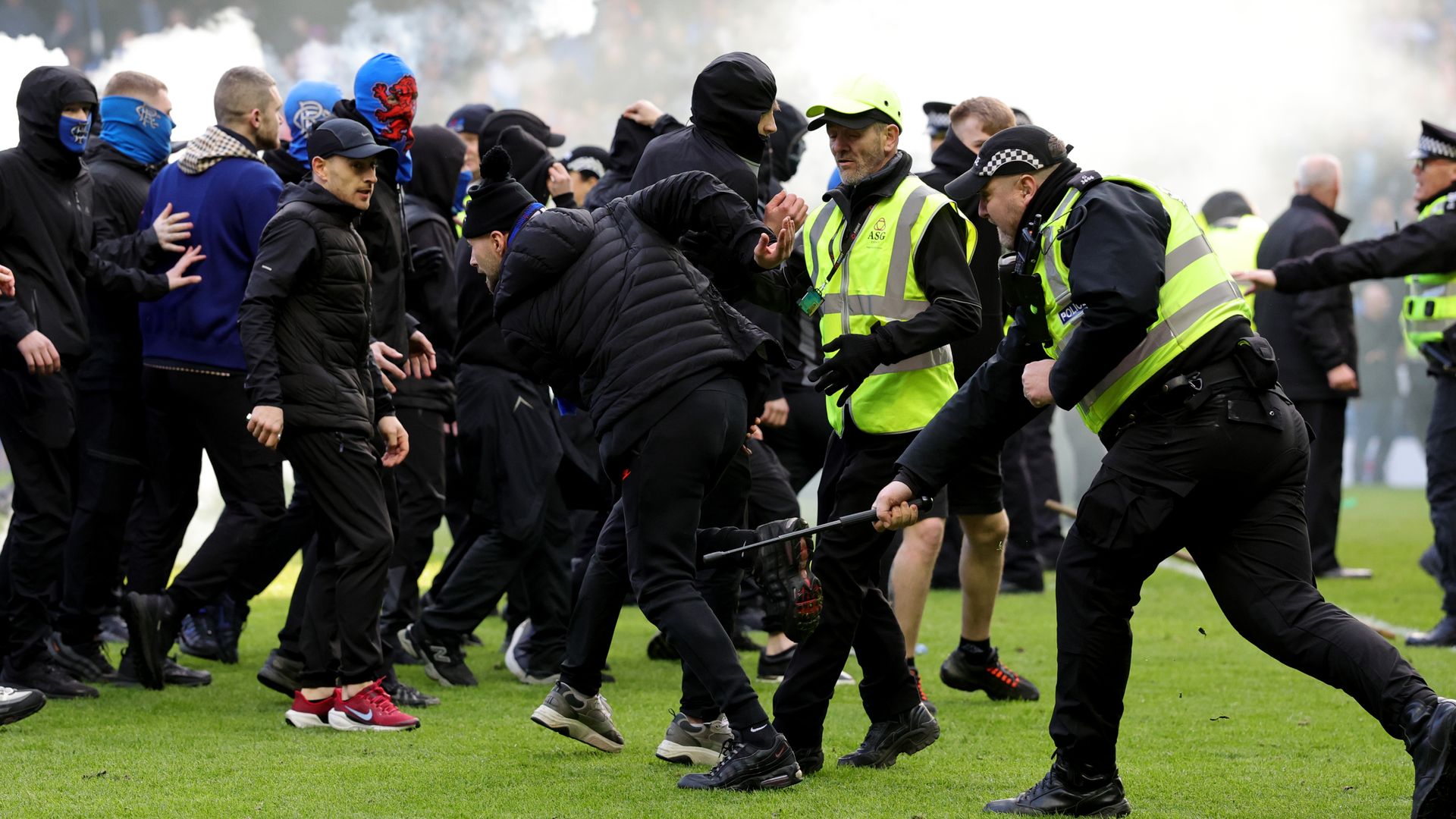
The physical breach of the pitch perimeter during the Glasgow Derby represents a total breakdown of the containment-to-stewardship ratio, where the emotional volatility of a cup tie intersects with outdated architectural and human-resource constraints. To view these events as mere "fan clashes" is to ignore the systematic failure of the tiered security model designed to separate two distinct, high-energy populations. The reality of modern stadium management is that once the psychological barrier of the touchline is compromised, the logistical capacity to restore order scales inversely with the number of participants.
The Kinematics of Crowd Rupture
The transition from a seated or standing spectator to a pitch invader follows a specific sequence of behavioral triggers. In high-tension fixtures like the Rangers and Celtic rivalry, this is rarely a spontaneous individual act; it is a collective failure of the "buffer zone" mechanics.
The Pressure Gradient
Stadiums are designed to manage fluid dynamics. When a goal is scored or a match ends, the emotional pressure within a specific section (the away end or the home core) spikes. If the physical infrastructure—typically a combination of LED boards, low-level walling, and a line of stewards—cannot exert an equal and opposite force, a rupture occurs.
- The Lead Actor Effect: A single individual breaches the line, testing the response time of the nearest steward.
- The Response Lag: A delay of even four seconds in neutralising the first invader signals to the wider group that the perimeter is "soft."
- Mass Incursion: The secondary wave follows, moving from individual trespass to collective occupation.
The Three Pillars of Containment Failure
Evaluating the security collapse during the cup tie requires an audit of three specific operational pillars. Each pillar represents a layer of defense that, when stripped back, reveals why the pitch became a site of confrontation.
1. Spatial Geometry and Architectural Vulnerability
Older stadiums, or those not retrofitted with modern "steep-profile" stands, suffer from a proximity issue. The distance between the front row and the pitch is often less than three meters. This distance is insufficient for a steward to transition from a monitoring posture to an interception posture. When fans are concentrated in lower tiers, the gravitational momentum of a surge makes it physically impossible for a thin line of human security to hold the perimeter.
2. The Human Capital Deficit
Security at high-risk sporting events relies on a mix of police (SPS - Specialist Public Order) and private stewarding. The logic of the "soft-coat" steward is to provide guidance, not physical combat. However, in the Rangers-Celtic context, the expectation placed on low-wage, often under-trained private contractors to stand between two opposing sets of hostile fans is a fundamental miscalculation of risk.
The cost function of stadium security often prioritizes volume over specialized training. When an incursion begins, these stewards often retreat—not out of cowardice, but because their operational remit does not include the use of force required to repel a mob. This creates a vacuum that only the police can fill, but the mobilization of police onto the turf takes time that the situation does not afford.
3. The Tribal Proximity Paradox
Most global derbies utilize a "sterile zone" or a "no-man's-land" between opposing fans. When fans from both sides breach the pitch simultaneously, the stadium's internal geography is erased. The pitch, which is supposed to be a neutral, protected workspace for athletes, becomes an unregulated commons. The "clash" is the inevitable result of two opposing groups occupying a space that lacks the physical barriers present in the stands.
Quantifying the Escalation: The Inter-Group Feedback Loop
The violence seen on the pitch is a manifestation of an unmanaged feedback loop. In social identity theory, the presence of an out-group (the rival fans) reinforces the cohesion of the in-group.
- Provocation phase: Fans from Team A enter the pitch to celebrate.
- Perceived threat phase: Fans from Team B interpret this as a territorial violation or a direct taunt.
- Counter-incursion: Team B enters the pitch to "defend" their perceived honor or to physically confront the intruders.
This loop accelerates because the pitch offers no "escape valves." Unlike a street where crowds can disperse into side alleys, a pitch is a closed rectangle. Once both sets of fans are on the grass, they are funneled toward each other by the very stands that were meant to keep them apart.
The Failure of Deterrence Theory
Legislative measures, such as the Offensive Behaviour at Football and Threatening Communications (Scotland) Act (even in its post-repeal landscape) and various banning orders, operate on the principle of rational choice. The theory suggests that a fan will not enter the pitch because the cost (a lifetime ban and a criminal record) outweighs the benefit (a moment of adrenaline).
However, during a cup tie, the "benefit" is filtered through a collective emotional lens. The individual ceases to calculate personal risk and instead acts as part of a biological mass. Deterrence fails at the exact moment it is most needed. The legal system focuses on post-match prosecution, which does nothing to solve the immediate tactical problem of a pitch full of combatants.
Structural Recommendations for High-Risk Fixtures
To prevent the recurrence of these scenes, the operational framework must move from reactive policing to proactive spatial engineering.
Hardened Perimeter Deployment
The use of temporary, retractable high-tension netting or increased "moat" depths in the corners where away fans are situated can disrupt the "Lead Actor Effect." If the first five people cannot physically get over the barrier, the mass incursion never starts.
The Rapid Response Core
Rather than a uniform line of stewards around the entire pitch, security should be deployed in "heavy-response pods" at the four corners and the mid-points of the touchline. These pods should consist of personnel equipped and trained for physical containment, allowing the "soft-coat" stewards to focus on crowd guidance rather than riot control.
Real-Time Video Analytics for Pre-Incursion Detection
CCTV systems should be integrated with software that monitors the "lean" of the crowd. A crowd about to surge exhibits different physical characteristics (density, forward tilt, and rhythmic pulsing) than a crowd that is merely cheering. Detecting these markers 60 seconds before a breach allows for the pre-emptive deployment of police to the specific point of failure.
The focus must shift from punishing the "clash" to eliminating the environment that permits the "meeting." Until the pitch is treated as a high-security industrial zone rather than a public park, the Glasgow Derby will continue to provide the physical space for these breakdowns to occur. The objective is the total removal of the "choice" to invade, replacing it with a physical impossibility.
The next logical step for governing bodies is a mandatory audit of stadium "break-out" points, specifically targeting the zones where rival fan seating is closest to the playing surface, and enforcing a minimum 1:5 ratio of specialized police to private stewards in those sectors.