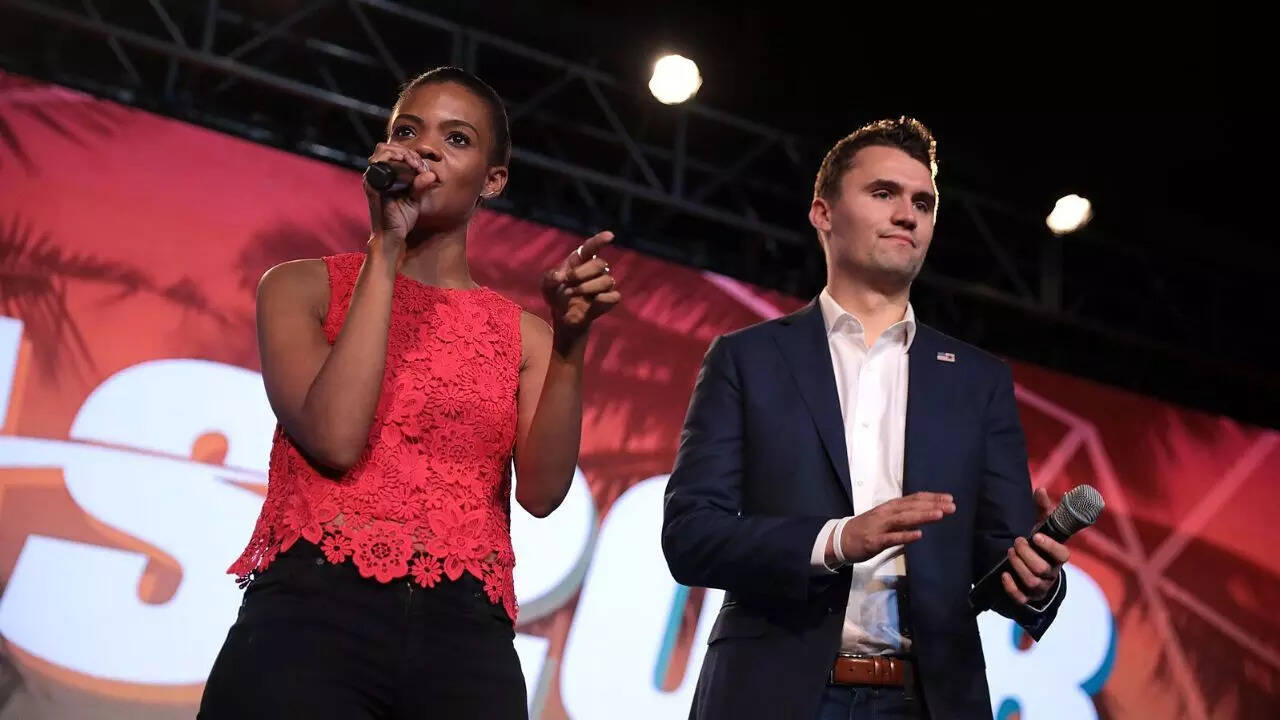
The intersection of high-frequency political media and physical security risks creates a volatile feedback loop where visibility functions as both a primary asset and a terminal liability. When Candace Owens publicly suggested that Charlie Kirk—founder of Turning Point USA—feared assassination, she was not merely making a personal observation; she was identifying a critical threshold in the Political Exposure Life Cycle. This lifecycle dictates that as an individual's ideological utility increases, the cost of their personal security scales non-linearly, eventually reaching a point where the threat of kinetic violence becomes a fixed variable in operational planning.
Analysis of the situation involving Kirk, Owens, and the subsequent commentary by figures like Pastor Jack Hibbs reveals a broader structural shift in how political movements manage internal and external volatility. To understand the gravity of these claims, one must dissect the three specific pressure points that transform a media personality into a high-value target. Recently making headlines in related news: The Kinetic Deficit Dynamics of Pakistan Afghanistan Cross Border Conflict.
The Triad of Target Acquisition
Threat escalation against political figures does not happen in a vacuum. It is driven by the convergence of three distinct factors that increase the probability of a security breach.
- Ideological Polarization Density: Kirk’s position at the forefront of youth-oriented conservatism places him at the center of cultural friction points. When a figurehead becomes synonymous with a specific movement, they cease to be viewed as individuals and instead become symbols. This symbolic status is the primary driver for "lone wolf" actors seeking maximum impact with minimal resources.
- Platform Reach vs. Physical Vulnerability: The Turning Point USA model relies on high-visibility campus tours and public rallies. This creates a strategic contradiction: the mission requires accessibility, but the risk profile demands isolation.
- Internal Fractionalization: Public comments by peers—such as Owens—serve to validate the severity of external threats. By acknowledging the fear of assassination, the peer group inadvertently confirms the target's high value to adversaries, potentially emboldening those monitoring the discourse for signs of weakness or disruption.
The Security-Communication Paradox
The revelation that Kirk may have "feared for his life" highlights the Security-Communication Paradox. In this framework, any public admission of a security threat serves a dual and conflicting purpose. Additional information regarding the matter are detailed by The Guardian.
On one hand, it functions as a deterrence signal. By making the threat public, the organization notifies potential attackers that security measures are heightened and that the target is hyper-aware. This increases the "work factor" for an adversary, who must now account for more sophisticated countermeasures.
On the other hand, it acts as a validation signal. For a radicalized actor, the knowledge that their target is afraid is a metric of success. It proves that their presence or the threat of their ideology is causing tangible psychological and operational strain on the opposition. Owens’ commentary, while perhaps intended as a defense of Kirk or an explanation for his behavior, effectively lowered the information barrier regarding his internal state and security posture.
Institutional Response and the Role of the Clergy
The involvement of Pastor Jack Hibbs adds a layer of moral and communal authority to the narrative, shifting it from a standard political dispute to a matter of existential significance. Hibbs’ confirmation—stating that Kirk was "going to get killed"—utilizes a different form of social capital.
In high-stakes political environments, the clergy often serve as "crisis buffers." They provide a non-political veneer to security concerns, framing the threat not as a consequence of political strategy, but as a battle between broader moral forces. This framing is essential for maintaining the morale of the donor base and the activist core. If a leader is perceived as retreating out of fear, it creates a leadership vacuum. However, if the retreat or heightened security is framed as a "necessary preservation of a vital voice," the movement remains intact.
The Cost Function of High-Stakes Activism
Maintaining a figure like Charlie Kirk in the public eye involves an escalating cost function. Security expenditures for Tier 1 political influencers are no longer a discretionary budget line; they are a prerequisite for existence.
- Fixed Costs: These include 24/7 personal protection details (PPD), secure transport, and residential hardening.
- Variable Costs: These fluctuate based on the geographic location of events. A campus visit in a hostile district requires a 3x to 5x increase in security personnel compared to a friendly venue.
- Opportunity Costs: The most significant hidden cost is the loss of spontaneous engagement. When a leader must be moved through "sterile corridors" and shielded from the public, the very authenticity that built their brand begins to erode.
The "assassination fear" cited by Owens indicates that Kirk’s organization likely hit a "Risk Ceiling"—the point where the projected cost of a potential incident outweighs the projected benefit of a specific public appearance. When this ceiling is hit, the organization must pivot.
Logical Fallacies in Public Threat Assessment
Public discourse often fails to distinguish between "credible threats" and "existential anxiety." In the case of high-profile conservatives, the media environment often creates a feedback loop that obscures the actual data.
- The Availability Heuristic: Because high-profile attacks are widely publicized, the public (and the targets themselves) may overestimate the probability of an attack occurring at any given moment.
- Confirmation Bias: If Kirk or his team believe they are under imminent threat, every minor security anomaly—a protester getting too close, a suspicious package, an anonymous email—is interpreted as part of a coordinated assassination plot.
- Strategic Leakage: In some instances, the discussion of threats is a calculated move to garner sympathy or to justify the silencing of critics. However, the specificity of the claims made by Owens and Hibbs suggests an actual operational shift rather than a mere PR maneuver.
Structural Fragility of Decentralized Movements
The friction between Owens and Kirk reveals a deeper structural fragility within modern conservative media. Unlike traditional political parties, which have clear hierarchies and internal dispute-resolution mechanisms, the current "influencer-led" model is inherently unstable.
When one influencer (Owens) begins to speculate on the psychological state or physical safety of another (Kirk), it creates a "contagion of instability." If the movement’s leaders are perceived as being in a state of constant, life-threatening fear, the rank-and-file members may experience a "chilling effect," reducing their own willingness to engage in public activism. This is the ultimate goal of political intimidation: not necessarily the elimination of the leader, but the paralysis of the followers.
The Predictive Model of Targeted Violence
Security professionals use the "Pathway to Violence" model to assess how an individual moves from grievance to an actual attack. The stages include:
- Grievance: The perception of a wrong that must be righted.
- Ideation: Deciding that violence is the only solution.
- Research and Planning: Identifying the target’s movements and security gaps.
- Preparation: Acquiring tools and conducting rehearsals.
- Breach: The actual attempt.
By publicly discussing Kirk’s fear, Owens and Hibbs have effectively signaled that Kirk is currently in the "Research and Planning" crosshairs of his adversaries. This moves the situation from a theoretical risk to an active operational concern.
Strategic Pivot for Turning Point USA
Turning Point USA must now decide whether to lean into the "martyrdom" narrative or to professionalize their security communications to stop the information leakage. The current strategy of allowing third parties to discuss assassination threats is counterproductive. It creates a perception of chaos.
To regain control of the narrative and the physical environment, the organization must implement a Protocol of Silence regarding specific security concerns. This involves:
- Centralizing Security Communications: Only a designated security chief should speak to the necessity of protective measures, stripping the narrative of its emotional and political weight.
- Decoupling Personality from Platform: Reducing the reliance on Kirk as the sole face of the organization. By distributing the "target surface" across multiple leaders, the organization lowers the incentive for an adversary to focus on a single individual.
- Hardening through Technology: Utilizing advanced surveillance and preemptive intelligence gathering to replace visible, aggressive security details with "low-signature" protection. This preserves the brand’s image of accessibility while maintaining a high safety threshold.
The long-term viability of high-impact political influencers depends on their ability to manage this "Threat-Visibility Ratio." If the threat becomes the dominant story, the influencer’s ability to affect policy and public opinion is effectively neutralized. The transition from a "campus provocateur" to a "protected asset" is a one-way street; once a figure enters the realm of assassination-level threats, their operational freedom is permanently curtailed.
The strategic play here is to transition Kirk from a high-visibility target to a high-influence strategist. This requires a reduction in unscripted public exposure and an increase in secure, controlled media environments. If the organization continues to allow the "assassination" narrative to dominate, they risk a self-fulfilling prophecy where the perceived vulnerability of the leader invites the very attack they are trying to prevent.