The Silence is a Lie
Omar used to love the sound of the rain hitting the corrugated tin roofs of Omdurman. It was a rhythmic, predictable comfort. Now, the rain is a threat. Every downpour in Khartoum does more than just cool the stifling air; it shifts the earth. It unearths things that were meant to stay buried. It washes away the thin layer of dust covering the iron fruit of a two-year war.
Khartoum is no longer a city of commerce, coffee, and academic ambition. It has become a vast, unintentional warehouse of kinetic energy waiting for a catalyst. When the fighting shifted, the soldiers left, but their footprints remained in the form of unexploded ordnance (UXO). Mortar shells that failed to whistle, grenades with pins pulled but springs rusted shut, and landmines tucked neatly under the soil like sleeping predators.
The war between the Sudanese Armed Forces (SAF) and the Rapid Support Forces (RSF) turned the capital into a frontline. But when frontlines move, the danger stays. This is the story of the "duds"—the weapons that didn't go off when they were supposed to, which means they are scheduled to go off at a time of their own choosing.
The Anatomy of a Hidden Killer
Imagine a kitchen. It belongs to a woman named Amna. She fled the city when the shelling began, escaping with nothing but the clothes on her back and her children’s hands gripped tightly in hers. She returns months later, hoping to find her life intact. The walls are still standing. The stove is where she left it. But nestled in the corner of the pantry, half-hidden by a fallen bag of flour, is a dark, finned object the size of a large papaya.
It is a 120mm mortar round.
It struck the roof, punched through the ceiling, and decided not to explode. Not yet. Amna doesn't know that the internal firing pin is resting a hair’s breadth away from the primer. She doesn't know that the heat of the afternoon sun expanding the metal, or the vibration of her footsteps, could be the final instruction that shell needs to complete its purpose.
This isn't a rare occurrence. Experts estimate that in urban conflicts, between 10% and 30% of fired munitions fail to detonate on impact. In a city like Khartoum, where thousands of rounds were traded daily during the height of the urban siege, the math is horrifying. We are talking about tens of thousands of volatile, unpredictable explosive devices scattered through living rooms, schools, and hospitals.
Why the Ground Remembers
The physics of a "dud" are deceptively simple. A fuse might be defective. The angle of impact might have been too shallow. The ground might have been too soft, cushioning the blow and failing to trigger the pressure plate. In Khartoum’s case, the sandy soil often acts as a silencer, swallowing shells whole.
They sink. They wait.
Then the seasons change. The Blue and White Nile rise. The floods come. Water moves the soil, and suddenly, a landmine planted in a strategic trench a mile away is now sitting in the middle of a footpath used by children walking to a makeshift clinic. This is the "migration" of the threat. You can map a minefield, but you cannot map a flood.
The technical term for this is "explosive remnants of war" (ERW). It sounds clinical, almost tidy. The reality is anything but. It is a child picking up a "shiny toy" that turns out to be a submunition from a cluster bomb. It is a farmer's plow hitting a legacy of a battle he never took part in.
The Human Cost of Curiosity
Children are the primary victims of this hidden architecture of death. Their world is defined by exploration. To a ten-year-old boy in a war zone, a strangely shaped piece of metal isn't a hazard; it’s a curiosity. It’s something to take apart, to show friends, or to try and sell for scrap metal to buy a meal.
Consider the "butterfly" mine. It’s small, plastic, and has wings. It looks like a toy. It was designed to flutter to the ground from a plane. It was also designed to take off a foot or a hand, not necessarily to kill, but to maim—to drain the resources of the enemy by forcing them to care for the wounded. In Khartoum, the "enemy" is now the returning civilian.
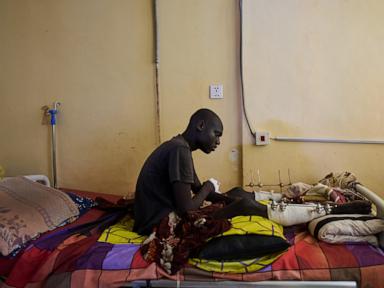
The medical infrastructure in Sudan is already on its knees. Most hospitals in the capital are shuttered, looted, or occupied. When a UXO detonates, there is often no ambulance to call. There is no trauma center with a steady supply of blood. There is only a frantic search for a bandage and a prayer that the bleeding stops.
The Ghost Sweepers
There are people who run toward these objects. De-mining teams and local volunteers attempt to clear the path for the rest of humanity. They work with agonizing slowness. In a city environment, the work is exponentially harder than in an open field. You can't just use a metal detector when the entire ground is filled with rebar, shrapnel, and discarded soda cans.
Every beep of the sensor is a potential heart attack. Every inch of soil must be prodded with a non-magnetic needle. They work in the heat, wearing heavy Kevlar suits that turn into personal saunas, their visors fogging with sweat. They are fighting a war against an enemy that has no soldiers, only triggers.
But the scale of the problem in Khartoum dwarfs the current resources. De-mining is expensive. It is dangerous. And most importantly, it requires a level of stability that Sudan currently lacks. You cannot safely clear a neighborhood while snipers are still perched on the water towers or while the roar of jets still splits the sky.
The Psychological Siege
The presence of UXOs does something to the mind. It turns a home into a cage. Even after the guns go silent, the residents of Khartoum live in a state of hyper-vigilance. You stop walking on the grass. You stop letting your children play out of sight. You look at every pile of rubble not as a ruin to be cleared, but as a grave to be avoided.
This is the invisible stake of the conflict. The war doesn't end when the peace treaty is signed. For the people of Khartoum, the war will end decades from now, when the last piece of rusted iron is finally pulled from the mud. Until then, the city is a minefield disguised as a home.
The international community often focuses on the "active" war—the troop movements, the political machinations, the death tolls from the latest drone strike. But the "passive" war is just as lethal. It is the slow-motion tragedy of a population returnee being blown up by a ghost.
The Weight of the Future
Khartoum was once the heart of African-Arab synthesis, a place where the two Niles met in a literal and metaphorical embrace. Today, the confluence is stained. The debris of modern warfare—sophisticated, durable, and patient—has been woven into the city’s fabric.
Every brick that is moved to rebuild a house carries a risk. Every new garden planted is a gamble. The people of Sudan are resilient; they have survived coups, famines, and dictatorships. But how do you fight a shadow? How do you reclaim a city when the very ground beneath your feet has been programmed to betray you?
The metal seeds are planted deep. They don't need water or sun to grow. They only need a single, misplaced step. As the sun sets over the Nile, casting long, orange shadows across the skeletal remains of the city's skyline, the silence of Khartoum feels heavy. It isn't the silence of peace. It is the silence of a held breath.
Somewhere in a darkened hallway, a small, metal pin is slowly losing its battle with gravity.