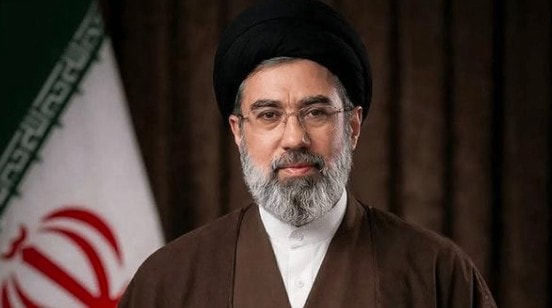
The Strait of Hormuz is closed again, and the world is holding its breath as oil prices twitch. On April 18, 2026, Iran’s new Supreme Leader, Mojtaba Khamenei, broke his silence to declare that his "brave navy stands ready" to hand the United States a bitter defeat. It sounds like the same old script we’ve heard for decades, but the context has shifted. We aren't looking at the Iran of 2020. This is a regime led by a man who officially took the mantle only last month after the death of his father, Ali Khamenei, and he's doing it in the middle of a hot conflict.
If you're wondering why a decimated navy is making such bold claims, you've got to look past the hull counts. U.S. Central Command (CENTCOM) reports they’ve already neutralized roughly 90% of Iran's conventional naval fleet. Yet, here is Mojtaba, doubling down. It isn't about winning a ship-to-ship battle in the middle of the ocean. It's about the leverage of a choke point and the desperate need for a new leader to prove he’s got the iron his father had.
The Reality of the Bitter Defeats Warning
Mojtaba’s statement, blasted out via his Telegram channel and state media, coincided with the anniversary of the Iranian Army’s creation. He claimed that the navy is ready to strike like "lightning." Honestly, it’s a ballsy move considering the U.S. has been running a naval blockade on Iranian ports, turning back dozens of ships just this week.
When Mojtaba talks about "bitter defeats," he isn't dreaming of sinking a U.S. supercarrier with a destroyer. He's talking about the cost of business. Iran has pivoted. They know they can’t win a conventional fight against the U.S. Navy’s 5th Fleet. Instead, they’re leaning into what’s left:
- Sea mines that are cheap, hard to find, and terrifying for insurance companies.
- Fast-attack craft that swarm in ways radar still struggles to track perfectly.
- Shore-based anti-ship missiles tucked into the rugged cliffs along the coast.
The goal isn't to sink the fleet. It's to make the Strait of Hormuz so dangerous that the global economy chokes. By closing the Strait again, Iran is reminding everyone that they still control one-fifth of the world’s oil supply, even if their main fleet is at the bottom of the Persian Gulf.
Mojtaba Khamenei is Fighting for Legitimacy
You’ve got to understand who is talking here. Mojtaba Khamenei didn't just inherit a country; he inherited a war. Since taking over in March 2026, he’s been under immense pressure to show the Islamic Revolutionary Guard Corps (IRGC) that he won't blink. Many within the clerical establishment in Qom weren't thrilled about a "hereditary" succession, so Mojtaba has to be more hardline than the hardliners.
He hasn't been seen in public much since the war intensified. This Telegram message is a signal to his own people as much as it is to Washington. He’s saying, "I’m still here, and the military is still mine." It’s a classic move: when internal legitimacy is shaky, you project external strength. He’s tying his survival to the "valiant" navy, even as that navy is objectively struggling to stay afloat.
What Most People Get Wrong About the Naval Balance
Most analysts look at the numbers and laugh. They see 11 U.S. carriers versus zero Iranian carriers. They see high-tech Aegis destroyers versus aging Iranian frigates. They think the "war" is over because the big ships are gone. That’s a mistake.
Iran’s navy was never built to be a "blue water" force. It’s a "green water" and "brown water" force designed for asymmetric chaos. The real threat in April 2026 comes from:
- Drone Swarms: Iran’s Shahed-series drones have evolved. They’re being used as "suicide boats" and low-flying missiles that can overwhelm defense systems by sheer volume.
- Subsurface Assets: They still have small Ghadir-class midget submarines that are notoriously difficult to sonar-detect in the shallow, noisy waters of the Gulf.
- The Blockade Feedback Loop: The U.S. is blockading Iranian ports to stop the flow of weapons and oil. Iran responds by closing the Strait to stop everyone's oil. It’s a game of chicken where the "defeat" isn't measured in sunken ships, but in the price of gas in Ohio or London.
The Failed Diplomacy and the Looming Escalation
The timing of this "stands ready" warning isn't accidental. It comes right as talks in Islamabad hit a wall. Iran’s Deputy Foreign Minister, Saeed Khatibzadeh, basically said there’s no point in meeting until the U.S. lifts the blockade. Meanwhile, the U.S. won't lift the blockade until Iran stops firing on tankers.
We’re in a loop. With world leaders like Donald Trump and Masoud Pezeshkian supposedly headed to Pakistan for a second round of negotiations, Mojtaba is trying to build a "position of strength." He wants to walk into those talks—or have his representatives walk in—with the world terrified that he’ll actually try to sink something significant.
How to Read Between the Lines
Don't expect a massive naval battle tomorrow. Expect "annoyance warfare." Iran just fired on two more vessels. They’re using small boats with machine guns and RPGs to harass merchant ships. It’s low-tech, high-impact.
If you're tracking this conflict, watch the insurance premiums for tankers. That’s the real scoreboard. Mojtaba Khamenei knows he can’t "defeat" the U.S. Navy in a way that leads to a surrender ceremony. But he can "defeat" the American public's appetite for a long, expensive war by making the global economy hurt.
Basically, the "bitter defeats" he’s promising are financial and political, not necessarily purely kinetic. He's betting that the U.S. will tire of the blockade before Iran tires of the isolation.
What happens next?
Keep an eye on the Strait. If Iran successfully deploys a new generation of sea mines, the U.S. will have to divert massive resources to minesweeping, which slows everything down. For the average observer, the next step is simple: watch the Islamabad talks. If those fail, Mojtaba’s rhetoric will likely turn into more "lightning" strikes in the water.
Don't get distracted by the bravado. Look at the chokepoints. That’s where the real war is being fought.