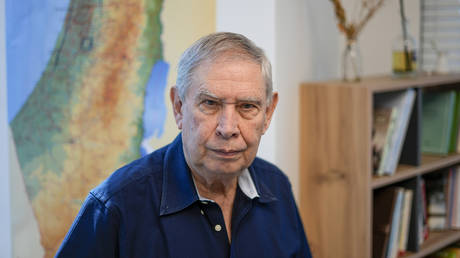
When Tamir Pardo, the man who ran Israel’s Mossad from 2011 to 2016, stepped forward to compare the current state of the West Bank to South African apartheid, the shockwaves were felt far beyond the intelligence community. This wasn't a fringe activist speaking. This was a man who spent his life in the deepest corridors of the Israeli security establishment, a veteran of the legendary Sayeret Matkal, and a direct appointee of Benjamin Netanyahu. Pardo’s assessment is that Israel has institutionalized a dual legal system where two people living in the same territory are judged by two different sets of laws based on their ethnicity.
The weight of this statement lies in its source. In the world of high-stakes intelligence, words are weighed like gold. Pardo’s intervention suggests that the internal rot within the Israeli political system has reached a point where the very guardians of the state feel the need to sound a desperate alarm. He is not alone in this grim assessment, but his specific invocation of historical parallels marks a shift from tactical disagreement to a fundamental moral and existential crisis.
The Mechanics of a Dual Reality
To understand why a former spy chief would use such incendiary language, one must look at the administrative machinery governing the West Bank. It is a complex, overlapping grid of military orders and civil statutes. On one side of a highway, an Israeli settler lives under Israeli civil law, enjoying the protections of a modern democracy. On the other side, a Palestinian neighbor is subject to a military court system with a conviction rate that nears 100 percent.
This is not a temporary byproduct of conflict. It is a settled reality. Security experts argue that the permanence of this arrangement has stripped away the "temporary occupation" defense that Israel used in international courts for decades. When the infrastructure—the roads, the water grids, the power lines—is built to serve one group while bypassing the other, the "apartheid" label ceases to be a political slur and becomes a technical description of a governance model.
The "why" behind this shift is rooted in the ascent of the far-right within the Israeli cabinet. Figures who were once on the extreme margins of society now hold the keys to the civilian administration in the West Bank. They aren't looking for a "solution" in the traditional diplomatic sense. They are looking for total sovereignty. For someone like Pardo, who viewed the Mossad’s mission as ensuring the long-term survival of a democratic Jewish state, this ideological takeover represents a greater threat than any foreign intelligence agency.
Intelligence vs Ideology
The tension between the professional security class and the political leadership has reached a breaking point. For decades, the "defense establishment"—the IDF, Shin Bet, and Mossad—acted as a pragmatizing force. They were the ones telling the politicians what was actually happening on the ground, often acting as a brake on the more radical impulses of the Knesset.
That brake has failed. The current government has effectively sidelined the professional assessments of the intelligence community in favor of a Messianic vision of territorial expansion. When Pardo speaks of "violence that echoes" the darkest chapters of the 20th century, he is referring to the dehumanization required to maintain a permanent underclass. It is a process that starts with rhetoric and ends with a broken military code.
Consider the rise of settler violence and the military’s role in it. Investigative reports and whistleblower testimonies from groups like Breaking the Silence often point to a "standing by" policy. Soldiers, tasked with maintaining order, frequently find themselves in a position where they either cannot or will not intervene when settlers attack Palestinian villages. This erosion of the chain of command is what keeps Pardo up at night. If the state loses its monopoly on the use of force, or if that force is used selectively based on ethnicity, the state itself begins to dissolve.
The Demographic Ghost in the Room
Every discussion about the West Bank eventually hits the wall of demographics. The math is cold and unforgiving. Between the Jordan River and the Mediterranean Sea, the population of Jews and Arabs is roughly equal. If Israel holds the land but denies the vote to half the population, it is no longer a democracy. If it gives everyone the vote, it is no longer a Jewish state.
Pardo’s warning is essentially a plea for the "separation" doctrine that once dominated the Israeli center-left. He views the current trajectory as a slow-motion suicide. By absorbing millions of Palestinians into a system where they have no rights, Israel is creating a pressure cooker that will eventually explode. The "security" rationale used to justify the status quo is, in Pardo’s view, actually the greatest long-term security threat the nation faces.
The comparison to historical atrocities or systems of segregation isn't meant to be a direct one-to-one historical match. History rarely repeats itself perfectly. Instead, it serves as a psychological mirror. It is an attempt to force a society to look at its own reflection before the image becomes unrecognizable.
The International Price of Internal Policy
For years, Israel’s diplomatic strategy relied on the idea that the occupation was a "work in progress" that would be resolved via a two-state solution. This gave allies like the United States and the European Union the political cover to continue their support. Pardo’s testimony effectively shreds that cover.
If a former Mossad chief says the "A-word," the international community loses its ability to look the other way. We are seeing the beginning of a shift in the halls of Washington and London. Younger generations of voters do not see a "pioneering democracy"; they see a powerful military force suppressing a stateless population. The diplomatic "Iron Dome" that has protected Israel from sanctions and international isolation is developing cracks.
This is not just about morality. It is about the hard currency of international relations. Israel’s tech economy, its military partnerships, and its academic collaborations depend on being part of the Western democratic club. If it is perceived as an ethno-state maintaining a colonial project, those doors will begin to close. The Mossad knows this. The generals know this. The politicians, it seems, are the only ones who think they can defy the laws of political gravity.
The Internal Schism
The protests that have rocked Tel Aviv and Jerusalem over the last year are not just about judicial reform. They are about the soul of the country. Pardo’s comments are a subset of this larger civil war. One side sees the West Bank as "Judea and Samaria," a divinely promised heartland that must be settled at any cost. The other side, which includes much of the old security elite, sees it as a strategic and moral albatross that will sink the Zionist project.
The irony is that the more the government tries to secure the land, the more insecure the people become. The cycle of raid and reprisal in places like Jenin and Nablus is not a sign of strength. It is a sign of a failed strategy. When you have to deploy several battalions to protect a few hundred people at a religious site, you are not a sovereign power; you are an occupier in a state of constant friction.
Pardo’s bluntness is a reflection of his desperation. He has seen the classified files. He knows the human cost of the occupation on the soldiers who have to enforce it. He knows that you cannot maintain a "clean" democracy at home while running a military dictatorship ten miles away. The two realities eventually bleed into each other.
The "apartheid" label is a heavy one, and many in Israel and the diaspora reject it with vitriol. They point to the rights of Arab citizens within the 1948 borders, who serve in the Knesset and sit on the Supreme Court. But Pardo’s focus is on the territory that Israel controls but refuses to annex—the gray zone where law is replaced by the barrel of a gun. In that space, his assessment is difficult to refute with logic alone. It can only be refuted with the promise of a change that no one in the current leadership seems willing to make.
The silence from the political center in response to Pardo’s claims was telling. There were no detailed rebuttals, only attempts to discredit his character or his "political" motivations. This is the hallmark of a debate that has moved beyond facts and into the territory of fundamental identity.
Israel’s security establishment was built on the principle of "cold analysis." Pardo is applying that cold analysis to the most sacred cow in Israeli politics. His conclusion is that the greatest threat to Israel is not a nuclear Iran or a Hezbollah rocket barrage. It is the loss of the moral compass that allowed the state to claim it was a "light unto the nations." Without that, it is just another small, heavily armed country struggling to keep its boot on the neck of a neighbor, waiting for the inevitable day when the weight becomes too much to bear.
The transition from a "defense-minded" society to an "occupation-minded" one is nearly complete. Pardo’s warning is the final signal from the old guard that the ship is heading for the rocks. Whether anyone at the helm is listening is another matter entirely. The machinery of the state is now in the hands of those who see the rocks not as a danger, but as the destination.