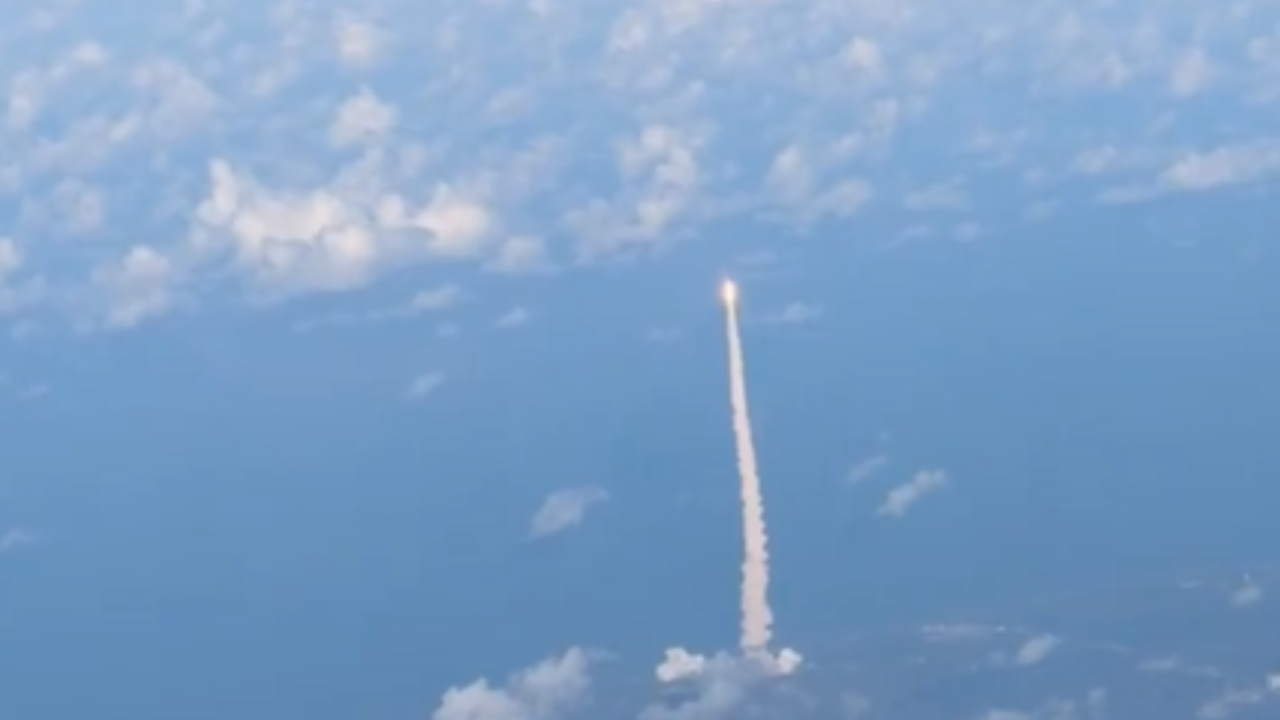
Imagine looking out your scratched oval window at 35,000 feet and seeing a pillar of fire punch through the clouds. That's exactly what happened for a few lucky passengers on a commercial flight near the Space Coast yesterday. While thousands of people paid hundreds of dollars for lawn chairs at the Kennedy Space Center, someone in seat 14A got a view that was, quite frankly, way better.
The Artemis II launch is finally here. After years of delays and billions in spending, NASA’s Space Launch System (SLS) rocket roared off Pad 39B on April 1, 2026. It's the first time since 1972 that humans are headed toward the Moon. This isn't just another satellite delivery. It’s a 10-day mission carrying Reid Wiseman, Victor Glover, Christina Koch, and Jeremy Hansen on a high-speed loop around our lunar neighbor. Learn more on a connected issue: this related article.
The view from the clouds
Most people watch launches from the ground. You get the chest-thumping rumble and the smell of salt air. But watching from a jet provides a perspective you can't buy. A viral video captured from a commercial flight shows the SLS clearing the thick Florida humidity and piercing the stratosphere. From that height, you don't just see a rocket; you see the curvature of the Earth and the true scale of the power required to leave it.
The video shows the solid rocket boosters (SRBs) glowing like a miniature sun against the darkening sky. Because the launch happened at 6:35 p.m. EDT, the "twilight effect" was in full swing. This happens when the rocket is high enough to be illuminated by the sun while the ground is in shadow. It creates a glowing, iridescent plume that looks more like a nebula than exhaust. Further journalism by AFAR delves into comparable views on the subject.
Why this mission is a big deal
I'll be blunt. We’ve been stuck in Low Earth Orbit (LEO) for too long. Since the Apollo era ended, the furthest we've gone is about 250 miles up. Artemis II is changing that. This crew isn't landing yet—that's for Artemis III—but they're testing the Orion spacecraft’s life support systems in the harsh environment of deep space.
- First Woman: Christina Koch is breaking the ultimate glass ceiling.
- First Person of Color: Victor Glover is the pilot, proving space is finally for everyone.
- International Reach: Jeremy Hansen is the first Canadian to leave LEO.
- Speed: They’ll hit speeds of roughly 25,000 mph during reentry.
NASA isn't just doing this for the "firsts," though. They're doing it because we need to know if the SLS and Orion can actually keep humans alive for 10 days without the protection of Earth's magnetic field. If a fuse blows or a heater fails out there, you can't just wait for a resupply ship from SpaceX. You’re on your own.
The luck of the flight path
You might wonder how a commercial jet gets that close. The FAA clears a massive "no-fly zone" around the Cape during launches. Pilots have to skirt the edges of this restricted airspace. If your flight path takes you from, say, New York to Miami or Atlanta to Orlando, there’s a slim window where you might be perfectly positioned.
I’ve seen plenty of launch footage, but there’s something raw about a shaky cell phone video from a passenger jet. It reminds you that while this is a multi-billion dollar government operation, it’s happening in the same sky we use to go on vacation. It’s a weird collision of the mundane and the miraculous.
What happens now
The crew is currently in the "high Earth orbit" phase. They aren't heading straight for the Moon yet. They're spending the first 24 hours in a massive elliptical orbit to make sure the Orion ship is healthy. Once they get the green light, they’ll fire the engine one last time to slingshot toward the Moon.
If you're in Florida for the next few days, keep your eyes on the news. The mission doesn't end with the launch. We still have to get them back. The planned splashdown is set for April 10, 2026, in the Pacific Ocean.
Don't just watch the curated NASA feed. Check social media for more "passenger views." Sometimes the best way to understand the magnitude of what we’re doing is to see it through the eyes of someone who just happened to be looking out the window at the right time.
Check your flight paths if you're flying near Florida this week. You might just get the best souvenir of your life.