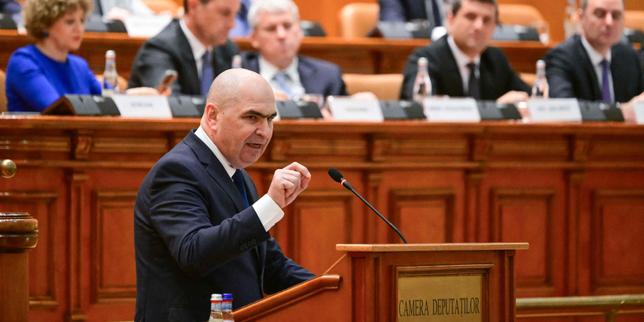
The coffee in the Romanian Parliament’s press gallery always tastes like burnt rubber and desperation, but on this particular Tuesday, it was the only thing keeping the room from vibrating with anxiety. Outside, the Bucharest wind whipped across the Piața Constituției, a vast, stone-cold reminder of the country’s architectural obsession with power. Inside, the air was thick with the scent of cheap suits and the electric hum of a political execution.
Ilie Bolojan, a man whose reputation was built on the unglamorous, gritty work of fixing things—potholes, budgets, bureaucratic sludge—stood at the center of the storm. He is a liberal, a technocrat at heart, the kind of leader who treats a national budget like a blueprint rather than a wish list. But in the grand, vaulted chambers of the Palace of the Parliament, blueprints are easily shredded.
The vote was not a surprise, yet it felt like a physical blow. When the final tally was read, the numbers confirmed an alliance that, only a year ago, would have seemed like a fever dream. The Social Democrats (PSD) and the far-right Alliance for the Union of Romanians (AUR) had shaken hands. They had found a common enemy in Bolojan.
The government fell. Just like that.
The Mathematics of a Marriage of Convenience
To understand why this matters, you have to look past the mahogany desks and the formal titles. Think of a bridge. Bolojan was trying to reinforce the pillars—tax reforms, European integration, the tightening of fiscal screws to keep the currency from collapsing. It was hard, unpopular work. It required the kind of discipline that makes for very dull campaign posters.
On the other side stood the Social Democrats, masters of the traditional political machine, and the far-right, fueled by a scorching brand of nationalism that views every European Union directive as a personal insult. Individually, they represent two different Romanias. One is nostalgic for the safety nets of the past; the other is angry at the uncertainties of the future.
Together, they became a wrecking ball.
The vote of no confidence wasn't just about policy. It was a visceral rejection of the "liberal way." In the halls of power, the whispered justification was simple: Bolojan was too rigid. He was too focused on the long-term health of the state and not enough on the immediate hunger of the political base. The coalition of the left and the extreme right realized that if they didn't stop him now, he might actually succeed in making the system too transparent for their liking.
The Ghost in the Room
Consider a shopkeeper in Oradea, the city Bolojan famously transformed before moving to the national stage. Let’s call him Mihai. For years, Mihai saw his city become a jewel of Western Romania because Bolojan prioritized efficiency over ego. When Bolojan became Prime Minister, Mihai felt a rare spark of hope. Maybe the rest of the country could look like his street. Clean. Functional. Predictable.
But politics is rarely about the shopkeeper.
As the debate raged before the vote, the rhetoric from the far-right benches didn't mention Mihai’s shop. They spoke of "national dignity" and "sovereignty," words that sound grand until you try to use them to pay for a shipment of imported goods. They painted Bolojan as a puppet of Brussels, a man who cared more about the approval of bankers in Frankfurt than the struggles of the elderly in the rural heartlands.
It was a masterful performance of populist theater. The Social Democrats provided the votes, and the far-right provided the fire. They leveraged the very real fatigue that many Romanians feel—a fatigue born from thirty years of transition that never seems to end.
The Invisible Stakes
When a government falls in this manner, the immediate casualty is stability.
Romania is currently a vital piece of the European puzzle. It sits on the edge of a continent reshaped by war in neighboring Ukraine. It is a hub for energy, a transit point for grain, and a frontline for NATO. When the leadership is decapitated, the gears don't just stop; they begin to grind against one another.
The markets noticed immediately. The currency, the leu, didn't plummet, but it shivered. Investors hate uncertainty even more than they hate taxes. By ousting a Prime Minister who was seen as a reliable partner by the West, the new parliamentary majority sent a signal that Romania was entering a period of introspection—or worse, isolation.
The real danger lies in the precedent. The alliance between the PSD and the far-right is a "red-brown" coalition, a term historians use with a shudder. It suggests that the guardrails of traditional political decorum have been dismantled. When the center-left decides that the extreme right is a more palatable partner than the liberal center, the political landscape doesn't just shift. It breaks.
The Long Walk Out
After the vote, I watched Bolojan leave the chamber. He didn't look like a defeated man; he looked like a man who had seen the math and knew the equation no longer balanced. He walked with a steady pace, ignored the shouting cameras, and disappeared into the labyrinthine corridors of the world’s second-largest building.
The victors were already celebrating. There were handshakes and backslapping. The leaders of the far-right were already speaking to the cameras about a "new era." But they haven't agreed on what that era looks like. They only agreed that Bolojan shouldn't be part of it.
Consider what happens next: a period of intense, backroom bargaining where the spoils of the state are divided among people who have very little in common besides a desire for power. The Social Democrats want to expand spending to keep their voters happy. The far-right wants to pivot away from European influence. These two goals are fundamentally at odds. You cannot spend money you don't have while alienating the people who lend it to you.
The tragedy of the situation is that the "dry facts" of the competitor's article—the tally of the votes, the names of the parties—are just the surface of a much deeper wound. Romania is a country caught between its aspirations for a modern, European future and the gravitational pull of its more cynical, populist past.
Bolojan represented a specific path. It was a path of austerity, yes, but also of progress. It was the path of the hard "how" rather than the easy "why."
As the sun set over Bucharest, the Palace of the Parliament stayed lit, a massive, glowing mountain of marble. Inside, the deals were being struck. Outside, the city moved on, unaware that the rules of the game had just been rewritten in the dark.
The lights didn't go out all at once. They just dimmed, one room at a time, until the shadows were long enough for everyone to hide in.