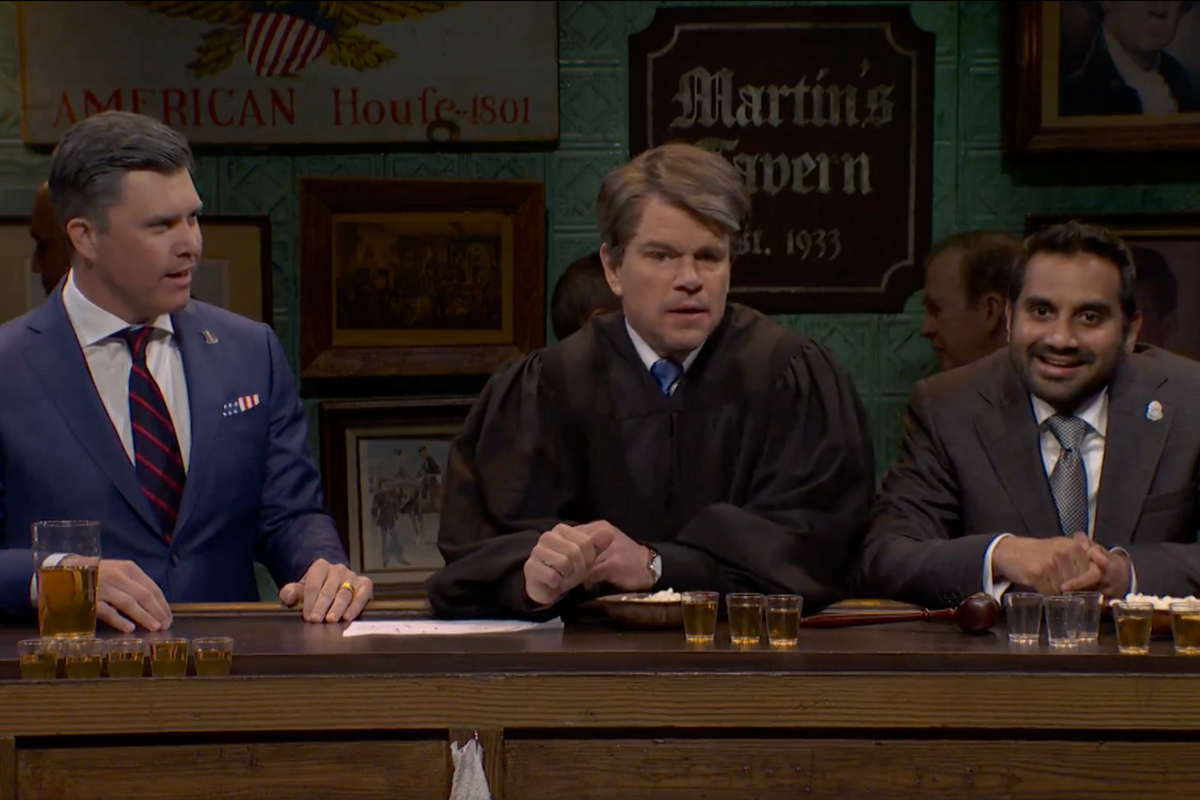
The lights in Studio 8H are brighter than they have any right to be. They catch the sheen of sweat on a forehead, the glint of ice in a plastic cup, and the desperate, frantic energy of a culture trying to laugh its way through a fever dream. When Matt Damon stepped onto that stage, he wasn't just playing a Supreme Court nominee. He was holding up a mirror to a nation that had forgotten where the performance ended and the law began.
The air in the room shifted. It wasn't the usual polite chuckle of a Saturday night audience. It was a roar of recognition.
Damon, channeling a high-octane, beer-soaked version of Brett Kavanaugh, didn't just mimic the man; he inhabited the absurdity of the moment. He screamed. He snorted. He drank water like it was a lifeline and defended his "calendar" like it was a holy relic. But beneath the caricature of the "keg-stand judge" lay a much darker, sharper point about the fragility of the institutions we take for granted.
The sketch used a boozy, belligerent facade to scream a truth that the evening news was too polite to whisper: the lines between reality TV, the judiciary, and the executive branch had finally dissolved into a single, chaotic blur.
The Theater of the Absurd
Imagine a courtroom where the gavel is replaced by a red Solo cup.
In this hypothetical space, the law isn't about precedent or justice. It’s about who can shout the loudest, who can play the victim with the most conviction, and who can keep the crowd entertained long enough to slip a permanent change into the books. This was the "invisible stake" Damon tapped into. By portraying Kavanaugh as a man who would do anything—including weaponizing his own entitlement—to reach the bench, the show wasn't just mocking a person. It was mocking a system that had become vulnerable to that exact brand of performance.
The "boozy" nature of the cold open served as a metaphor for the intoxication of power.
When a leader or a judge operates with the frantic, unhinged energy of someone who believes they are untouchable, the rules of the game change. We aren't watching a deliberation anymore. We are watching a hostile takeover disguised as a hearing. The sketch leaned heavily into this, suggesting that if the highest court in the land could be swayed by a loud enough tantrum, then the path to a third term for a sitting president wasn't just a conspiracy theory. It was a logical progression of a world where "might makes right" had been rebranded as "ratings make right."
The Shadow of the Third Term
The most chilling beat of the night came not from a joke about beer, but from the underlying suggestion of what comes next.
If you can change the rules of the confirmation, you can change the rules of the election. If you can change the rules of the election, the concept of a "term limit" becomes a mere suggestion. The narrative woven through the laughter was one of erosion. It’s the slow, steady drip of water on a stone. One day, the stone is gone, and you’re left wondering when the hole got so deep.
Consider the mechanics of the "forever" presidency.
It starts with the judiciary. By seating individuals who feel a deep, personal debt to the executive branch, the checks and balances designed by the founders begin to look more like rubber stamps. The sketch played on the idea that Kavanaugh was the vanguard of this movement—a loyalist in robes who would eventually look the other way when the traditional four-year cycles were challenged.
It felt like a joke.
Until you realized that the audience wasn't just laughing at the antics; they were laughing because the alternative—admitting that the guardrails were gone—was too terrifying to process in silence.
The Human Cost of the Spectacle
We often talk about politics in terms of "bases" and "demographics," but the real story is always human.
The human element of that SNL cold open was the palpable sense of exhaustion. You could see it in the faces of the actors playing the senators. You could hear it in the jagged edges of Damon’s delivery. It was the exhaustion of a public that had been forced to treat a serious constitutional crisis as a variety show.
When we turn our leaders into characters, we lose the ability to hold them accountable. A character can’t be fired; they can only be canceled or renewed. By leaning into the "boozy" persona, the sketch highlighted how easily a serious man can hide behind a ridiculous one. If everyone is busy talking about the beer and the shouting, no one is talking about the long-term implications of a politicized court.
The invisible stake here is our own attention.
Every time we engage with the spectacle, we pull our eyes away from the policy. We become fans or haters rather than citizens. The "third term" isn't a surprise attack. It's a slow-motion car crash that we can't stop watching because the driver is making such a funny face.
The Mirror in the Dressing Room
Behind the scenes of that broadcast, there was a sense of urgency.
SNL has always been a pressure valve for the American psyche, but this felt different. It wasn't just satire; it was an intervention. The writers knew that the "standard" news cycle had failed to convey the visceral reality of the situation. They needed a movie star. They needed a performance so loud and so jarring that it would break through the noise of the twenty-four-hour news cycle.
Damon's Kavanaugh was a vessel for all the anger, confusion, and disbelief of a summer spent watching the impossible become the inevitable.
It reminded us that these figures—these "giants" of the law and the state—are just people. They are people with flaws, tempers, and agendas. When we strip away the marble columns and the black robes, we are left with a man in a chair, yelling about his friends and his hobbies while the future of the country hangs in the balance.
The Sound of the Gavel
The laughter died down eventually.
The show moved on to the monologue, the sketches about brunch, and the musical guest. But the image of that frantic, red-faced man stayed. It stayed because it felt more "real" than the actual footage of the hearings. It captured the emotional truth of the era: a sense that the adults had left the room and the kids were currently lighting the curtains on fire.
The path to a third term doesn't require a coup in the streets.
It only requires a shift in what we are willing to tolerate. It requires us to become so used to the circus that we stop noticing when the lions are let out of their cages. The SNL cold open wasn't a prediction; it was a diagnosis. We are living in an age where the loudest voice wins, and the loudest voice is currently asking for another round.
The ice in the cup has melted. The lights are still on. And the audience is still waiting to see if the next act is a comedy or a tragedy.
We are all sitting in that studio, watching the red "ON AIR" light, hoping that someone, somewhere, still knows the difference between a punchline and a law.