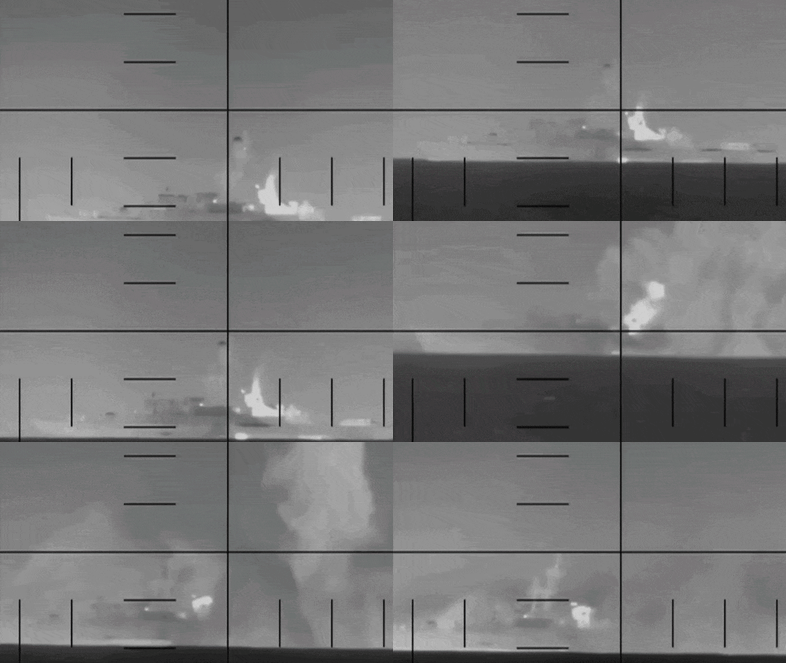
The Persian Gulf does not forgive a lack of balance. At the Bandar Abbas naval base, the water is a thick, humid soup that clings to the steel of warships like a second skin. In July 2024, the Sahand, a jewel of the Iranian Navy’s Moudge-class frigates, sat in this heavy heat. She was supposed to be a symbol of self-sufficiency, a 310-foot testament to a nation’s ability to project power despite decades of international isolation.
Then, she simply leaned over.
It wasn’t a torpedo that did it. No stealth bomber dropped a precision payload into her engine room. Instead, the Sahand succumbed to the most basic laws of physics—laws that do not care about geopolitical posturing or the prestige of an admiral. During what should have been a routine repair, the ship lost her equilibrium. She listed, she took on water, and within hours, she was a carcass of iron lying on her side in the shallow silt.
The Weight of Ambition
To understand why the Sahand ended up as a submerged cautionary tale, you have to look at what she was carrying. Imagine a person trying to walk across a frozen pond while balancing a massive, ornate chandelier on their head. The chandelier represents the modern sensors, anti-ship missiles, and point-defense systems that Iran squeezed onto a hull originally designed in the 1960s.
The Moudge-class is essentially a clone of the British-built Vosper Thornycroft frigates. Those ships were elegant, fast, and light. But the modern Iranian Navy didn't want light; they wanted a floating fortress. They added domestic radar arrays, heavy box launchers for Noor missiles, and the Kamand close-in weapon system. Every time a new piece of tech was bolted to the upper decks, the ship’s center of gravity crept upward.
Top-heavy.
In naval architecture, this is the "hidden killer." A ship stays upright because its center of buoyancy and its center of gravity play a constant, delicate game of seesaw. If the weight gets too high, the seesaw tips. It doesn’t take a storm to trigger the disaster. A slight shift in ballast during a repair, a sudden inflow of water through an unsealed maintenance hatch, or even a poorly executed turn can be the catalyst.
The Illusion of Recovery
When the Sahand first capsized, the Iranian state media apparatus went into a familiar cycle of minimization. They claimed it was a minor incident, a technical mishap that would be corrected. And for a moment, it looked like they might pull it off. Salvage crews worked through the sweltering nights. They used massive air bags and cranes, fighting the suction of the seafloor.
Consider the perspective of a hypothetical dock worker—let’s call him Abbas—standing on the concrete pier. He watches the massive chains strain. The water boils with mud and diesel. Slowly, the Sahand begins to right herself. There is a collective sigh of relief. The pride of the fleet is coming back to life.
But the sea was only teasing.
As the ship was being leveled, the integrity of her internal bulkheads failed. The "free surface effect" took over. This is a terrifying phenomenon where a small amount of water moving across a wide deck creates a massive, shifting momentum that becomes impossible to stop. As the Sahand swung back toward a level position, the water inside her surged to the other side.
The chains snapped. The air bags burst with the sound of cannon fire. The Sahand didn't just tip back; she plunged. This time, she didn't stop until she was almost entirely submerged, her radar masts poking out of the water like the fingers of a drowning man.
The Invisible Stakes
We often talk about naval warfare in terms of "sinking" a ship, as if the only way to remove a vessel from the board is through violence. But the Sahand was "sunk" by a failure of infrastructure and expertise. It highlights a recurring theme in the history of desperate navies: the gap between the desire for high-tech hardware and the mundane reality of maintenance.
The United States and its allies didn't need to fire a shot because the structural integrity of the Iranian naval program was already under immense internal pressure. When you operate under sanctions, you don't always get the best steel. You don't always get the most precise calibration tools. You make do. You innovate. You "leverage" whatever you have—until the moment the physics of the ocean reminds you that "making do" isn't enough.
The loss of the Sahand was more than the loss of a hull. It was the loss of time. It takes years to build a frigate in a sanctioned shipyard. It takes months to train a crew to trust the deck beneath their feet. When that deck disappears into the harbor mud, the psychological impact on the fleet is corrosive. Every other captain in the Moudge-class now looks at his own ship and wonders if the balance is just as precarious.
A Pattern of Iron and Salt
The Sahand is not an isolated ghost. She joins the Kharg, a massive replenishment ship that caught fire and sank in the Gulf of Oman in 2021. She joins the Konarak, a support vessel accidentally struck by a missile from her own fleet during a training exercise. These are not just accidents; they are symptoms.
Naval power is often measured by the number of missiles or the range of a radar. That is a mistake. Real power is found in the things that aren't exciting to talk about: the quality of the welds, the rigorous training of the damage control teams, and the mathematical certainty of the ship's stability.
If a navy cannot keep its ships upright in its own home port, its ability to threaten the Strait of Hormuz or challenge a carrier strike group becomes a performance rather than a reality. The Sahand was meant to be a hunter. Instead, she became an artificial reef.
The Silent Harbor
Walking past the docks at Bandar Abbas today, the space where the Sahand once sat is a void. The cranes are still there. The oil slicks still shimmer on the surface. But the ship is gone, a victim of an enemy that cannot be outmaneuvered or intimidated: the relentless, uncaring gravity of the deep.
The water in the Persian Gulf remains still. It hides the rust, the broken glass of the bridge, and the silent corridors where sailors once walked. It is a reminder that in the theater of high-stakes geopolitics, the loudest message isn't always delivered by a missile. Sometimes, it is delivered by the sound of a hull slowly gurgling as it disappears beneath the waves, leaving nothing behind but a few bubbles and the stinging scent of failure.
The ocean has a way of settling all debts. It doesn't care about the name painted on the bow or the flag flying from the mast. It only cares if the ship is true. And on that humid July day, the Sahand was found wanting.