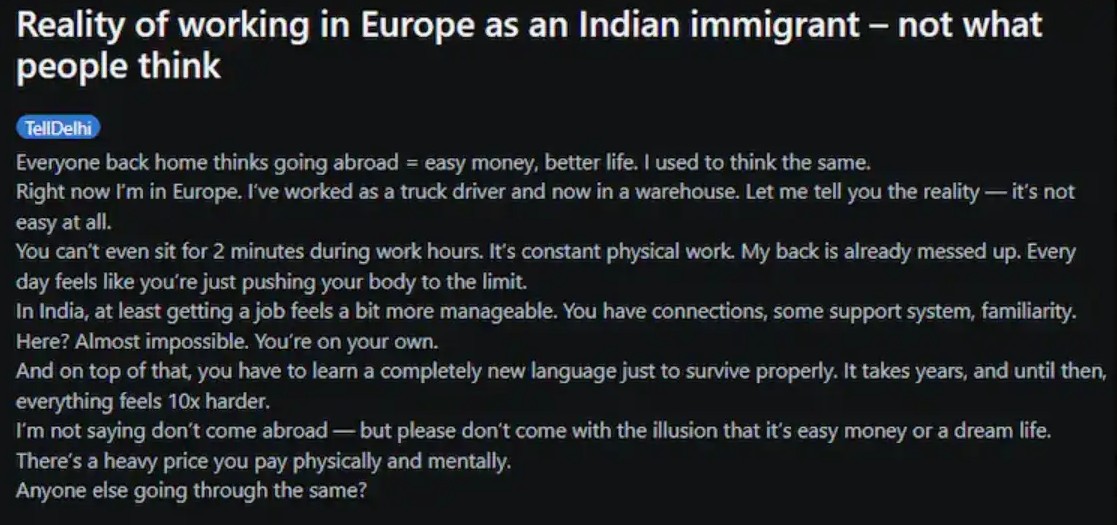
The dream of driving big rigs across the smooth, scenic highways of Europe lures thousands of Indian drivers every year. They imagine high wages in Euros, a life of dignity, and escaping the chaotic, often dangerous roads of South Asia. But the reality is a massive wake-up call. Recent viral testimonials from Indian truckers already on the ground in countries like Poland, Germany, and Hungary show that the job isn't just about steering a wheel. It's a grueling test of endurance where you're often treated more like a biological component of the machine than a human being.
European logistics companies are desperate for labor. They've turned to India to fill the massive driver shortage left behind by aging local populations and the departure of Ukrainian drivers. However, the promise of a better life often masks a rigid system that leaves zero room for error or rest. If you think you’re going to spend your weekends sightseeing in Paris or Berlin, you’re in for a shock. Most of the time, you’re stuck in a metal box on the side of a highway, counting down the minutes until your tachograph says you can move again.
The Two Minute Rule and the Digital Leash
When an Indian trucker says you can't even sit for two minutes, they aren't being hyperbolic. They're talking about the tachograph. This is a digital device installed in every European truck that records your driving time, speed, and rest periods. It is the ultimate boss. In India, a driver might push through exhaustion to reach a destination or take a long nap when they feel like it. In Europe, the law is absolute.
You drive for four and a half hours. You stop for 45 minutes. Not 44 minutes. Not 40. If you move that truck even a few meters to find a better parking spot during your break, the sensor records "driving." You've just broken the law. The fines are astronomical, often equaling a week's wages, and the police don't care about your excuses. This creates a high-pressure environment where drivers are constantly staring at a digital clock, terrified that a small mistake will wipe out their earnings.
It's a bizarre paradox. You’re forced to rest by law, yet the pressure to deliver on time is so high that the rest doesn’t feel like rest. You spend your break worrying about the next leg of the journey or looking for a secure spot to park. Finding parking in Western Europe is a nightmare. Truck stops are frequently full by 4:00 PM. If your clock is running out and there’s no spot, you’re forced to park illegally on a hard shoulder, risking safety and more fines.
The Loneliness Nobody Prepared For
Driving in India is a social activity. You have a helper, you stop at dhabas, you talk to other drivers, and there’s a sense of community even in the chaos. In Europe, you’re solo. For weeks on end, the only voice you might hear is the GPS or a brief, functional exchange with a warehouse worker who doesn't speak your language.
The isolation hits Indian drivers hard. You’re cooking dal and roti on a portable gas stove in the rain on a German Autobahn siding. You're eating alone in your cab. The "life in Europe" you see on Instagram—the sparkling cities and historic monuments—is usually just a blur in the rearview mirror. You see the industrial backside of Europe. Loading docks, chemical plants, and grey concrete warehouses.
The Financial Reality vs the Instagram Hype
Let's talk about the money because that’s why everyone goes. A driver in Europe can earn between €1,800 and €2,500 per month depending on the country and the routes. On paper, that’s a fortune compared to Indian salaries. But the expenses eat it up fast.
- Initial Costs: Many drivers pay agents in India upwards of ₹5,00,000 to ₹8,00,000 for visas and job placements. It takes over a year just to break even.
- Living Expenses: You aren't staying in hotels. You live in the truck. You pay for your own food, showers at truck stops (which cost €3-€5 each), and laundry.
- Remittance Pressure: Most of the money goes back home to pay off loans or support families. This leaves the driver with a bare-bones existence in Europe.
Many drivers feel trapped. They can’t go back because of the debt they took on to get there, but staying means enduring a lifestyle that is mentally and physically draining.
Why Logistics Companies Want Indian Drivers
European trucking is in a state of crisis. The International Road Transport Union (IRU) has repeatedly warned that the driver shortage is reaching a breaking point. Western European drivers don't want the job. They want to be home with their families every night. This led companies to recruit heavily from Eastern Europe, and now, from Central and South Asia.
Indian drivers are prized because they’re hardworking and, frankly, they're willing to accept conditions that locals won't. They’re more likely to stay on the road for three to four weeks at a time, living in the "sleeper cab." To the companies, this is efficient. To the driver, it’s a nomadic existence that quickly loses its charm.
The Skill Gap and the Safety Barrier
There is a massive difference between driving a truck in Punjab and navigating a 40-tonne semi-trailer through the narrow, snow-covered roads of Scandinavia or the tight roundabouts of the Netherlands.
The safety standards are non-negotiable. In Europe, load securing is a science. If your cargo isn't strapped down exactly to the centimeter, you're not moving. Many Indian drivers struggle initially with the technical complexity of modern European trucks—Euro 6 engines, automated transmissions, and advanced safety suites. There's a steep learning curve, and the "jugaad" mindset that works in India can get you fired or jailed in Europe.
The Hidden Racism and Language Barriers
It's not all "Equal Opportunity" out there. Indian drivers often report a cold reception at delivery points. Language is a massive barrier. If you don’t speak basic English, German, or Polish, you’re at a disadvantage. You can’t negotiate your wait times, you can’t explain issues with the paperwork, and you become an easy target for blame if something goes wrong.
How to Actually Succeed if You Go
If you're still determined to make the move, you have to stop looking at it as a vacation with a salary. It's a high-stakes technical job.
First, ignore the agents who promise you "easy work." There is no easy work in European logistics. You need to learn the regulations before you fly. Understand the EU Drivers' Hours rules (Regulation (EC) No 561/2006) inside out. If you don't know the difference between a daily rest and a split rest, you’ll be broke from fines within a month.
Second, learn the language of the country you're heading to. Even 500 basic words will change how people treat you at the warehouses. It shows respect and competence.
Third, vet your employer. Some companies in Poland and Lithuania are notorious for "social dumping"—hiring non-EU drivers, paying them the bare minimum, and making them live in their trucks for months. Look for companies that offer "base" periods where you actually get to sleep in a real bed in a company-provided apartment.
The Hard Truth
The Indian trucker's life in Europe is a trade-off. You trade your time, your social life, and your physical comfort for a currency that is stronger than yours. It’s a temporary sacrifice for a long-term financial goal. But don't let the glossy recruitment videos fool you. It’s lonely, it’s cold, and the tachograph is always watching.
Before signing that contract and taking that loan, ask yourself if you’re ready to live in 2.5 square meters of space for 25 days a month. If the answer isn't a resounding yes, stay where you are. The Euro isn't worth your sanity.
Next Steps for Aspiring Drivers
- Check the Company: Research the company on European driver forums. Look for mentions of "pay per kilometer" schemes, which are often illegal and exploitative.
- Get Certified: Don't rely on your Indian license alone. Ensure you understand the CPC (Certificate of Professional Competence) requirements in the EU.
- Financial Planning: Calculate your "net" take-home after accounting for food and truck-stop fees. Subtract the monthly loan repayment for your visa. If the remaining amount isn't significantly higher than what you can earn in a major Indian city, the move is a bad investment.