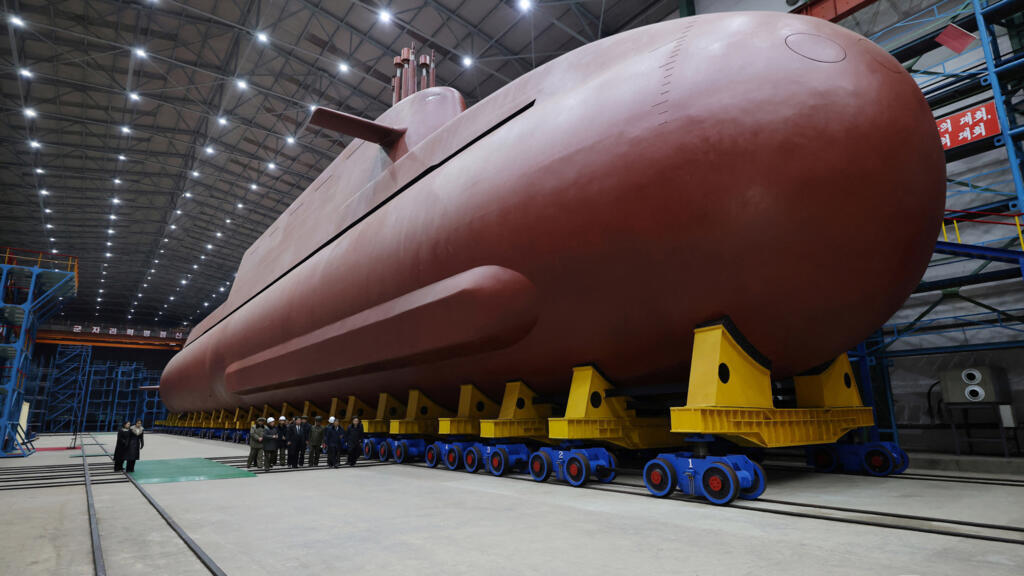
Kim Jong Un is no longer content with a "fortress mainland" strategy. The recent inspection of a new, large-scale destroyer and the explicit pledge to arm the North Korean Navy with tactical nuclear weapons represents a fundamental shift in Pyongyang’s military doctrine. For decades, the Korean People's Navy (KPN) was a coastal force—a collection of aging, noisy submarines and fast-attack craft designed for hit-and-run skirmishes. That era is dead. By integrating the Hwasal-2 cruise missile and the Haeil underwater drone into a new class of surface combatants, North Korea is attempting to create a "blue water" nuclear deterrent that complicates American and South Korean missile defense in ways a silo-based ICBM cannot.
The core of this strategy isn't just about prestige. It is about survivability. While fixed launch sites on land are easy to monitor via satellite, a nuclear-armed destroyer hidden among the jagged coastlines of the East Sea creates a permanent shell game for Western intelligence. Recently making headlines recently: Finland Is Not Keeping Calm And The West Is Misreading The Silence.
The Engineering of a Nuclear Destroyer
The vessel at the center of this buildup is a departure from previous North Korean naval architecture. Historically, their ships were derivatives of Soviet-era hulls like the Najin class. This new platform, however, shows a distinct move toward stealth shaping and vertical launch systems (VLS). Stealth in this context does not mean invisibility; it means reducing the Radar Cross Section (RCS) enough to delay detection by carrier strike groups.
Modern naval warfare is dictated by the "anti-access/area-denial" (A2/AD) bubble. If North Korea can successfully mount nuclear-tipped cruise missiles on these ships, they effectively extend their nuclear umbrella hundreds of miles out to sea. This forces the U.S. Navy to keep its high-value assets, like aircraft carriers, further away from the peninsula. Further details regarding the matter are covered by The Washington Post.
The technical challenge remains the propulsion and stability. To carry a heavy VLS battery and the associated radar arrays, a ship requires significant displacement. Observers note that the hull design suggests a focus on stability in rougher waters, indicating that Kim Jong Un intends for these ships to venture far beyond the 12-mile limit.
Why the Sea Matters Now
Pyongyang has watched the war in Ukraine with intense interest. They have seen how relatively inexpensive maritime drones and cruise missiles can neutralize a larger, more traditional navy. But where Ukraine uses conventional explosives, Kim Jong Un is doubling down on "tactical" miniaturized warheads.
The "why" is simple. If the United States believes it can take out North Korea’s land-based missiles in a first strike, the deterrent fails. But if a nuclear-armed destroyer is patrolling the Sea of Japan, the U.S. faces a "second strike" capability that is much harder to track. This is the North Korean Naval Nuclear Triad.
The Haeil Factor
The most overlooked aspect of this naval expansion is the integration of the Haeil unmanned underwater vehicle. While the destroyer acts as the visible symbol of power, these "radioactive tsunamis"—as Pyongyang calls them—are designed to be launched from surface ships or submarines to detonating near enemy ports.
The engineering reality of a nuclear-armed drone is terrifyingly efficient. It doesn't need to be fast. It only needs to be quiet. By using the new destroyer as a mothership for these drones, North Korea creates a mobile launch platform that can strike Busan or Tokyo with almost zero warning.
The Russian Connection and Technical Leaps
Critics often dismiss North Korean hardware as "parade pieces" or "smoke and mirrors." That is a dangerous mistake. The speed at which North Korea has moved from primitive rockets to solid-fuel ICBMs and sophisticated naval hulls suggests a massive influx of external expertise.
Since the 2023-2024 warming of relations between Moscow and Pyongyang, there is high confidence among analysts that Russian naval architecture and electronic warfare suites are finding their way into North Korean shipyards. Russia needs shells for its war; North Korea needs the blueprints for modern naval sensors and noise-reduction technology.
- Satellite Guidance: Integration with Russian GLONASS or refined North Korean satellite tech for mid-course cruise missile corrections.
- AIP Systems: Potential for Air-Independent Propulsion (AIP) in future submarine variants, though currently focused on surface hull stability.
- Composite Materials: Increased use of radar-absorbent coatings to mask the ship’s profile.
A Crisis of Regional Missiles
The South Korean response, known as the "Kill Chain" strategy, relies on preemptive strikes. But how do you preemptively strike a moving target that might be hiding in a sea-cave or a fog-shrouded bay? The introduction of the nuclear-capable Hwasal-2 on these ships changes the math.
Unlike ballistic missiles, which follow a predictable arc, cruise missiles fly low and can maneuver. When launched from a ship, they can approach their target from the sea, bypassing many of the land-based radar systems pointed toward the North Korean border. This creates a "blind spot" in the defense of Seoul and Tokyo.
We are seeing the birth of a maritime insurgency on a national scale. Kim Jong Un is not trying to match the U.S. Navy ship-for-ship. He is trying to make the cost of American intervention so high—and the risk of a naval nuclear exchange so certain—that the U.S. is forced to rethink its presence in the Indo-Pacific.
The Economic Strain of Naval Ambition
Steel and sensors are expensive. For a country under heavy sanctions, building a modern destroyer is a monumental drain on resources. This suggests that the Kim regime has prioritized the navy over almost all other conventional military branches. This is a gamble. If these ships are sunk early in a conflict, North Korea loses a massive percentage of its strategic worth.
However, the propaganda value within North Korea is equally vital. Kim is presenting himself as the commander of a "world-class" naval power. This bolsters internal loyalty during periods of food insecurity and economic hardship. The image of the leader on the bridge of a sleek, modern warship is a powerful tool for domestic control.
The hardware is real. The intent is clear. The North Korean Navy is no longer a collection of coastal patrol boats; it is becoming a mobile, nuclear-armed extension of the regime's survival instinct.
You can monitor the specific sea-trial coordinates of these new vessels by tracking the "No-Sail" zones recently issued in the East Sea.