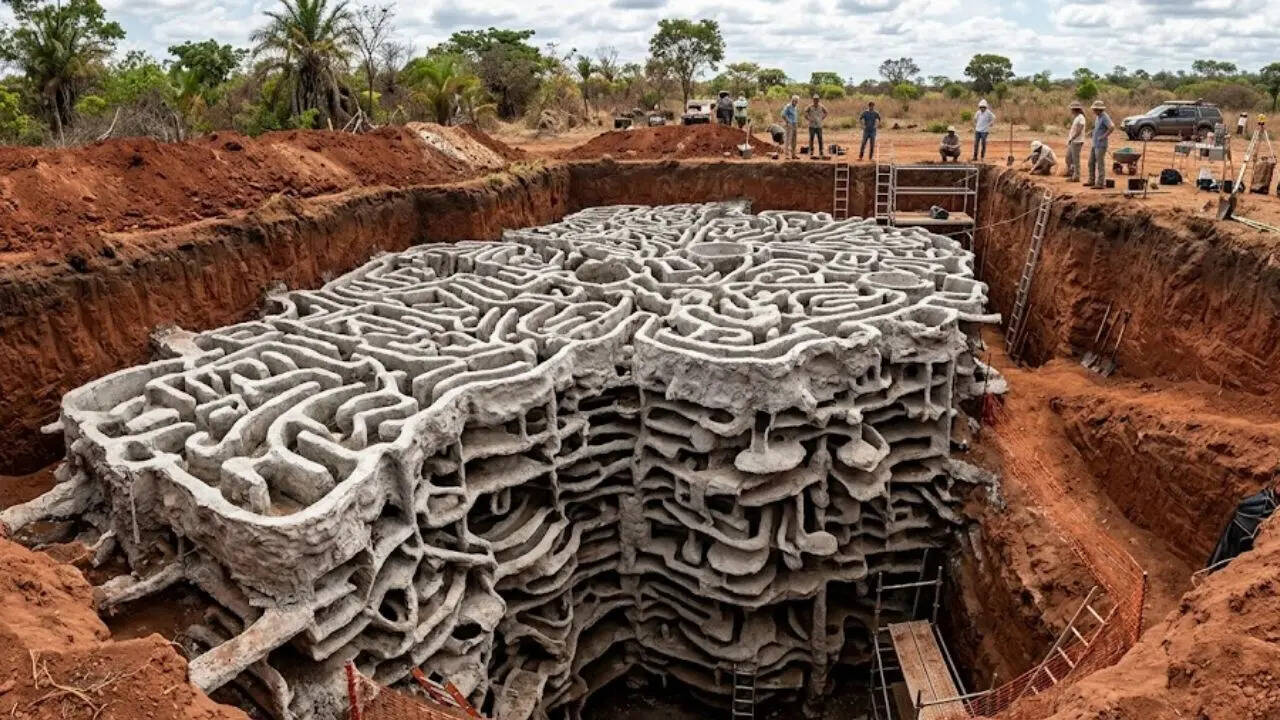
The internet loves a spectacle, and nothing fed the viral beast quite like the footage of scientists pouring ten tons of liquid concrete into a Brazilian field. We’ve all seen the headlines. They call it a "megacity." They compare it to the Great Wall of China. They marvel at the "hidden civilization" of Atta laevigata.
But here is the reality: calling this a "city" is a fundamental misunderstanding of biological engineering. We are projecting human urban planning onto a system that functions more like a respiratory organ than a municipality. The viral fascination with the sheer scale of the excavation—which moved 40 tons of earth—misses the far more provocative truth about how leafcutter ants actually manage thermodynamics and waste.
Stop looking at the concrete cast as a map of streets. It is a map of a massive, subterranean lung.
The Concrete Fallacy
The most egregious error in the popular narrative is the assumption that the complexity of the structure implies a "master plan" or a centralized intent. The 2011 excavation led by Professor Luis Forgi (and often attributed to the work of Bert Hölldobler and E.O. Wilson) revealed a labyrinth reaching 26 feet underground.
The "shock" expressed by mainstream media stems from a failure to grasp stigmergy.
In human construction, we require blueprints. We require a hierarchy. We require a project manager who understands the final form. Ants require none of that. Stigmergy is a mechanism of indirect coordination where the trace left in the environment by an individual—a pheromone deposit or a specific clump of soil—serves as the stimulus for the next individual to act.
When you look at those massive concrete pillars, you aren't looking at "architecture" in the human sense. You are looking at the physical manifestation of a feedback loop. The "city" wasn't "built"; it emerged. To call it a city is to anthropomorphize a biological process until it loses all scientific meaning. It’s like calling a beehive a "condominium complex." It’s technically descriptive but intellectually bankrupt.
Ventilation is the Only Metric That Matters
Mainstream reports focus on the "highways" connecting the chambers. They miss the oxygen.
A colony of millions of leafcutter ants isn't just a collection of insects; it is a massive, heat-generating biomass. These ants don't even eat the leaves they harvest. They use them to farm a specific type of fungus, Leucoagaricus gongylophorus. This fungus is incredibly sensitive. If the CO2 levels rise too high or the temperature fluctuates by more than a few degrees, the fungus dies. If the fungus dies, the colony starves.
The structure you see in that Brazilian field is a sophisticated heat-exchange system. The tunnels are angled specifically to exploit the Bernoulli principle.
$$P + \frac{1}{2}\rho v^2 + \rho gh = \text{constant}$$
By creating openings at different elevations and wind exposures, the ants generate a passive pressure gradient. Surface breezes across the higher mounds pull stale, CO2-heavy air out of the deep chambers, while fresh oxygen is drawn in through the lower peripheral tunnels.
When the researchers poured that concrete, they didn't just fill a "city"; they filled a circulatory system. The vastness of the structure isn't an ego project by a "queen"—it is the minimum viable surface area required to keep a subterranean fungal farm from suffocating under its own metabolic heat.
The Myth of the "Shocking" Discovery
The media framed this as a "hidden" world suddenly brought to light, as if we had no idea ants were capable of large-scale excavation. This is historical revisionism for the sake of clicks.
Myrmecologists have understood the scale of Atta colonies for decades. What was actually significant about the Brazil excavation wasn't the size, but the spatial distribution of the refuse chambers.
In any high-density population, waste management is the primary bottleneck. Leafcutter ants have dedicated "garbage man" castes. These workers spend their entire lives moving waste to specific external or deep-subsurface pits. They are effectively quarantined; they don't interact with the rest of the colony to prevent the spread of pathogens.
The Brazilian site showed that these waste pits were positioned with surgical precision to avoid contaminating the fungal gardens. This isn't a "city" with a "sewer system." It is a biological body that has evolved to put its kidneys as far away from its mouth as possible.
The Cost of the Concrete Test
Let’s talk about the methodology, because this is where the "lazy consensus" gets uncomfortable. To visualize this structure, scientists pumped 10 tons of concrete into a living, functioning ecosystem.
I’ve seen researchers justify this by saying the colony was "abandoned." Maybe it was. But the reality is that we destroyed the very thing we were trying to understand to turn it into a museum piece. We solidified a dynamic, shifting process.
An ant nest is not a static object. It is a fluid. It grows, contracts, and shifts daily based on moisture levels and the health of the fungus. By turning it into a concrete statue, we’ve created a snapshot that people now mistake for the permanent "design" of the species.
Imagine trying to understand how a human heart works by filling it with quick-drying resin while the patient is running a marathon. You’d get the shape, sure. But you’d lose the pulse. You’d lose the movement of the valves. You’d lose the essence of the thing.
Why Scale is the Wrong Metric
"It covers 500 square feet!" the articles scream.
Who cares?
Scale is the least interesting thing about Atta laevigata. The real disruption to our understanding of technology and labor lies in their energy efficiency.
Humans require massive external energy inputs to maintain a city: electricity, fossil fuels, complex supply chains. A leafcutter colony operates on the energy harvested from local biomass, processed through a symbiotic relationship with a fungus that is found nowhere else in nature.
They have solved the problem of sustainable, high-density living without a single watt of generated power.
- Waste Management: 100% recycling rate within the ecosystem.
- Climate Control: Zero-energy passive ventilation.
- Labor Distribution: Decentralized, stimulus-driven task allocation.
If we want to learn from the Brazilian "city," we need to stop gawking at the size of the holes and start looking at the logic of the voids. We are obsessed with the "stuff"—the concrete, the dirt, the tunnels. We should be obsessed with the air.
The Problem with Your "Megacity" Questions
People always ask: "How did they know where to dig?" or "Who told them to build the highway?"
The premise is flawed. No one "knows" where to dig. No one is "told" to build.
If you want to understand this, you have to abandon the idea of the individual. In a colony of this size, the individual ant is not the organism. The colony is the organism. The tunnels are its pores. The fungus is its stomach. The "megacity" is simply the exoskeleton of a collective intelligence that is far more efficient than any human urban sprawl.
We call it a "shocking discovery" because we are arrogant enough to think that complexity requires a "thinker." It doesn't. It just requires time, a consistent set of environmental pressures, and a feedback loop that rewards efficiency over ego.
The concrete cast in Brazil isn't a testament to "ant architects." It is a tombstone for our misunderstanding of how the natural world actually scales. We see a city because that's the only way we know how to organize ourselves. The ants see a lung. And the lung is breathing just fine without our metaphors.
Stop looking for a city. Start looking for a system.