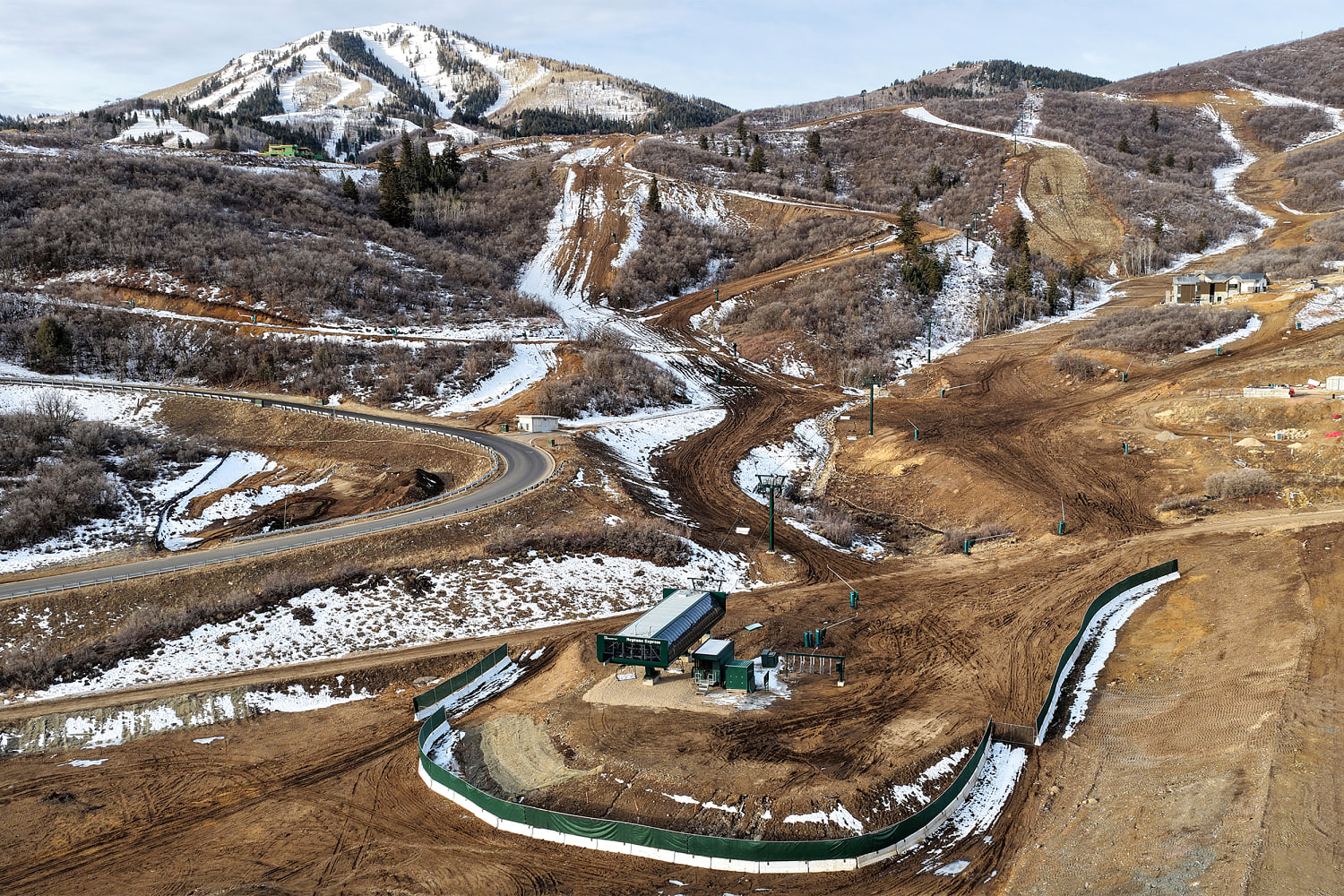
The media loves a predictable apocalypse. Every spring, the same tired narrative resurfaces: a "snow drought" in the Sierras or the Rockies means we are all going to burn by August. They point to brown patches where there should be white powder, check the SNOTEL data like it's a doomsday clock, and tell you to prepare for the worst.
They are right about the fire, but they are dead wrong about the reason.
The "snow drought equals wildfire" logic is a lazy mental shortcut that ignores the actual mechanics of forest ecology. In fact, if you’re terrified of a dry winter, you’re missing the much more dangerous reality of a "wet" one. I have spent years looking at the data from the National Interagency Fire Center (NIFC) and talking to the people who actually drop into these burns. The secret they won’t tell you? A heavy snowpack is often just a massive fertilizer injection for the very fuel that kills people.
The Green Up Trap
The general public operates on a binary: Wet is good, dry is bad. If it rains or snows, the fire risk goes away. If it’s dry, the risk goes up. This is a fundamental misunderstanding of fuel loading.
When we have a massive snow year, it doesn’t just "dampen" the ground. It fuels a "green up" of fine herbaceous fuels—grasses, invasive cheatgrass, and small shrubs. These plants grow at an exponential rate when the soil is saturated. Then, inevitably, the summer heat hits. Those lush green hills turn into billions of tons of standing tinder.
A "snow drought" actually limits the growth of these fine fuels. Without the moisture to sprout, the "fuel bed" remains thin. You can have a record-breaking dry year and a relatively mild fire season because there simply wasn't enough new growth to carry the flames from tree to tree.
The industry calls this the "Cheatgrass Cycle." It’s a vicious feedback loop that traditional reporting completely ignores because "Snow is good" is an easier headline to sell than "Ecological complexity dictates that moisture is a precursor to combustion."
The Temperature Delusion
The competitor's article screams about warm weather. Again, they’re looking at the wrong thermometer.
Wildfire risk isn't dictated by the absolute temperature in May; it’s dictated by the Vapor Pressure Deficit (VPD). This is the difference between how much moisture the air can hold and how much it actually contains.
$VPD = e_s - e_a$
Where $e_s$ is the saturation vapor pressure and $e_a$ is the actual vapor pressure.
When the VPD is high, the air literally sucks the moisture out of the living needles and dead wood. You can have a cool, 70-degree day with a massive VPD that creates more fire risk than a 95-degree day with high humidity. By focusing purely on "warm weather," the mainstream media ignores the atmospheric thirst that actually turns a forest into a matchbox.
The Fire Suppression Paradox
Stop trying to "prevent" fires. That is the very mindset that got us into this mess.
For a century, we followed the "10 a.m. Rule"—every fire must be out by 10 a.m. the next day. We treated fire like a disease rather than a biological necessity. The result? We’ve created "zombie forests." These are ecosystems with unnaturally high densities of small-diameter trees and a massive buildup of "duff" (dead needles and branches) on the forest floor.
When you have a snow drought, it’s actually the perfect time for Managed Wildfire. If the ground is dry but the winds are low, we should be letting it burn. But because of the "Snow Drought Panic," political pressure forces agencies to suppress everything. We keep the lid on the pressure cooker while the fuel loads keep climbing.
If you want to stop the "Mega-fires," you have to stop crying about the snow and start demanding more smoke in the air during the off-season. We are currently in a "fire deficit," not just a snow drought. We owe the land a debt of flame, and the interest rate is paid in destroyed homes and charred towns.
The Problem With "Wildfire Risk" Maps
Most people look at a wildfire risk map and think it’s a static property of their ZIP code. It’s not. It’s a snapshot of a moving target.
The "Risk" is composed of three things:
- Ignition Probability: Humans (power lines, campfires, cigarettes).
- Fire Behavior: Fuel, weather, and topography.
- Values at Risk: Your house, the power grid, the watershed.
A snow drought only affects #2, and even then, only temporarily. It does nothing to address the fact that we keep building "McMansions" in the Wildland-Urban Interface (WUI). We are building tinderbox communities in the middle of a landscape that evolved to burn.
I’ve seen developers build high-end subdivisions in areas of the Oregon Cascades that have a return-interval for fire of less than 50 years. Then, when a fire inevitably shows up, they blame "climate change" or a "dry winter" instead of their own architectural arrogance.
Why Your "Fire-Wise" Landscaping is Mostly Theater
You’re told to rake your leaves and trim your bushes. That’s cute. But in a high-intensity crown fire driven by a 40-mph wind, those embers are traveling two miles ahead of the main front. They aren't going to care if your rose bushes are trimmed.
If your roof is made of wood shakes and your vents aren't ember-proofed, your house is a furnace waiting for a spark. The focus on "snow drought" shifts the responsibility away from individual home hardening and back onto the "weather," which is a convenient scapegoat for poor urban planning.
The Myth of the "Permanent" Drought
The term "snow drought" implies a temporary aberration. In reality, what we are seeing in the West is Aridification.
It’s not a drought. A drought implies it’s going to end and go back to "normal." Aridification means the baseline has moved. We need to stop waiting for the "big snow year" to save us. Even when we get a big snow year—like the West did in 2023—it doesn't fix the underlying structural deficit in the soil and the reservoirs.
[Image showing the difference between a temporary drought and long-term aridification in the Colorado River Basin]
We are managing a 21st-century ecological shift with a 20th-century mindset. We talk about "fighting" fire like it's a war we can win. You don't "win" against an elemental force. You negotiate with it.
Stop Asking "When Will it Rain?"
People also ask: "How much snow do we need to end the fire season?"
This is the wrong question. The right question is: "How much fuel is on the ground, and how much are we willing to let burn?"
If we have a record snowpack, it just delays the start of the season. It doesn't cancel it. In many cases, it makes the late-season fires more intense because of the increased grass load I mentioned earlier.
The obsession with snow levels is a form of climatological procrastination. It allows us to ignore the hard work of mechanical thinning, prescribed burns, and zoning laws. It’s much easier to look at a SNOTEL map and feel either relieved or panicked than it is to admit that our entire forest management strategy is a bankrupt relic of the Smokey Bear era.
The Hard Truth About Your Summer Plans
If you’re a hiker or a traveler, you’ve been told to avoid the woods during a "snow drought" year because it’s "dangerous."
Here is the counter-intuitive reality: A snow drought year is often the best time to be in the backcountry. Why? Because the trails are clear earlier, the stream crossings are safer, and the mosquito populations—which rely on standing meltwater—are decimated.
The risk of being caught in a wildfire is statistically lower than the risk of dying in a car accident on the way to the trailhead. But the "Snow Drought" alarmism keeps people locked in their air-conditioned homes, disconnected from the very landscape they claim to want to protect.
We have pathologized the weather. We have turned a lack of frozen water into a moral failing of the planet. It’s time to grow up and realize that the West is a fire-dependent ecosystem. Whether the snow falls or it doesn't, the fire is coming. The only thing we get to decide is how much control we want to have when it arrives.
Stop staring at the sky. Look at the brush in your backyard. That's where the real drought is—a drought of common sense in how we inhabit the woods.
Get your vents screened. Buy a HEPA filter for the smoke. And for the love of the Sierras, stop thinking a blizzard in March is going to solve a problem we’ve been building for a century.