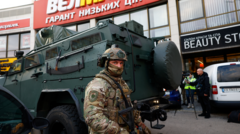
The incident in Kyiv, resulting in at least six fatalities during a coordinated small-arms assault and hostage-taking event, represents a failure in early-stage threat detection within an urban theater already strained by external military pressure. To understand the gravity of this breach, one must move past the emotional surface of the casualty count and examine the Urban Siege Triad: tactical penetration, psychological leverage via hostages, and the systemic response latency of local security forces. In a city where the threat profile is typically defined by long-range kinetic strikes, the pivot to close-quarters asymmetric violence creates a specific set of operational challenges that standard municipal policing is rarely equipped to neutralize without significant collateral risk.
The Mechanics of Urban Penetration
The success of a gunman in an urban center like Kyiv depends on a specific sequence of logistical and tactical maneuvers. The attacker exploits the "Gray Zone" of city life, where high-density populations provide natural camouflage for the movement of small arms and tactical gear.
Structural Vulnerability Analysis
Every building targeted for a hostage situation possesses a Containment Index. This is defined by the number of ingress/egress points relative to the available floor space and the presence of internal structural barriers. In the Kyiv event, the attacker likely identified a "Bottleneck Site"—a location where a limited number of exits could be covered by a single high-rate-of-fire weapon.
- Entry Dynamics: The transition from a concealed state to an active threat state occurs in seconds. The initial five minutes of such an assault determine the maximum potential casualty rate.
- Ammunition Logic: Fatalities are rarely the result of random fire. They are the product of "High-Probability Targeting," where the assailant focuses on clustered groups during the initial panic phase before shifting to a defensive posture.
The Hostage Variable as a Defensive Buffer
The shift from an active shooter scenario to a hostage situation changes the objective from simple liquidation to strategic stalemate. For the assailant, hostages serve as Human Shields (Physical) and Political Capital (Psychological).
The Hostage Valuation Function
The value of a hostage to an attacker is inversely proportional to the aggression of the responding force. If the state demonstrates a "Zero-Negotiation Bias," the hostage’s value drops, often leading to immediate execution. However, in Kyiv, the presence of six initial fatalities suggests the attacker utilized the threat of further executions to establish a "Kill-Free Buffer Zone," forcing a tactical pause from the SBU (Security Service of Ukraine) or local police.
- Isolation: The first priority of the gunman is to sever the hostages' communication with the outside world, preventing real-time intelligence on internal positioning.
- Attrition: Hostage situations are games of physiological endurance. Every hour that passes increases the cognitive load on the negotiator and the physical exhaustion of the tactical team, while the attacker manages their adrenaline through controlled periodic violence.
Response Latency and the Tactical Gap
The time elapsed between the first shot and the deployment of a specialized counter-terrorism unit is known as the Tactical Gap. In an active war zone, this gap is often distorted. While there is a high concentration of armed personnel, their training is frequently geared toward front-line infantry combat rather than high-precision urban hostage recovery.
Resource Misallocation
In Kyiv, the primary defensive posture is oriented toward air defense and sabotage detection. A localized mass shooting creates a "Cognitive Dissonance" for command structures. They must determine if the event is a criminal act, a rogue military incident, or a coordinated diversion for a larger external operation. This determination phase creates the window in which the casualty count rises from "initial" to "final."
- Intelligence Failure: The ability to smuggle weapons into a secured capital suggests a breakdown in the Checkpoint Efficiency Ratio.
- Perimeter Management: Effective response requires a dual-perimeter approach. An inner perimeter contains the threat, while an outer perimeter manages the inevitable influx of civilian observers and secondary threats.
Quantifying the Socio-Political Impact
Beyond the immediate loss of life, an event of this nature in a national capital acts as a force multiplier for psychological instability. It signals to the population that the "Front Line" is not a geographic location, but a persistent state of vulnerability.
The Confidence Decay Curve
Security in a capital city relies on the public's perception of state omnipotence. When a single gunman can seize a central location and dictate terms for any length of time, the Social Contract of Protection undergoes a stress test.
- The Second-Order Effect: The six deaths in Kyiv will likely lead to an immediate tightening of internal security protocols, which simultaneously increases safety and decreases urban efficiency. This is a "friction tax" imposed by the attacker on the city’s economy.
- Media Amplification: The gunman utilizes the global media cycle to bypass military censorship. By taking hostages, they ensure that the event cannot be ignored or downplayed, forcing the government to address the breach publicly.
Tactical Evolution of Urban Assaults
The Kyiv incident is not an isolated tragedy; it is an evolution in urban warfare. As high-tech defenses (like Iron Dome or Patriot systems) make long-range attacks more difficult or expensive, asymmetric actors revert to low-tech, high-impact "Retail Terrorism."
Proactive Mitigation vs. Reactive Containment
The current model for urban security is reactive. Units wait for a breach to occur before deploying. A data-driven alternative requires Predictive Behavioral Mapping, identifying individuals or groups with the logistical capacity to execute such an operation before they enter the "Red Zone" of the city center.
- Hardware Tracking: Monitoring the black market for specific ammunition types used in high-capacity urban strikes.
- Simulated Stress Testing: Municipalities must run "Broken Building" drills that specifically address hostage situations in high-traffic commercial zones, distinct from standard fire or bomb drills.
The immediate strategic priority for Kyiv’s internal security apparatus is to conduct a Deep-State Forensic Audit of the weapons' origin. If the hardware was sourced from internal military stockpiles, the threat is a systemic leakage. If it was smuggled, the threat is a border permeability issue. The resolution of this hostage crisis—regardless of the final body count—will dictate the internal movement restrictions for millions of citizens over the next fiscal quarter. The state must now choose between maintaining an open, resilient capital or transforming Kyiv into a "Hardened Core" where every public space is treated as a potential combat zone.