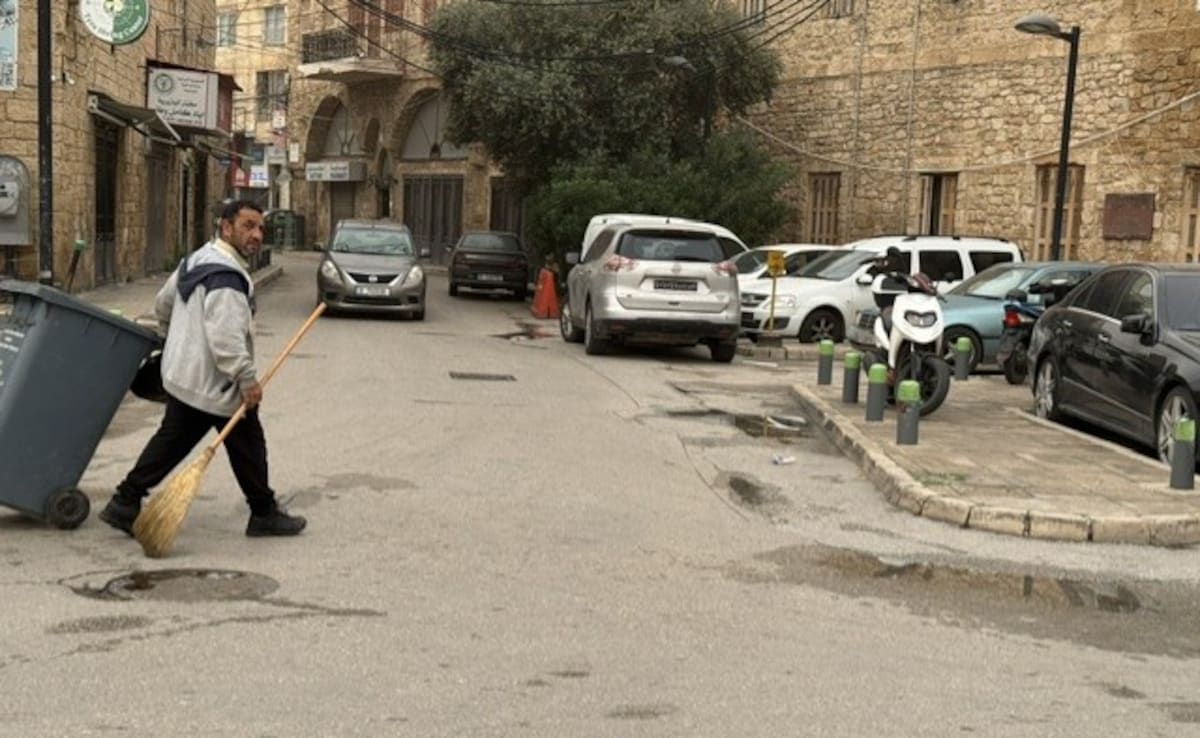
In active combat zones, the collapse of civil infrastructure often precedes secondary health crises that can rival the kinetic conflict in total lethality. The persistence of sanitation services in Lebanon during periods of intensive bombardment is not a matter of civic sentimentality; it is a complex feat of distributed logistics and risk-managed labor. When standard municipal frameworks fragment under fire, the maintenance of waste management cycles functions as a critical barrier against the biological acceleration of disaster. To understand how these systems "keep the streets alive," one must analyze the intersection of labor vulnerability, logistical bottlenecks, and the decentralized governance that prevents total systemic failure.
The Triad of Urban Stability
The survival of an urban center during a blockade or bombardment relies on three interlocking pillars of sanitation. Failure in any single vector initiates a feedback loop of decay that renders the environment uninhabitable regardless of the military situation.
- Pathogen Suppression: The immediate removal of organic waste prevents the emergence of vector-borne diseases such as cholera, typhoid, and leptospirosis. In the Mediterranean climate, the decomposition rate of organic matter accelerates during the summer months, shortening the window for collection from days to hours.
- Structural Mobility: Accumulated waste creates physical blockages. In narrow urban corridors, uncollected refuse restricts the movement of emergency vehicles, including ambulances and civil defense units. Sanitation is, therefore, a prerequisite for all other emergency responses.
- Psychological Normalcy: The visual presence of waste signals a breakdown in the social contract. Regular collection serves as a non-verbal indicator of administrative persistence, which is vital for maintaining the internal stability of the remaining civilian population.
The Labor Risk Architecture
The workers maintaining these systems operate within a specific risk architecture that differs from both combatants and standard civilians. Most sanitation labor in Lebanon is performed by migrant populations or economically marginalized citizens who face a binary choice between high-risk exposure and total loss of subsistence.
The Exposure Function
The risk to a sanitation worker is defined by the function of Time on Street (ToS) multiplied by Proximity to Strategic Assets (Pa). Garbage trucks are slow-moving, large-signature targets that must follow predictable routes. Unlike private vehicles that can navigate sporadically, waste management requires a sequential "stop-and-start" pattern. This pattern increases the ToS, making the crew vulnerable to misidentification or "double-tap" strikes where a secondary hit occurs shortly after an initial engagement.
Resource Scarcity and Maintenance
In a conflict environment, the supply chain for specialized machinery disintegrates. The "Value of the Asset" (the truck) often exceeds the "Cost of Labor." When parts are unavailable due to border closures or port strikes, the fleet undergoes rapid cannibalization. Technicians must maintain hydraulic systems and compactors using substandard materials, leading to a higher frequency of mechanical failures. A breakdown in a "red zone" is not merely a logistical delay; it is a life-threatening event where the crew must choose between abandoning a million-dollar asset or attempting a field repair under fire.
Logistical Bottlenecks and Displacement Stress
The geography of waste management in Lebanon is defined by a centralized-to-decentralized shift. Under normal conditions, waste is moved from points of origin to large-scale landfills or processing plants. During bombardment, the "Primary Transit Route" is frequently severed.
- Access Restricted Zones: Certain neighborhoods become inaccessible due to debris or active targeting. This creates "Waste Islands" where refuse accumulates beyond the capacity of local containers.
- Landfill Overreach: If a major landfill—such as those near the coast or border regions—falls within a combat zone, the entire city’s waste flow must be rerouted. This increases the "Ton-Mile" cost of collection and strains the fuel reserves of the municipal fleet.
- Displaced Population Spikes: When residents flee from high-intensity zones to perceived safe havens, the waste output of those "safe" areas can triple overnight. The infrastructure in these receiving zones is rarely scaled for such surges. This results in "System Saturation," where the local bin capacity and collection frequency are outstripped by the sheer volume of human activity.
The Decentralization of Responsibility
The reason the Lebanese system has not completely buckled lies in its inherent fragmentation. While a centralized system is efficient, it is also fragile. Lebanon’s reliance on a mix of private contractors (like RAMCO or CityBlu), municipal unions, and local NGOs creates a redundant, "Hydra-headed" network.
When the central state fails to provide funding or direction, local mukhtars (village leaders) and municipal councils often take direct control of the process. They secure fuel through the black market or local donations and organize ad-hoc crews. This Hyper-Local Sovereignty ensures that even if the national grid or ministry collapses, the street-level collection continues through informal social hierarchies.
However, this decentralization has a ceiling. Localized efforts cannot manage long-term environmental hazards like leachate (the toxic liquid that drains from landfills). Without national coordination, the focus shifts from "Waste Management" to "Waste Displacement"—simply moving the problem from the street to a nearby valley or vacant lot. This solves the immediate urban mobility problem but creates a decades-long ecological and health liability.
The Fuel and Energy Constraint
Sanitation is fundamentally an energy-intensive industry. A standard compactor truck consumes significant diesel, especially when idling during the loading process. In a conflict, fuel becomes a weaponized commodity.
- Prioritization Conflict: Municipalities must choose between fueling water pumps, hospital generators, or garbage trucks. In these trade-offs, sanitation often drops in priority until the smell and public health risk become untenable.
- The Black Market Premium: When official fuel supplies are cut, the cost per ton of waste collected rises exponentially. This creates a "Fiscal Deficit" that municipalities cannot fill, leading to a reliance on international aid or emergency grants from organizations like the UNDP or UNICEF.
Operational Limitations of Current Models
The current "heroic persistence" model is unsustainable for long-duration conflicts. The psychological toll on workers, combined with the physical degradation of equipment, leads to a "Failure of Attrition."
One significant limitation is the lack of armored or "hardened" sanitation equipment. In high-risk zones, waste collection is often restricted to the pre-dawn hours. While this reduces the risk of being caught in daytime skirmishes, it limits the total volume that can be processed. Furthermore, the absence of standardized "Conflict-Zone PPE" leaves workers exposed not just to shrapnel, but to the hazardous materials—medical waste, unexploded ordnance (UXO), and caustic chemicals—that inevitably end up in the general waste stream during a war.
Strategic Realignment for Urban Resilience
To move beyond the narrative of "keeping streets alive" and into the realm of sustainable urban survival, the following structural adjustments are necessary for municipalities operating under fire.
Tactical Modularization
Shift from large, 20-ton compactor trucks to smaller, more agile units. While less efficient in terms of volume per trip, smaller vehicles are harder to target, can navigate debris-strewn streets, and represent a lower capital loss if destroyed. These units should be deployed in a "Swarm" pattern rather than a single, predictable route.
Waste Stream Separation at Source
The greatest risk in conflict zones is the mixing of organic waste with dry recyclables. Organic waste is the driver of disease. Municipalities must enforce a "Dry/Wet" separation at the household level, even during active fighting. If organic waste can be composted locally in small-scale pits, the volume of waste requiring high-risk transport is reduced by up to 60%.
Formalizing Informal Labor Protections
Sanitation workers must be reclassified as "Essential Emergency Personnel," granting them the same status and protections (and potentially the same deconfliction protocols) as Red Cross or Civil Defense workers. This includes providing life insurance and specialized training for identifying UXOs within the waste stream.
Decentralized Leachate Management
Municipalities must invest in portable, small-scale treatment kits to handle runoff from temporary dump sites. This prevents the permanent contamination of groundwater, which is often the only source of water when central pumping stations are bombed.
The maintenance of sanitation in Lebanon is a study in the resilience of necessity. It is a system that functions not because of high-level strategic planning, but because the alternative is a rapid descent into an unrecoverable bio-hazard environment. The true metric of urban survival in a conflict is not just the ability to withstand impact, but the ability to process the metabolic output of the remaining population. Any military or humanitarian strategy that ignores the mechanics of waste collection will eventually find the territory it seeks to protect or control rendered uninhabitable by its own neglect. Moving forward, the focus must shift from reactive "heroism" to the hardening of the logistical infrastructure that allows these essential cycles to persist.