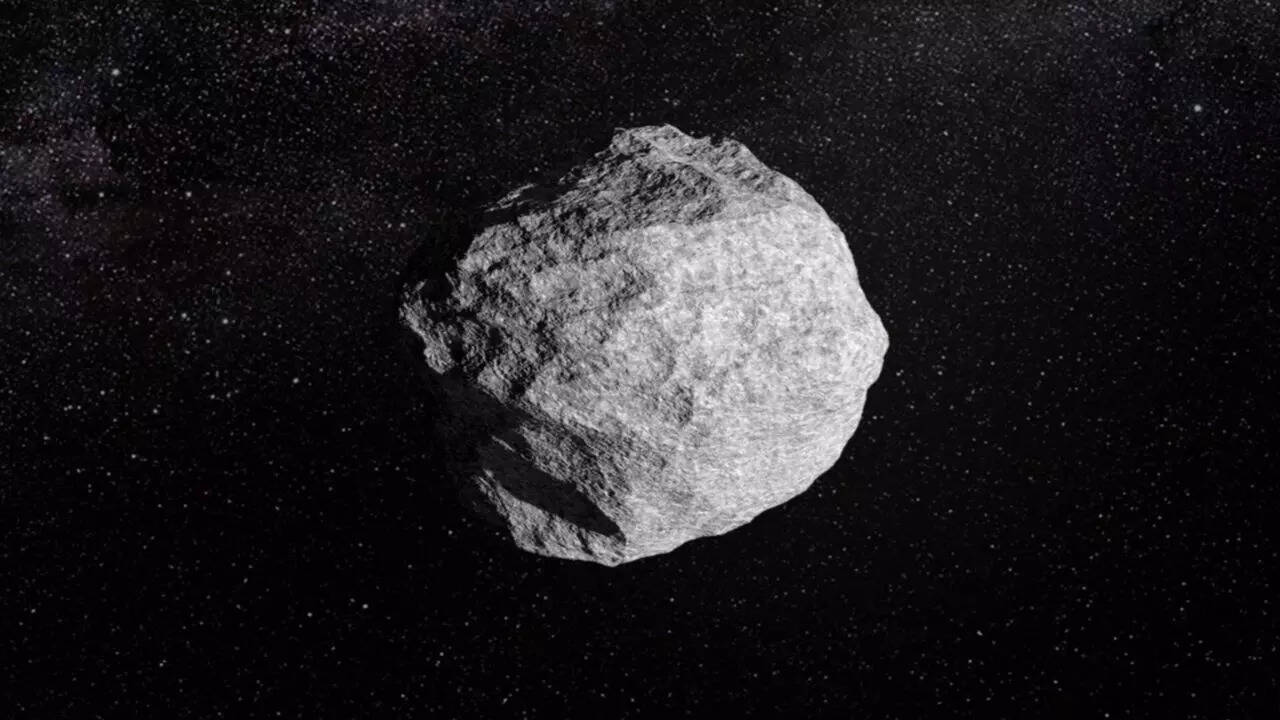
The removal of Asteroid 2024 YR4 from the Sentry Impact Monitoring Scale is not an isolated event of "correction" but a demonstration of the narrowing variance in celestial mechanics. When this near-Earth object (NEO) was first detected in late 2024, the initial sparse data points created an observation arc so short that the mathematical uncertainty of its 2032 trajectory encompassed the Moon’s orbital volume. As of early 2026, the integration of new radar astrometry and extended optical tracking has collapsed that probability density function, shifting the 2032 encounter from a potential impact scenario to a standard close approach.
The transition from a "high-risk" designation to a "zero-risk" status reveals the three-stage lifecycle of impact assessment: detection, uncertainty propagation, and atmospheric/orbital refinement.
The Geometry of Uncertainty
Orbital determination is fundamentally a problem of statistical regression. When a new asteroid is discovered, its position is known, but its velocity vector—specifically its direction and magnitude in 3D space—carries a margin of error.
- The Observation Arc: This is the time elapsed between the first and last recorded sightings. A 24-hour arc provides a crude line; a 100-day arc provides a refined ellipse.
- The Virtual Impactors (VIs): Because the exact path is unknown, astronomers create thousands of "virtual asteroids" within the range of mathematical possibility. If one of these virtual paths intersects a celestial body, an impact probability is assigned.
- The Keyhole Effect: For 2024 YR4, the initial data suggested the asteroid might pass through a "gravitational keyhole"—a specific region of space where Earth's or the Moon's gravity would deflect the object just enough to ensure a collision on a subsequent pass.
The "confirmation" that 2024 YR4 will miss the Moon is the result of the observation arc growing long enough to prove that none of the remaining valid orbital solutions intersect the lunar disk.
Quantifying the Sentry Risk Table
The Sentry system, managed by NASA’s Center for Near-Earth Object Studies (CNEOS), utilizes the Palermo Technical Impact Hazard Scale. This scale is logarithmic, comparing the likelihood of the detected potential impact to the "background risk" posed by objects of the same size over the intervening years.
2024 YR4 peaked at a level that demanded immediate prioritized tracking. The object, estimated at roughly 50 to 80 meters in diameter, carries a kinetic energy profile capable of causing significant regional damage—comparable to or exceeding the 1908 Tunguska event.
$KE = \frac{1}{2}mv^2$
In this equation, the mass ($m$) is a derivative of the asteroid's brightness (absolute magnitude) and assumed albedo (reflectivity). If the asteroid is darker than assumed, it is larger and more massive. The velocity ($v$) is determined by its solar orbit. For 2024 YR4, the relative velocity during the 2032 approach is high enough that even a glancing blow would result in a multi-megaton energy release.
The Role of Radar Astrometry in Risk Elimination
Optical telescopes measure the "angular" position of an object—where it is on the sky's dome. However, they are poor at measuring the precise distance (range) and the speed at which the object is moving toward or away from us (range-rate).
This is the bottleneck that initially kept 2024 YR4 on the risk list. To break the bottleneck, planetary radar (using facilities like Goldstone or the Canberra Deep Space Communication Complex) bounces radio waves off the asteroid.
- Range Precision: Radar can measure the distance to an asteroid millions of miles away with an accuracy of a few meters.
- Doppler Shift: By measuring the change in frequency of the returned signal, scientists determine the velocity to within millimeters per second.
Once radar data for 2024 YR4 was integrated into the JPL Horizons system, the "uncertainty ellipse" shrank by orders of magnitude. The center of that ellipse now sits comfortably outside the Moon’s orbital radius for the 2032 flyby.
Gravitational Perturbations and N-Body Simulations
Calculating an orbit for 2032 is not a simple two-body problem (Asteroid + Sun). It requires an N-body simulation that accounts for the gravitational pull of all major planets, the Moon, and even the largest asteroids like Ceres and Vesta.
The "Moon miss" is significant because the Moon is a small target relative to the vastness of cislunar space. For an asteroid to have been "on track" for a lunar impact, its trajectory had to be precise to within a fraction of a degree. The removal of 2024 YR4 from the risk list indicates that the non-gravitational forces—such as the Yarkovsky effect—have also been accounted for.
The Yarkovsky Effect: This is a minute force acting on a rotating asteroid caused by the uneven emission of thermal photons. Over decades, this "thermal thruster" effect can push an asteroid thousands of kilometers away from its predicted ballistic path. For an object the size of 2024 YR4, this effect is a critical variable in long-term (10+ year) predictions.
Structural Vulnerabilities in Global Detection
While 2024 YR4 is no longer a threat, the process highlighted a systemic gap in our detection infrastructure. The asteroid was "recovered" (found again after being lost) only because of its specific brightness and orbital tilt.
Current limitations include:
- Solar Blind Spots: Objects approaching from the direction of the Sun remain invisible to ground-based optical telescopes.
- South-Hemisphere Coverage: There is a historical lack of high-cadence survey telescopes in the Southern Hemisphere compared to the North.
- Small-Body Characterization: We are proficient at finding "planet killers" (1km+), but "city killers" like 2024 YR4 are often only found years or months before a close approach.
The resolution of the 2024 YR4 scare validates the current mathematical models used by CNEOS and ESA’s NEO Coordination Centre. It proves that the system is designed to "fail safe"—it overestimates risk when data is scarce and aggressively prunes that risk as data density increases.
The strategic priority shifts now to the next cohort of objects on the Sentry list. For any object with a Palermo Scale rating above -2, the protocol dictates a transition from survey-mode to characterization-mode. This involves multi-band photometry to determine composition (S-type, C-type, or M-type asteroids) and light-curve analysis to determine rotation period. These physical characteristics are the prerequisites for any kinetic impactor deflection mission, should the orbital math ever fail to move toward a zero-probability conclusion.
Maintain focus on the 2029 Apophis flyby as the next primary data-gathering window for refining these perturbation models.


