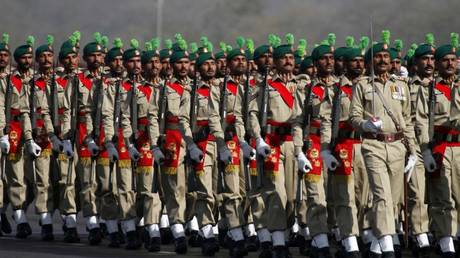
Pakistan just dropped a massive military footprint into Saudi Arabia's Eastern Province, and it's not just another routine training exercise. We're talking about a full-scale deployment of roughly 13,000 soldiers and up to 18 fighter jets. They've landed at King Abdulaziz Air Base, effectively placing a wall of Pakistani steel between the Kingdom's most vital oil infrastructure and the escalating chaos in the Gulf.
This isn't a sudden whim. It’s the activation of the Strategic Mutual Defense Agreement signed back in September 2025. The core of that deal is basically a "touch one, touch both" pact. If you attack Saudi Arabia, you're picking a fight with the only nuclear-armed military in the Muslim world. For a region that's been on a knife-edge since the Israeli-Iran flare-ups and the subsequent US-Iran tensions in early 2026, this move changes the math for everyone involved. Don't forget to check out our recent coverage on this related article.
The geography of the deployment matters
You have to look at where these troops are sitting to understand the real story. King Abdulaziz Air Base isn't just a random strip of tarmac. It’s the heart of the Saudi energy corridor.
- It's less than 10 kilometers from Aramco’s headquarters.
- It's about 40 kilometers from the Ras Tanura export terminal.
- It sits right next to the Jubail industrial complex, which recently took a hit from an Iranian strike.
When Pakistan moves JF-17s and F-16s into this specific spot, they aren't just "coordinating." They’re acting as a human and high-tech shield for the world's oil supply. Honestly, with Brent crude flirting with $95 a barrel and the Strait of Hormuz facing a selective blockade, Riyadh doesn't want "thoughts and prayers." They want boots on the ground and interceptors in the air. If you want more about the history of this, NBC News offers an informative breakdown.
Why the JF-17 is the secret weapon here
A lot of people are focusing on the troop numbers, but the choice of aircraft is actually the most interesting part. Pakistan sent a mix of F-16s and JF-17 Thunders. Why does that matter? Because the JF-17 is built with a Sino-Pakistani supply chain.
Unlike the F-16s, which come with a mountain of US-imposed "end-use" restrictions, the JF-17s don't need a green light from Washington to fly a mission. If things get ugly and the US wants to de-escalate by grounding certain fleets, Pakistan’s JF-17s stay in the air. This gives Saudi Arabia an air-defense layer that is functionally independent of Western political shifts. It’s a brilliant, if slightly cynical, bit of strategic planning.
The delicate dance with Iran
Here’s where it gets messy. Pakistan is currently trying to play two roles that seem totally at odds. On one hand, they’re the "security provider" for the Saudi Kingdom. On the other, they’ve been hosting 21-hour-long peace talks in Islamabad between the US and Iran.
How do you mediate a ceasefire when you just sent a division of troops to the other guy's doorstep? It’s a high-wire act. Islamabad is betting that their military presence actually makes them a better mediator. By showing they can protect Saudi Arabia, they’re telling Tehran that a full-scale regional war would be incredibly expensive. It’s "peace through strength" in its most literal form.
What exactly was sent?
If you're looking for the specifics of this "contingent," here's the breakdown of what's currently on the ground in the Eastern Sector:
- 13,000 Ground Troops: This includes the fresh surge of 3,000 personnel plus the 10,000 who were already stationed there under older arrangements.
- 10 to 18 Fighter Jets: A mix of F-16 Block 52s and JF-17s.
- Missile Interceptors: Pakistan quietly moved air defense batteries last month when Iranian strikes on US bases in the Gulf spiked.
- Support Personnel: Logistics and technical crews to keep the bird's-eye surveillance and strike capabilities running 24/7.
[Image of JF-17 Thunder fighter jet]
The "Article 5" of the Middle East
The 2025 pact is being called the Muslim world's version of NATO’s Article 5. It’s a formal, binding commitment. In the past, Pakistan’s military support for the Saudis was often hushed up or framed as "training." Not anymore. The Saudi Ministry of Defense is being loud about this because they want the deterrent effect to be public.
They're essentially telling regional rivals: "If you want to hit our oil, you have to go through the Pakistan Army." For Pakistan, the payoff is clear. They get massive economic backing and energy security from Riyadh at a time when their own economy has been battered by regional unrest.
What this means for you
If you're watching this from the outside, the immediate impact is on the price of the gas in your tank. This deployment is a stabilizing force. If Pakistan can successfully deter further strikes on Saudi infrastructure, it prevents the kind of supply shock that would send oil to $120+ and wreck global markets.
However, keep an eye on those Islamabad talks. If the mediation fails and the US-Iran conflict escalates further, those 13,000 Pakistani troops go from being a "deterrent" to being on the front lines of a very real war.
If you want to track how this affects regional stability, don't look at the diplomatic statements. Watch the flight paths at King Abdulaziz Air Base and the oil tanker traffic coming out of Ras Tanura. That’s where the real story is written.