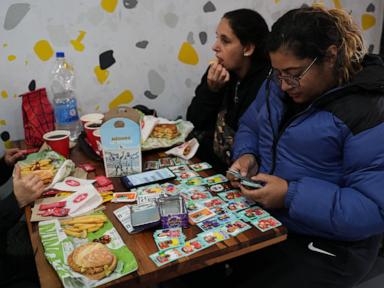
In the plazas of Buenos Aires, the air smells of roasted peanuts and desperation. Thousands of people gather not for a political protest or a religious vigil, but to swap small rectangles of adhesive paper. To an outsider, the sight of grown men in business suits haggling with teenagers over a holographic image of Lionel Messi might look like a collective fever dream. It is actually a high-stakes informal economy born from a perfect storm of scarcity, inflation, and national identity.
The World Cup sticker album, produced by the Italian giant Panini, is no longer a mere childhood hobby in Argentina. It has morphed into a sophisticated market where supply chain failures meet a population looking for any hedge against a crumbling local currency. When the latest album launches, the official distribution channels often collapse within forty-eight hours. This vacuum is immediately filled by the "parque" markets—vast, unregulated trading hubs where the true value of a player is determined by the cold logic of the street rather than the price on a packet. Don't miss our earlier post on this related article.
The Scarcity by Design Myth
Retailers across Argentina have frequently accused Panini of intentionally choking the supply to drive up hype. However, the reality is rooted in more mundane, yet devastating, logistics. Argentina’s import restrictions and fluctuating production costs make it a nightmare for any international manufacturer to maintain steady stock. When the demand is vertical, the traditional "kioscos"—the small street-corner shops that are the lifeblood of Argentine neighborhoods—are often the first to be cut out of the loop.
This perceived betrayal led to an unprecedented intervention by the Argentine government. In a move that made international headlines, the Secretary of Commerce sat down with representatives from the Union of Kioskeros and Panini executives to negotiate sticker distribution. It was a moment of peak absurdity that highlighted a fundamental truth: in Argentina, the availability of World Cup stickers is a matter of national security and social peace. When the kiosks go empty, the black market thrives, and prices for a single "hard-to-find" sticker can skyrocket to ten times the cost of a full pack. To read more about the history here, Business Insider offers an in-depth breakdown.
Trading as a Survival Strategy
While a pack of stickers has a fixed retail price, that price is an illusion once the foil is torn open. In the plazas, the economy is strictly peer-to-peer. You will see "the book," a thick binder where professional traders keep their inventory. They aren't looking for a "one-for-one" swap. They understand the tiered rarity.
- The Legends: Players like Messi or Neymar Jr. command a premium that defies the mathematical probability of finding them in a pack.
- The Shinies: Foil badges and stadium stickers act as the "gold standard" of the plaza, often requiring four or five regular players in exchange.
- The Fillers: Mid-tier players from less popular national teams are traded in bulk, often used as "change" to balance a lopsided deal.
For many Argentines, this isn't just about finishing a book. It is a masterclass in negotiation and valuation. In a country where the annual inflation rate often clears triple digits, the sticker market is a tangible way to understand how value is assigned to an asset when the currency is failing. People treat these stickers with more care than they treat the pesos in their wallets. They know the stickers will hold their utility until the final whistle of the tournament, whereas the money under their mattress loses value by the hour.
The Social Fabric of the Plaza
The physical act of meeting in a public square is the most vital component of this phenomenon. Digital apps and online marketplaces exist, but they lack the immediate verification of a face-to-face trade. In places like Parque Rivadavia or Plaza Belgrano, the demographics are erased. A wealthy lawyer from Recoleta might find himself pleading with a delivery driver from the outskirts of the city to trade a Croatian midfielder for a Mexican goalkeeper.
This social leveling is unique to the World Cup season. The shared obsession creates a temporary truce in a deeply polarized society. However, the atmosphere isn't always festive. Professional "scalpers" now haunt these gatherings, buying up packs in bulk from wholesalers and selling them at a 300 percent markup to parents who are tired of seeing their children cry over empty shelves at the local shop. This predatory layer of the hobby has turned a communal experience into a predatory one, reflecting the broader economic struggles of the nation.
The Psychology of the "Cromo"
Why does a piece of paper evoke such passion? Behavioral economists point to the "intermittent reinforcement" of opening a blind pack. It is gambling rebranded for all ages. But in Argentina, it goes deeper. The "cromo" (sticker) is a physical manifestation of hope. With every pack opened, there is a chance to hold a piece of the glory that the national team promises.
Collectors often talk about the "missing one"—the single sticker that stands between them and a completed 600-plus page odyssey. This search becomes an obsession that consumes weekends and family budgets. The drive to finish the album is a rare opportunity for a sense of completion and "winning" in a life that often feels dictated by external economic forces beyond one's control.
The Logistics of the Underground Market
The supply chain of the Argentine sticker market is a fractured mess. When Panini shipments are delayed at the port or diverted to large supermarket chains, the "kiosqueros" feel the burn. These small business owners have staged protests, claiming that large corporations are receiving preferential treatment while the traditional vendors who support the brand year-round are left with nothing.
This friction has birthed a gray market. Wholesalers sometimes "leak" boxes to private sellers who operate out of WhatsApp groups or Instagram pages. These sellers bypass the price controls attempted by the government, creating a tiered system where those with the most disposable income can simply buy their way to a completed album, while the working class is left to spend their Sundays in the plaza, hoping for a lucky break.
Beyond the Foil
The craze eventually fades. Once the tournament ends, the binders are put on shelves, and the plazas return to their quiet routines of dog walkers and joggers. But the scars of the sticker war remain. The event exposes the fragility of the Argentine retail sector and the speed with which a hobby can be weaponized by economic necessity.
It is a mistake to view the gatherings in the plazas as mere "buzz" or "fever." It is a cold, calculated response to a dysfunctional market. When people cannot trust the stores to stock the goods, or the government to manage the economy, they take to the streets to trade what they have for what they need. Today it is stickers; tomorrow it could be anything else. The infrastructure of the plaza trade is now a permanent fixture of Argentine life, ready to be activated whenever the next scarcity hits.
The next time you see a crowd huddled over a piece of paper in Buenos Aires, don't look for the joy of the game. Look for the ledger. Look for the calculation in the trader's eyes. They aren't just playing a game; they are navigating a collapse, five stickers at a time. If you want to understand the true state of the Argentine economy, stop looking at the central bank reports and start counting the Messis in the park.