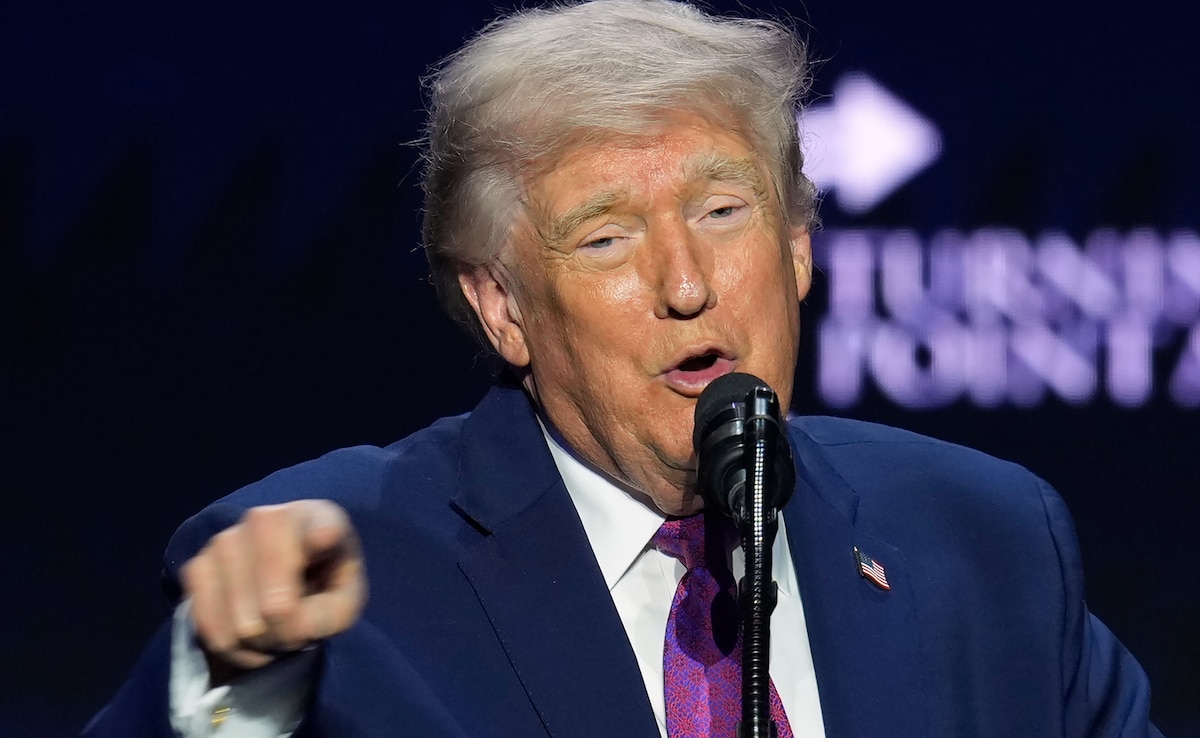
Donald Trump is once again dangling the prospect of declassifying government files related to Unidentified Anomalous Phenomena (UAP), promising a disclosure that would supposedly settle the debate over extraterrestrial visitation. This isn't just about little green men; it’s a calculated political maneuver involving some of the most guarded secrets in the American military-industrial complex. By signaling a willingness to open the "UFO files," Trump is tapping into a deep-seated public distrust of the administrative state, positioning himself as the only actor capable of forcing the hand of a reluctant intelligence community.
The timing is far from coincidental. As the 2026 political cycle heats up, the narrative of "government transparency" serves as a powerful weapon against entrenched federal agencies. But beneath the campaign rhetoric lies a complex reality of classification laws, Title 10 vs. Title 50 authorities, and a defense establishment that has spent eighty years perfecting the art of the redaction pen. To understand why these documents remain buried, one must look past the sensationalism and into the budgetary black holes where "The Program" supposedly lives.
The Lever of Radical Transparency
For decades, the UFO topic was relegated to the fringes of supermarket tabloids and late-night radio. That changed in 2017 when the New York Times revealed the existence of a secret Pentagon program known as AATIP. Since then, we have seen a steady drip of official admissions, including grainy infrared videos of "Tic Tac" shaped objects outmaneuvering Navy jets. Trump knows that this topic now commands mainstream attention. By promising to release "very interesting documents," he is leaning into a populist demand for the truth, regardless of what that truth actually entails.
This strategy forces the Department of Defense (DoD) into a defensive crouch. If they refuse to comply with a presidential directive for declassification, they appear to be part of a "Deep State" cover-up. If they do comply, they risk exposing technical capabilities—radar signatures, sensor ranges, and orbital mechanics—that are far more sensitive than the nature of the objects being tracked. The tension isn't just about aliens; it’s about who controls the flow of information in Washington.
The SAP Problem
The primary hurdle to any president simply "releasing the files" is the existence of Special Access Programs (SAPs). These are programs so sensitive that they are exempted from standard oversight. Even within the SAP world, there are "waived" programs where only a handful of congressional leaders, the "Gang of Eight," are even briefed on their existence.
Military contractors like Lockheed Martin and Northrop Grumman have long been rumored to be the custodians of retrieved hardware. Because these materials are held by private entities under government contract, they fall into a legal gray area. A president can order the DoD to declassify its files, but forcing a private corporation to hand over proprietary research derived from "non-human" tech is a much steeper uphill climb. It requires more than a signature; it requires a legislative sledgehammer that hasn't been built yet.
Intelligence Community Resistance and the Brinkmanship of Secrets
The friction between a commander-in-chief and the intelligence agencies is usually a quiet affair of memo-trading and slow-walking. On the UAP issue, it has become a public brawl. When Trump hints at a "very soon" release, he is essentially threatening to burn down the classification barriers that have protected the Air Force and the CIA since the late 1940s.
Critics argue that this is a dangerous game. Declassifying data from an AESA (Active Electronically Scanned Array) radar to show a UFO doesn't just show the UFO; it tells our adversaries exactly how sensitive our sensors are and how we filter out "clutter" from the sky. The Pentagon’s standard line is that "National Security" prevents disclosure. In reality, the fear is often more about admitting to a massive failure in airspace domain awareness. If objects can fly over restricted nuclear sites with impunity, the trillion-dollar defense budget starts to look like a bad investment.
The Grusch Fallout and the Whistleblower Wave
We cannot ignore the shadow of David Grusch. The former intelligence official’s 2023 testimony regarding "intact and partially intact craft" remains the cornerstone of the modern disclosure movement. Grusch didn't just provide anecdotes; he provided names of programs and locations to the Inspector General of the Intelligence Community.
Trump’s recent comments suggest he may have been briefed on these specific leads. If he follows through, the focus won't just be on grainy videos. It will be on the Internal Revenue Service (IRS) and the Government Accountability Office (GAO). Following the money is the only way to find the UAP programs. You don't look for the hangar; you look for the "miscellaneous" line items in the black budget that have been growing at an exponential rate for thirty years.
The Technology Gap and the New Arms Race
While the public wants to know if we are alone, the defense establishment is worried about who gets the "breakthrough" first. If UAP represent a leap in propulsion technology—specifically trans-medium travel (moving from space to air to water without changing speed or structure)—then whoever masters that tech wins the next century.
The "Very Interesting Documents" likely contain data on physical effects. This includes:
- Gravitational anomalies near the objects.
- Radio-frequency emissions that jam advanced electronic warfare suites.
- Biological effects on pilots who have come within proximity to the craft.
If the documents contain evidence that the U.S. has been attempting to back-engineer this technology, the legal implications are staggering. It would mean that a multi-decade technological monopoly has been maintained by a few unelected officials, bypassing the patent office and the public market. This isn't just a news story; it’s the biggest anti-trust case in human history.
The Role of the AARO
The All-domain Anomaly Resolution Office (AARO) was supposed to be the bridge between the public and the secret-keepers. Instead, it has become a lightning rod for controversy. Their reports, which largely dismiss the "alien" hypothesis while admitting they can't identify many of the objects, are seen by disclosure advocates as a sophisticated PR operation.
By bypassing AARO and promising direct release, Trump is signaling that the official channels are compromised. This is a classic "outsider" move. It appeals to the skepticism of a generation raised on the X-Files and internet forums, people who are tired of being told that what they see on radar is merely a "weather balloon" or "airborne clutter."
The Risk of Empty Promises
There is a distinct possibility that the "Very Interesting Documents" don't actually exist in the way people imagine. The "UFO files" might just be thousands of pages of inconclusive sensor data, blurry photos, and memos where different agencies argue about whose job it is to track "spheres" over the Atlantic.
The letdown could be immense. If the "release" turns out to be more of the same—highly redacted pages with 90% of the text blacked out—the political capital gained from the promise will evaporate. However, the move is less about the content and more about the authority to release. It is a demonstration of power over the permanent bureaucracy.
Moving Beyond the Disclosure Narrative
The focus on a "grand reveal" often distracts from the incremental progress being made in civilian science. Projects like the Galileo Project at Harvard are looking for UAP using non-government sensors. They don't need a president to declassify anything because they own their own data. This is the real threat to the Pentagon’s monopoly on the topic. If the private sector finds the "smoking gun" first, the government’s classification regime becomes irrelevant overnight.
The military knows this. They are in a race against the democratization of high-end surveillance technology. Every time a SpaceX rocket launches or a private satellite network expands, the "secret" gets harder to keep. The documents Trump is teasing might be the government's last chance to control the narrative before a civilian scientist catches a 4K image of a craft that clearly didn't come from a Boeing factory.
The Looming Constitutional Crisis
If a sitting or future president orders the declassification of UAP files and the Pentagon refuses on the grounds of "source and methods" protection, we enter uncharted legal territory. The President is the ultimate declassification authority, but the Atomic Energy Act and other statutes provide "born secret" protections that are notoriously difficult to strip away.
This isn't a theoretical debate. It is a collision between the executive branch's constitutional powers and the legislative safeguards put in place to protect nuclear and high-tech secrets. The "UFO" issue is the perfect vehicle for this showdown because it carries so much emotional and cultural weight. It is the one topic that can get the public to support a radical restructuring of the intelligence community.
Watch the language used in the coming months. If the rhetoric shifts from "aliens" to "illegal program oversight," the game has changed. The goal is no longer just finding out what's in the sky; it's about finding out who's been running the country without a license. Demand the raw data, not the summary. Demand the sensor logs, not the memo. Anything less is just more theater in an election year already full of it.