The sound did not come from the sky. It came from the earth itself—a low, visceral groan that vibrated through the soles of bare feet before it ever reached the ears. In the Luualaba province of the Democratic Republic of Congo, the earth is a deep, bruised crimson, rich with the minerals that power the modern world. But on a Tuesday that started like any other, that earth decided it would no longer be poked, prodded, or hollowed out.
It moved.
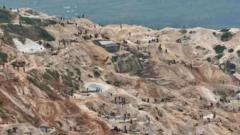
One moment, hundreds of men were swarming over the steep walls of an open-pit mine, their picks clinking against the rock in a rhythmic, desperate song of survival. The next, the horizon tilted. A wall of saturated red earth, loosened by unseasonable rains and the structural instability of a "rebel-held" site, collapsed with the weight of a mountain.
When the dust settled and the echoes of the roar faded into a terrifying silence, the Congolese government began the grim arithmetic of tragedy. The initial count was a number that stops the heart: 200 souls. Two hundred lives, many of them "artisanal" miners, a term that sounds like a boutique coffee shop but in reality describes a man with a shovel, a plastic bucket, and no safety harness.
The DRC is a land where the 21st century and the prehistoric world collide with devastating force. On the surface, the narrative is about a "rebel-held" mine, a phrase that evokes images of AK-47s and camouflage. But beneath that label lies a more complicated reality: the global hunger for the minerals that make our smartphones thin and our electric cars go 300 miles on a single charge.
The cobalt and copper in those hills are the nervous system of the digital age. Yet the people who extract them are living in a ghost story. Consider a man we will call Jean, a hypothetical but statistically accurate representation of the miners who perished. Jean does not care about the geopolitical implications of a "rebel-held" mine. He cares about the price of a kilogram of raw ore, which might buy enough cornmeal to feed his children for two days. When the rain starts, Jean knows the red mud is becoming heavy, like a wet sponge ready to crumble. He knows the "rebel" overseers haven't reinforced the walls with the steel and concrete required by law.
He digs anyway.
There is no choice in a landscape where the choice is between the risk of a landslide and the certainty of a hollow stomach. The government’s official statement describes the event as a catastrophic failure at an illegal site. This is factually true, but it is also a convenient way to distance the state from the systemic failures that allow such sites to exist. When a mine is "rebel-held," it means the profit is flowing into the pockets of local militias and corrupt officials rather than the national treasury. It means there are no safety inspectors. No emergency sirens. No one to call when the earth begins to groan.
The tragedy of the 200 is not just that they died; it is that they died for a product that most of the world believes is "clean." We talk about the green transition as if it were a bloodless evolution of technology. We look at the sleek lines of a Tesla or the glowing screen of a MacBook and see progress. But that progress is anchored in the red mud of the Lualaba.
Every battery has a ghost.
The logistics of a landslide this size are hard to wrap the mind around. Imagine two hundred people—the population of a small village, or every person on a full regional jet—erased in the time it takes to draw a single breath. The recovery efforts are not conducted with high-tech sensors or specialized rescue teams. They are conducted with the same shovels that caused the instability in the first place, wielded by mourning relatives who are literally digging for the bodies of their brothers, fathers, and sons.
The Congolese government has promised an investigation, but the history of the region suggests that "investigation" is a synonym for a news cycle that will eventually fade. The rebels will blend back into the jungle, the site will be declared a restricted zone for a few weeks, and then, slowly, the red mud will be disturbed once more. The minerals are too valuable to leave in the ground, and the people are too poor to stop digging.
This is the hidden cost of our interconnected world. We are tethered to the Lualaba by a thousand invisible threads. The metal in your pocket right now might have been pulled from the very earth that just buried 200 human beings. That realization is uncomfortable. It should be. It is the friction between our convenience and their catastrophe.
The world sees a number: 200. The families in the DRC see empty chairs and silent homes. They see a future that has been swallowed by the same ground they hoped would provide it. The red mud is not just soil; it is a witness. It remembers every strike of the pick, every drop of sweat, and the final, terrible weight of the collapse.
As the sun sets over the scarred hills of the Lualaba, the silence is heavier than the earth. There is no conclusion to a story like this, only the continuation of a cycle that demands we look away from the source of our power so we can continue to enjoy the light. But the light is flickering. The red mud is waiting. And the groan of the earth is a sound that, once heard, can never be forgotten.
The earth did not just move; it spoke. And it told us that the price of our future is too high for the people paying it today.