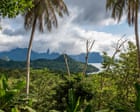
The humidity in the air on the island of Príncipe doesn’t just sit on your skin; it breathes with you. It is a thick, floral weight that carries the scent of damp earth and ancient volcanic rock. Here, in the Gulf of Guinea, the world feels older. They call it the "African Galapagos," a title that sounds like a marketing slogan until you see a bird with plumage the color of a bruised sunset that exists nowhere else on this planet.
For decades, the relationship between the people of Príncipe and this emerald wilderness was a simple, desperate calculation. If you are a father with three hungry children and no steady income, a sea turtle isn't a "critique of biodiversity." It is meat. A rare hardwood tree isn't a "carbon sink." It is charcoal for the cooking fire. To ask a villager to protect the ecosystem without offering a way to survive is not conservation. It is an insult.
But the silence of the forest is changing. A new experiment is unfolding, one that puts a literal price on the act of leaving a tree standing.
The Ghost of the Obo
Imagine a man named Manuel. He is a hypothetical composite of the dozens of hunters I’ve spoken to in the shadow of the Obo National Park. Manuel knows the forest better than any scientist. He knows where the orchids hide and which streams run dry in the heat. For years, Manuel’s wealth was measured by what he could take from the woods.
The conflict is invisible to the casual tourist staying in a luxury eco-lodge. It’s a quiet war between immediate survival and long-term legacy. The "African Galapagos" is home to species that branched off from their mainland cousins millions of years ago, evolving in a vacuum of mist and isolation. The Príncipe Thrush and the Príncipe White-eye are delicate threads in a web that, if snapped, can never be rewoven.
The problem with traditional conservation is that it often feels like a fence. It says, "Don't touch," while the people inside the fence are starving.
A Dividend for the Guardians
The shift began when the local government and international partners realized that the villagers weren't the enemies of the forest—they were its only hope. The new initiative is remarkably straightforward: direct payments for ecosystem services. It sounds like a dry economic term, but on the ground, it functions like a social contract.
Villagers are now being paid to monitor turtle nesting beaches instead of harvesting the eggs. They are paid to patrol the borders of the national park to prevent illegal logging. This isn't charity. It is a salary for a new kind of profession: the Professional Protector.
Consider the mathematics of a sea turtle. A dead turtle provides a few meals. A living turtle, monitored and protected by a local guide, draws researchers, photographers, and travelers who spend money in the village year after year. The challenge was bridging the gap between the "one-time meal" and the "lifetime of income."
The program operates on a community-reward system. When a village meets its conservation targets, funds are released not just to individuals, but to collective projects. New schools. Clean water systems. Reliable electricity. The forest is no longer a restricted zone; it is the village’s primary benefactor.
The Invisible Stakes of Isolation
Why does a tiny island off the coast of West Africa matter to a person sitting in a high-rise in London or a suburb in Tokyo? It’s tempting to speak in metaphors about "the lungs of the planet," but the reality is more jagged.
Príncipe is a laboratory. Because of its isolation, we can see the effects of human intervention in high definition. When a species goes extinct here, the impact is immediate and measurable. The birds that disappear were the ones spreading the seeds of the trees that hold the soil together. When the trees go, the rain washes the soil into the ocean, choking the coral reefs where the fish spawn.
It is a domino effect that ends with a fisherman casting a net into an empty sea.
By paying villagers to protect the "African Galapagos," we are testing a theory: can capitalism be inverted to save what it usually destroys? Usually, we pay for extraction. We pay for the oil, the timber, the gold. This model pays for the absence of extraction. It pays for the quiet.
The Resistance of the Old Ways
Transition is never a straight line. There is skepticism. In the village of Praia Burra, elders remember a time when the forest felt infinite. They look at the younger generation receiving payments for "doing nothing"—which is how some perceive the act of conservation—and they wonder if the soul of the island is being sold to foreign interests.
This is a valid fear. If the funding dries up, does the protection stop? If the global economy sags and the grants disappear, does Manuel go back to the charcoal pits?
The organizers of the Príncipe project are betting that the mindset shift is more durable than the money. When a child grows up seeing their father respected as a forest ranger rather than hunted as a poacher, the internal map of the village changes. The forest is no longer an adversary to be conquered. It's an asset to be managed.
The secret to this "African Galapagos" is that its survival isn't about biology; it's about the dignity of the people who live in it.
The Weight of the Green Canopy
The Príncipe experience is a microcosm of a much larger, global tension. Every year, we lose thousands of species in silence, simply because we haven't found a way to make them "profitable" while they are alive. The villagers of Príncipe are showing that when you compensate the people who have the most to lose, the forest finds its voice.
The real value of a tree in the Obo isn't the lumber. It’s the carbon it holds, the shade it provides, and the creatures it houses. We are finally starting to write checks to match that value.
As the sun sets over the island, the forest begins its nightly symphony. It is a loud, chaotic, and beautiful noise. It is the sound of a living system that hasn't been silenced yet. The villagers are the ones who hold the baton.
A turtle crawls toward the surf, its path illuminated not by a hunter’s torch, but by the quiet pride of a man who knows its survival is his success.