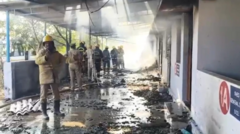
The air in Harda doesn't usually smell like sulfur. It smells of dust, diesel from the passing trucks, and the sweet, heavy scent of ripening grain from the surrounding Madhya Pradesh fields. But on a Tuesday morning that should have been ordinary, the air turned into a physical weight. It tasted of burnt chemicals and stolen futures.
Harda is a place where the economy is often measured in manual labor. For many, the work is a matter of survival, a daily grind to keep the lights on and the plates full. In the Bairagarh area, that survival was tied to the manufacturing of joy. Or at least, the appearance of it. Firecrackers. The colorful shells and cardboard tubes that light up weddings and festivals across India are born in places like these—cramped, hot, and dangerously volatile.
At 11:00 AM, the first explosion ripped through the silence. It wasn't just a sound. It was a pressure wave that shattered windows for kilometers. Then came the second. And the third.
Imagine a woman named Meena. She is a hypothetical composite of the dozens who worked there, but her reality is echoed in every headline. Meena wakes up at 5:00 AM. She makes chai for her children. She walks to the factory because the wage, however meager, is better than the uncertainty of the fields. She sits on a floor covered in gray powder. She rolls tubes. She fills them with a mixture of potassium nitrate, sulfur, and charcoal. To the world, this is "black powder." To Meena, it is the rent.
Then, a flicker. A stray spark. A dropped tool.
The reaction is instantaneous. Chemistry does not care about poverty. It does not care about the lack of fire exits or the fact that the factory was reportedly operating illegally despite previous warnings. When the heat hits the powder, the solid material converts into gas at an exponential rate. The pressure has nowhere to go but out.
The factory didn't just catch fire. It disintegrated.
The Anatomy of an Unnatural Disaster
The numbers coming out of Harda are staggering, but numbers are cold. Twenty-five dead. Over two hundred injured. These are not statistics; they are empty chairs at dinner tables. They are children waiting by the gate for a mother who will never walk home.
In the immediate aftermath, the scene was one of apocalyptic chaos. The force of the blasts was so intense that the ground shook as if an earthquake had struck. Debris, some of it flaming, was launched hundreds of feet into the air, raining down on neighboring houses and passing motorists. People were thrown from their motorcycles by the sheer force of the air moving away from the epicenter.
Rescue workers arrived to find a landscape of blackened brick and twisted metal. The fire continued to rage for hours, fed by the very products the factory produced. Every time a new pocket of explosives was reached by the heat, a fresh bang echoed through the valley, a cruel reminder of the danger that still lurked under the rubble.
Why does this keep happening? To understand that, we have to look at the invisible stakes.
The firecracker industry in India is a multi-billion dollar behemoth. It thrives on the demand for spectacle. We want the sky to bleed gold and green on Diwali. We want the loud cracks to announce our joy at weddings. But the supply chain for that joy is often built on a foundation of systemic neglect. Factories are often pushed to the outskirts of towns, away from the prying eyes of inspectors, operating in a grey zone of permits and "adjustments."
When a factory is built without proper ventilation, without blast walls, and without rigorous safety protocols, it isn't a workplace. It is a bomb waiting for a fuse.
The Human Cost of the Spectacle
Consider the rescuers. They are often locals, neighbors who ran toward the smoke while everyone else was running away. They spent hours digging through the hot remains with their bare hands, hoping to find a pulse where there was only ash. The trauma of what they saw—the physical toll of high-velocity explosions on the human body—is a weight they will carry long after the news cycle moves on to the next tragedy.
The state government has announced compensation. Money for the families of the dead. Money for the injured. It is a necessary gesture, but it feels hollow against the backdrop of preventable loss. You cannot buy back a life with a check. You cannot heal a third-degree burn with a press release.
The real problem lies in the gap between regulation and reality. India has strict laws regarding the manufacture and storage of explosives. The Petroleum and Explosives Safety Organization (PESO) sets clear guidelines. But on the ground, in places like Harda, those guidelines are often treated as suggestions.
The "invisible stakes" are the lives of the workers who have no other choice. If Meena complains about the smell of gas or the lack of extinguishers, she loses her job. There are ten other women waiting at the gate to take her spot. Poverty is the ultimate silencer of safety concerns.
A Cycle of Brief Outrage
We have seen this script before. Sivakasi, Virudhunagar, and now Harda.
The pattern is predictable. There is a blast. The media descends. Politicians offer condolences and "strict action." A few managers or owners are arrested. A week passes. The cameras leave. The rubble is cleared. And somewhere else, in another nondescript building on the edge of another small town, the powder starts being mixed again.
But consider what happens next if we don't change the narrative.
The demand for fireworks isn't going away. It is deeply ingrained in the cultural fabric of the country. However, the "hidden cost" of those fireworks is currently being paid by the poorest members of society. We are subsidizing our celebrations with the lives of the vulnerable.
Changing this requires more than just arresting a factory owner. It requires a fundamental shift in how we value the hands that make our products. It means demanding transparency in the supply chain. It means supporting legitimate, safety-conscious manufacturers and shunning the black market that thrives on cutting corners.
The chemistry of a firework is a marvel of human ingenuity. We have learned to package energy and release it in beautiful, controlled bursts. But in Harda, that energy was anything but controlled. It was a violent reclamation of space by elements that were never meant to be crowded into a poorly ventilated room.
The fire in Harda is out now. The smoke has cleared, leaving behind a jagged hole in the earth and a larger one in the community. The smell of sulfur lingers, though, a pungent ghost that haunts the streets.
As the sun sets over Madhya Pradesh, the silence is heavy. It is the silence of a town that has lost its breath. It is the silence of a mother's tea getting cold on a table. It is the silence that follows the final, devastating crack of a firework that was never meant to be lit.
The sky tonight is dark, and for the families in Bairagarh, that is exactly how it should stay.