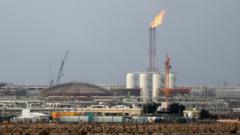
Stop blaming the headlines. Every time a drone flies over a Middle Eastern refinery or a pipeline in Qatar sees a "security incident," the financial press treats it like a biblical plague. They want you to believe that the global energy market is a fragile glass vase, shattered by a single localized event.
It is a lie.
The "Qatar attack" is a convenient ghost. It is the boogeyman that retail analysts use to explain away price hikes they should have seen coming eighteen months ago. If you think your local gas station's prices are soaring because of a flare-up in Doha, you are falling for the oldest shell game in the commodities business.
The Geography of Ignorance
Qatar is a Liquefied Natural Gas (LNG) titan. It is not an oil powerhouse.
The mainstream narrative conflates "energy" with "gasoline" as if they are interchangeable fluids flowing through the same pipe. They aren't. Qatar’s primary export is methane, chilled to $-162^{\circ} \text{C}$ and shipped to power plants in Seoul and Berlin. It has almost zero bearing on the Brent Crude or West Texas Intermediate (WTI) benchmarks that dictate what you pay at the pump.
When a disruption happens in the Persian Gulf, the knee-jerk reaction in the futures market is driven by algorithmic trading bots programmed to "buy on chaos." These bots don't read geopolitical nuance; they read keywords. "Explosion" + "Middle East" = "Buy Oil." It is a self-fulfilling prophecy of stupidity. The price goes up because we expect it to, not because there is a physical shortage of molecules.
I have sat in trading rooms where the "supply shock" was nothing more than a three-day delay on a single tanker. We watched the retail price jump ten cents overnight while the actual inventory levels remained at a five-year high. This isn't economics; it's theater.
The Refinery Bottleneck No One Talks About
The real reason prices are high has nothing to do with Qatari soil and everything to do with American and European steel.
We have stopped building refineries. In the United States, we haven't built a major, high-capacity refinery since 1977. We are trying to run a 2026 economy on a 1970s engine. While the "green transition" advocates push for a total shift to electric, they’ve successfully lobbied against the maintenance and expansion of the very infrastructure that keeps the world moving during the transition.
You can have all the crude oil in the world—you can drown in it—but if you can't "crack" it into gasoline, the price stays high. This is the Refining Margin Crack Spread.
$$\text{Crack Spread} = (2 \times \text{Gasoline Price} + 1 \times \text{Distillate Price}) - (3 \times \text{Crude Oil Price})$$
When the crack spread widens, the oil companies make a killing, not because the oil is scarce, but because the "kitchen" is too small to cook the food. The Qatar attack is just the smoke screen that allows refiners to maintain these margins without facing a congressional subpoena. They blame the "global instability" while their aging distillation units run at 98% capacity, praying a single bolt doesn't snap.
The SPR Deception
The Strategic Petroleum Reserve (SPR) is frequently touted as our shield against these "attacks." It’s a joke.
The SPR was designed for a 1973-style total embargo, not to micromanage the weekly price of a gallon of 87-octane. Every time the government releases oil from the reserve to "combat high prices," they are essentially trying to put out a forest fire with a squirt gun. It provides a temporary psychological dip, followed by a massive spike when the market realizes the reserve eventually has to be refilled—at a higher price.
The smart money knows that a depleted SPR makes the West more vulnerable, not less. When we drain the reserve to win a news cycle, we are handing the pricing power directly back to OPEC+ and the very regional players we claim to be "protecting" ourselves against.
The Myth of Energy Independence
Politicians love the phrase "energy independence." It’s a fantasy.
Oil is a global fungible commodity. Even if we pumped every drop we needed from Texas and North Dakota, we would still pay the global price. Why? Because a driller in the Permian Basin isn't a charity. If they can sell their barrel to a refinery in Rotterdam for $90, they aren't going to sell it to a refinery in New Jersey for $70 just because they share a zip code.
The "Qatar attack" ripples through the market because the market is a singular, interconnected web. But the ripple is amplified by speculative layers that have nothing to do with physics.
- Paper Oil vs. Physical Oil: For every one barrel of actual oil produced, there are roughly 30 "paper barrels" traded in the futures market.
- The Fear Premium: This is a literal line item. It’s the extra $5 to $10 tacked onto a barrel of oil just because something might happen.
If you want to understand why you're broke, stop looking at the map of the Middle East. Look at the balance sheets of the Wall Street firms that own the "paper oil." They love the Qatar headlines. It’s their Christmas.
Why "Big Oil" Actually Hates High Prices
Here is the most counter-intuitive truth of the industry: Exxon, Chevron, and Shell don't want $150 oil.
High prices are the "cure" for high prices. When gas hits $5 or $6 a gallon, two things happen that terrify the oil majors:
- Demand Destruction: People stop driving. They cancel vacations. They consolidate errands.
- Competitor Viability: High prices make expensive alternatives—like hydrogen, deep-sea wind, and ultra-high-cost shale—suddenly profitable.
The "sweet spot" for the industry is $70 to $80 a barrel. It’s high enough to print money, but low enough to keep the world addicted. These "shocks" like the Qatar incident disrupt that equilibrium. They force the public to look for the exit.
The industry isn't conspiring to make the price soar; they are struggling to keep a lid on a chaotic system that is being manipulated by hedge funds and panicked politicians who don't know the difference between an upstream drill bit and a downstream retail pump.
Stop Asking the Wrong Question
The question shouldn't be "When will gas prices go down?"
The question you should be asking is: "Why is our entire economic stability tied to a supply chain that reacts to a rumor of a fire in a country 8,000 miles away?"
The answer is that we have built a "Just-In-Time" energy economy with zero redundancy. We have prioritized "efficiency" and "shareholder buybacks" over "resilience." We have shuttered coal plants and nuclear facilities without having a viable base-load replacement, leaving us at the mercy of the natural gas market—which, yes, is influenced by Qatar.
But Qatar didn't cause this. Our own policy-driven fragility did.
The Brutal Path Forward
If you want lower gas prices, stop cheering for "green" subsidies that won't bear fruit for twenty years while simultaneously voting against the pipelines that could solve the problem in two.
You cannot hate the producer and love the product.
The next time you see a headline about an "attack" causing a price spike, do me a favor: ignore it. Look at the inventory reports. Look at the refinery utilization rates. Look at the crack spreads.
The "crisis" is a choice. We choose to remain vulnerable because it’s easier to blame a foreign actor than to admit we’ve regulated ourselves into a corner. We’ve traded our energy security for a sense of moral superiority, and now the bill is coming due at the pump.
Fix the refineries. Rebuild the reserves. Stop treating the Middle East like the center of the universe. Until then, keep your credit card ready—you’re going to need it.
Would you like me to break down the current refinery capacity numbers by region to show you where the real "invisible" shortages are happening?