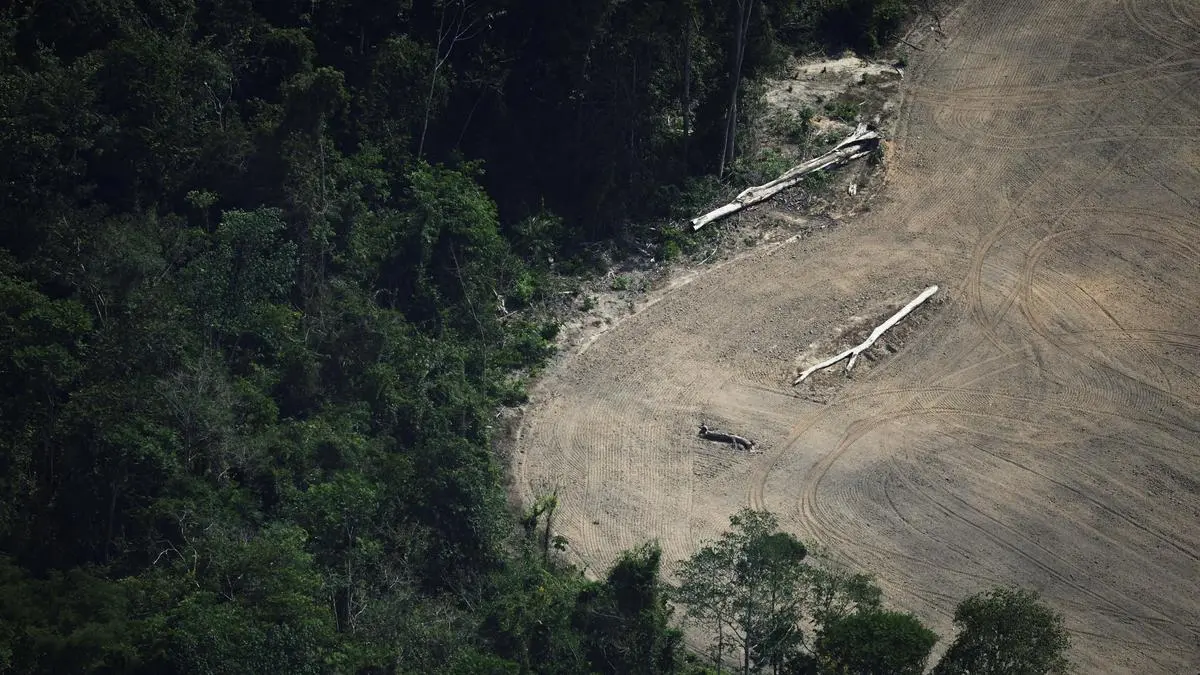
The 2025 contraction in global forest loss represents a significant deviation from the record highs of 2023-2024, yet interpreting this as a permanent victory for conservation ignores the underlying volatility of the commodities cycle. While the raw acreage of lost canopy decreased by approximately 24% year-on-year, this shift is primarily a byproduct of three converging factors: aggressive supply-chain regulation in the European Union, a temporary cooling of global beef and soy prices, and a cyclical weather shift away from the El Niño-induced droughts that exacerbated fire risks in the previous biennial. Understanding whether this trend is durable requires a dissection of the structural mechanisms governing land-use change.
The Mechanics of the 2025 Correction
The sharp decline in forest clearance is not a uniform global phenomenon but rather a concentrated success in specific jurisdictional clusters. The primary engine of this reduction is the implementation of the EU Deforestation Regulation (EUDR). By mandating that companies provide precise geolocation coordinates for the origin of products like palm oil, rubber, and timber, the regulation has effectively segmented the market. High-risk plots that previously contributed to aggregate loss figures are being bypassed by major importers, forcing a rapid, if painful, professionalization of land management in Southeast Asia and parts of the Amazon basin.
The relationship between forest loss and capital can be expressed as a function of the Opportunity Cost of Standing Timber. When the projected yield from agricultural conversion exceeds the long-term value of carbon credits or sustainable harvesting, clearing accelerates. In 2025, two specific variables shifted this equation:
- Interest Rate Lag: The prolonged period of high global interest rates finally throttled large-scale capital expenditures (CAPEX) for new plantation expansions.
- Sovereign Enforcement Efficiency: In Brazil and Indonesia, the use of low-latency satellite monitoring—specifically synthetic aperture radar (SAR) which penetrates cloud cover—allowed for real-time interdiction. The delta between a violation occurring and a fine being issued dropped from months to days.
The Biomass Carbon Debt Paradox
A common error in environmental reporting is the conflation of "reduced forest loss" with "carbon sequestration gains." While the rate of destruction slowed in 2025, the planet remained in a state of net forest loss. The atmospheric carbon debt continues to accumulate; we are simply adding to the ledger more slowly.
To evaluate the true impact of the 2025 data, we must categorize forest types by their carbon density and ecological complexity. Not all hectares are created equal.
- Primary Tropical Forests: These are the "Carbon Heavies." The 2025 reduction was most pronounced here, which is vital because these ecosystems store up to 50% more carbon per hectare than secondary regrowth.
- Secondary Regrowth: While acreage here may increase, these forests lack the root systems and soil organic matter (SOM) of ancient stands. They are more susceptible to the "Edge Effect," where the perimeter of a forest dries out and becomes a fire hazard.
- Boreal Peatlands: Loss here remained stubbornly high in 2025. Permafrost degradation acts as a feedback loop that is largely decoupled from human policy, representing a systemic risk that current conservation frameworks are ill-equipped to handle.
The Logic of Jurisdictional Decoupling
The 2025 data reveals a growing "decoupling" between countries that have integrated into the global green-bond market and those that remain reliant on unregulated "grey market" exports.
Brazil's 2025 performance stands as a case study in Policy-Driven Suppression. By reinstating the "Bolsa Verde" program and empowering IBAMA with enhanced seizure authorities, the state increased the "Risk Premium" for illegal loggers. When the probability of asset seizure (bulldozers, chainsaws, and trucks) exceeds the expected profit from the first two harvests of a cleared plot, illegal activity halts.
Conversely, regions in the Congo Basin showed less improvement. The lack of a centralized land registry creates a "Commons Dilemma" where no single entity is accountable for the long-term health of the canopy. Here, the driver is not industrial soy or beef, but decentralized subsistence charcoal production and artisanal mining. This segment of forest loss is resistant to EU-style trade regulations because the products never enter a formal international supply chain.
Identifying the Bottlenecks in Reforestation Technology
While "loss" decreased, "restoration" struggled to scale in 2025. The bottleneck is not a lack of capital but a lack of Biological Infrastructure. To move from a sharp fall in loss to a net gain in canopy, the following systems must be optimized:
- Seed Supply Chains: There is currently a global deficit of site-specific, genetically diverse seeds. Most 2025 reforestation efforts relied on monocultures, which are "Ecological Dead Ends"—they provide canopy cover but fail to support biodiversity or long-term resilience.
- Monitoring and Verification (MRV): The 2025 dip highlighted the need for better ground-truth data. Satellites can see trees, but they cannot easily measure soil carbon or the health of the understory. The next phase of forest management relies on the integration of eDNA (environmental DNA) sampling to verify that a forest is functioning, not just standing.
The Sovereign Wealth Influence
A significant, often overlooked variable in the 2025 numbers is the shift in how Sovereign Wealth Funds (SWFs) evaluate "Natural Capital." In 2025, several major funds integrated forest-risk assessments into their sovereign debt ratings. This means countries with high deforestation rates began to see higher borrowing costs.
This creates a Financial Feedback Loop:
- High deforestation leads to a lower ESG (Environmental, Social, and Governance) rating.
- Lower ratings increase the cost of servicing national debt.
- To lower debt costs, finance ministries are forced to fund environmental enforcement agencies.
This "Financialization of the Canopy" was more effective in 2025 than three decades of non-binding international treaties. It moved forest protection from the "Ministry of Environment" to the "Ministry of Finance," where the real power resides.
Future Pressure Points and the El Niño Cycle
The 2025 reprieve is precarious. Historically, periods of reduced forest loss are followed by "Rebound Clearing" when commodity prices recover. If the 2026-2027 period sees a return to higher beef prices or a spike in the demand for biofuels, the pressure on the "Frontier" will return.
The second major threat is the Hydrological Collapse. Forests create their own rain through evapotranspiration. As we approach the "Tipping Point"—estimated by some researchers to be around 20-25% total loss in the Amazon—the forest may transition into a savannah regardless of human protection efforts. We are currently at roughly 18%. The 2025 slowdown bought time, but it did not move the needle away from this structural threshold.
Strategic Execution for Global Supply Chains
For organizations operating within these landscapes, the 2025 data dictates a shift from "Risk Mitigation" to "Value Creation." Relying on the absence of deforestation is no longer enough to satisfy regulators or investors.
- Shift to Regenerative Agroforestry: Moving production into the forest canopy rather than clearing it. This requires a transition from sun-grown varieties to shade-grown systems, particularly for coffee and cocoa.
- Investment in Bio-Circularity: Utilizing the "waste" from legal forestry and agriculture to create high-value biochemicals, reducing the need to clear more land for raw material extraction.
- Tier 2 and Tier 3 Transparency: The 2025 enforcement focused on direct suppliers. The next wave of scrutiny will move deep into the sub-tier supply chain, where the majority of "Hidden Deforestation" occurs.
The 2025 downturn in forest loss is a tactical window of opportunity. It proves that when policy, finance, and technology align, the rate of destruction is not an unstoppable force. However, if this data is used as an excuse for complacency rather than a blueprint for scaling enforcement, the 2025 "success" will be remembered only as a statistical anomaly in a long-term downward trend. The objective now is to lock in these gains by codifying the high cost of clearing into the global financial architecture.